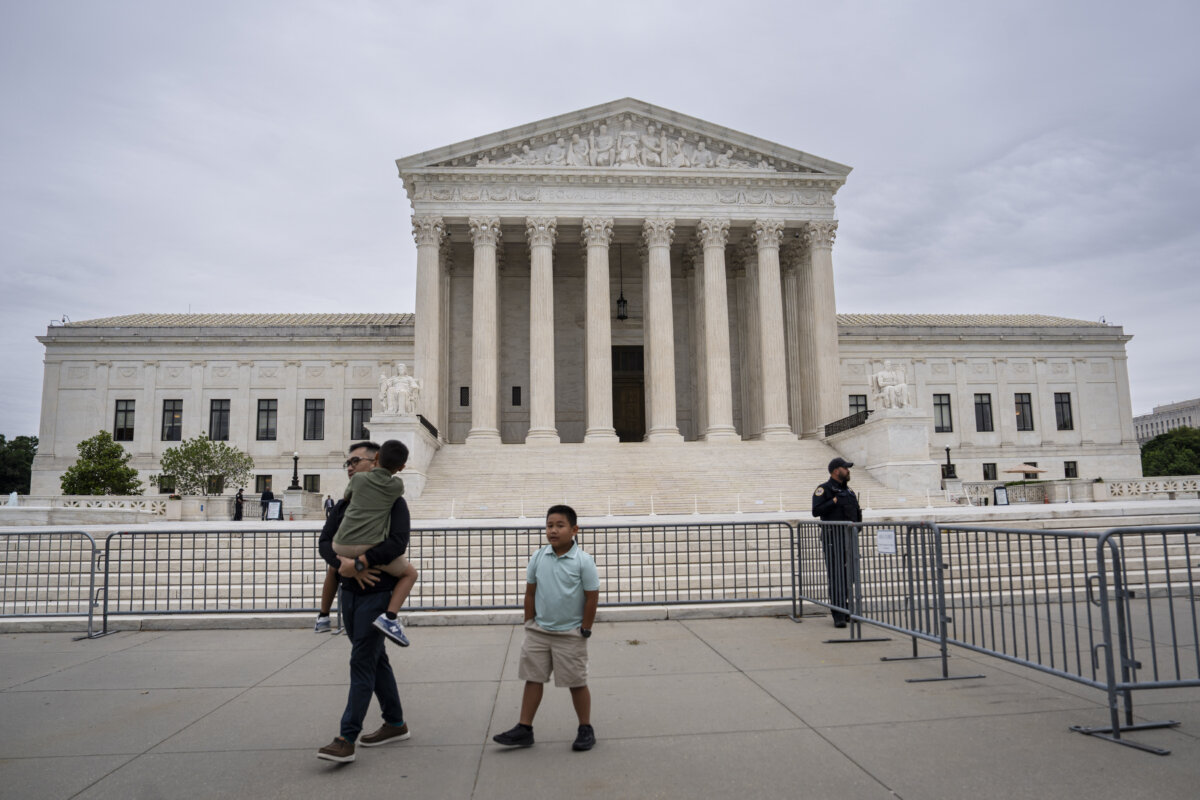

The U.S. Supreme Court on June 15 agreed to decide whether there is any point at which the U.S. Constitution requires certain immigration detainees to be given a bond hearing.
The court’s new decision in Genalo v. Black took the form of an unsigned order. No justices dissented. The court did not explain its decision.
In this due process-based challenge, the high court will consider whether there is a limit on how long the federal government may detain a person under the Immigration and Nationality Act without a bond hearing.
The court will also consider “whether, in such a bond hearing, due process requires placing the burden on the government to justify the alien’s continued detention by clear and convincing evidence.”
In this case, two lawful permanent residents were detained by Immigration and Customs Enforcement (ICE) after criminal convictions.
Carol Williams Black was in immigration detention for around seven months. Keisy G.M. was detained for approximately 21 months.
A panel of the U.S. Court of Appeals for the Second Circuit held that under Section 1226 (c) of the act when detention is “unreasonably prolonged,” due-process protections kick in.
Looking to Supreme Court precedents, the panel found that both detainees should be given bond hearings.
The full Second Circuit voted to deny an en banc hearing in front of all of the circuit’s judges. Several judges dissented.
The federal government asked the high court to review the Second Circuit’s denial of the appeal, citing a split among federal courts of appeals.
In its petition asking the Supreme Court to take the case, U.S. Solicitor General D. John Sauer said Section 1226 (c) provides that the release of certain “criminal aliens” is prohibited, except on “narrow, witness-protection grounds,” citing Jennings v. Rodriguez, a 2018 Supreme Court precedent.
Congress created that prohibition “out of concern that [bond] hearings could not be trusted to reveal which ‘deportable criminal aliens who are not detained’ might ‘continue to engage in crime or fail to appear for their removal proceedings,” Sauer said, citing Nielsen v. Preap (2019).
In Preap, the high court ruled that under the Immigration and Nationality Act, the government is allowed to detain and process defendants for deportation even if they are not federally detained immediately after being released from criminal custody.
Despite Preap, the Second Circuit panel still held that some Section 1226 (c) detainees, specifically, those whose detention has been “unreasonably prolonged,” possess a due-process right to a bond hearing.
“The panel’s decision is seriously misguided,” the government said.
Counsel for the immigrants had urged the Supreme Court not to take up the case.
Respondent Carol Black voluntarily departed the United States and withdrew his appeal of the removal order against him. Respondent Keisy G.M. was released from detention in 2022, the immigrants’ attorney, Cecillia Wang of the American Civil Liberties Union Foundation, said in a brief.
Black’s case is “unquestionably moot,” or legally irrelevant. The government itself has stated that G.M.’s case is also moot, Wang said.
“It would be passing strange for this Court to entertain the government’s novel legal theory in a context where the government itself has previously described the state’s as purely academic.”
Black, who was born in Jamaica, completed concurrent terms of five years’ probation after being convicted under New York law of first-degree sexual abuse and child endangerment.
G.M. is a native of the Dominican Republic. He pleaded guilty to second-degree assault in a New York state court and was sentenced to two years in prison and three years of supervised release. He was released early from prison after 19 months for good behavior, Wang said.
The Supreme Court is expected to hold oral argument in the case in its term that begins in October. A decision is likely to follow by June 2027.
 Friends Read Free
Copy
Facebook
Tweet
Friends Read Free
Copy
Facebook
Tweet