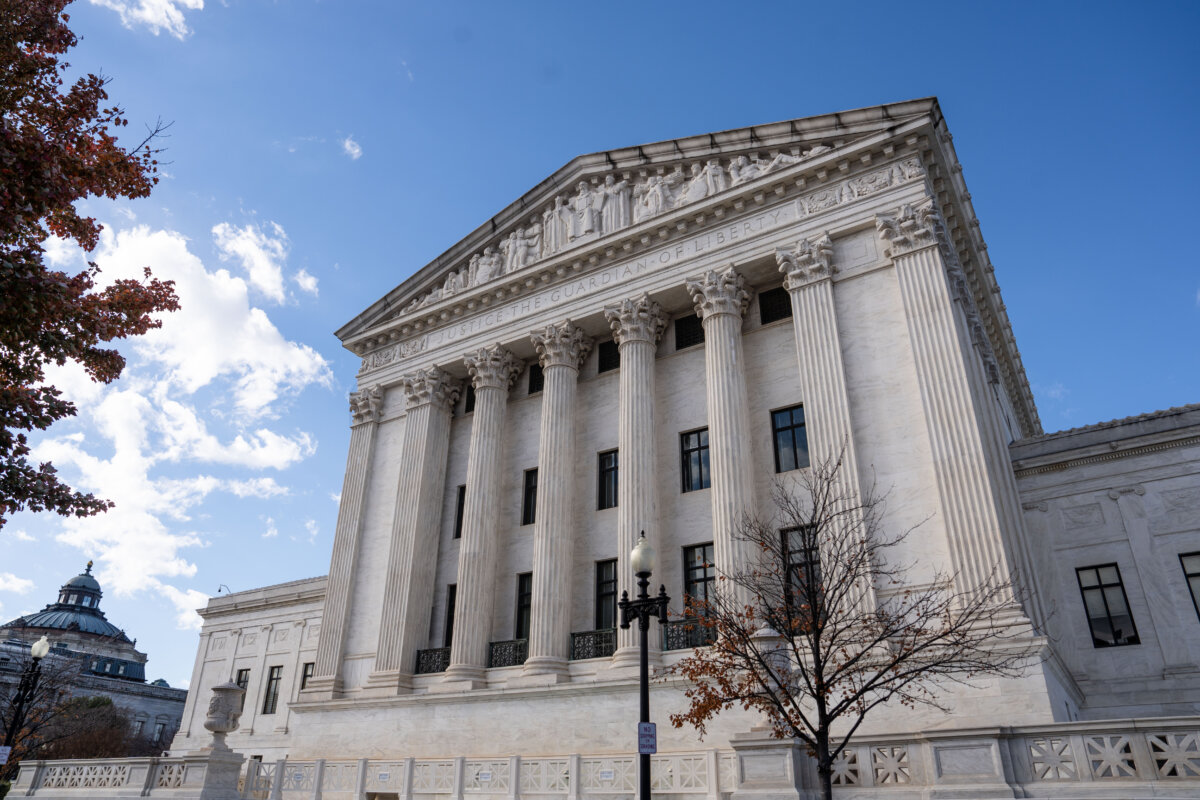

The U.S. Supreme Court has decided to hear the appeal of a black Mississippi death row inmate who argues that prosecutors discriminated against him by excluding black jurors from his trial.
The high court’s decision in Pitchford v. Cain on Dec. 15 took the form of an unsigned order. No justices dissented.
The petitioner, Terry Pitchford, was convicted of capital murder and sentenced to death in February 2006.
The case is about whether lower courts erred in holding that Pitchford waived his right to contest the prosecution’s decision to strike four black jurors.
Batson v. Kentucky, a 1986 U.S. Supreme Court decision, forbids a state from using its peremptory challenges to exclude jurors because of their race. A peremptory challenge is one that a lawyer does not have to justify in court.
Batson provides a three-step framework for assessing claims of deliberate racial discrimination in jury selection.
Step 1 requires a claimant to make a prima facie, or at least initially plausible, showing that the prosecutor had a race-based reason when he used a peremptory challenge. If step 1 is satisfied, step 2 requires the prosecutor to provide a race-neutral justification for striking a specific juror. Step 3 then requires the court to decide whether the claimant “has carried his burden of proving purposeful discrimination.”
Prosecutors argued that on Nov. 7, 2004, two black teenagers, Pitchford, then 18, and Eric Bullins, then 16, killed shopkeeper Reuben Britt, 67, during a botched robbery of a bait and grocery store.
The state alleged that Bullins fired two lethal .22 caliber shots while Pitchford fired a .38 caliber revolver that belonged to Britt and was loaded with non-lethal pellets. The state argued that Pitchford formed the needed mens rea, or criminal intent, for capital murder because he thought the revolver was loaded with lethal ammunition, a claim Pitchford disputed. The state took the position that the .38 caliber revolver was “the chain” that connected Pitchford to the crime scene, according to Pitchford’s petition.
The murder trial moved quickly.
On Feb. 6, 2006, the jury was seated in the Grenada Circuit Court after the district attorney used his four peremptory challenges to exclude potential jurors who were black, resulting in a largely white jury. The defense objected, citing Batson, but the trial judge sustained the juror strikes. Following the opening statements, later the same day, deliberations and the verdict took two days. By Feb. 9, Pitchford had been convicted and sentenced to death, the petition said.
The Mississippi Supreme Court rejected Pitchford’s appeal. The court found that he had waived his right to pursue the argument that the race-neutral reasons the prosecutor provided for the juror strikes were discriminatory, because he failed to fully develop that argument at trial.
Pitchford filed a petition in federal district court to challenge the conviction. The court found that Pitchford’s rights had been violated and cited the federal Antiterrorism and Effective Death Penalty Act in ordering that he be released or given a new trial within 180 days. The U.S. Court of Appeals for the Fifth Circuit reversed, ruling that the state courts did not violate clearly established federal law by refusing to consider such arguments, according to the petition.
The Fifth Circuit found that the trial court’s adjudication was reasonable because it did not omit Batson’s third step. The circuit court also relied on Mississippi precedent, which provides that when the trial record fails to contain an argument rebutting the prosecutor’s race-neutral explanation, the trial court is obliged to rule on the Batson challenge based exclusively on the prosecutor’s explanations, the petition said.
The petition said the U.S. Supreme Court should take up the case because the Fifth Circuit failed to follow its own precedents in interpreting Batson.
The state argued that the Fifth Circuit’s ruling was legally sound, so the petition should be denied.
“The court of appeals correctly ruled that no decision of this Court clearly establishes that a trial court or reviewing court must, in assessing a Batson claim, consider arguments or facts that a Batson challenger did not present to the trial judge and raised only on appeal,” the state’s brief reads.
Joe Perkovich, one of Pitchford’s attorneys, hailed the U.S. Supreme Court’s decision to take up the case.
“The gravity of the racial discrimination in this case … has focused attention on the power of our federal courts to vindicate essential rights under the U.S. Constitution,” Perkovich told The Epoch Times.
The Epoch Times reached out to the Mississippi attorney general’s office for comment but received no response.
The case is expected to be argued at the U.S. Supreme Court in 2026. A decision is likely to be issued by the end of June 2026.
 Friends Read Free
Copy
Facebook
Tweet
Friends Read Free
Copy
Facebook
Tweet