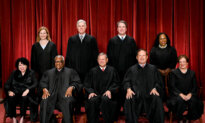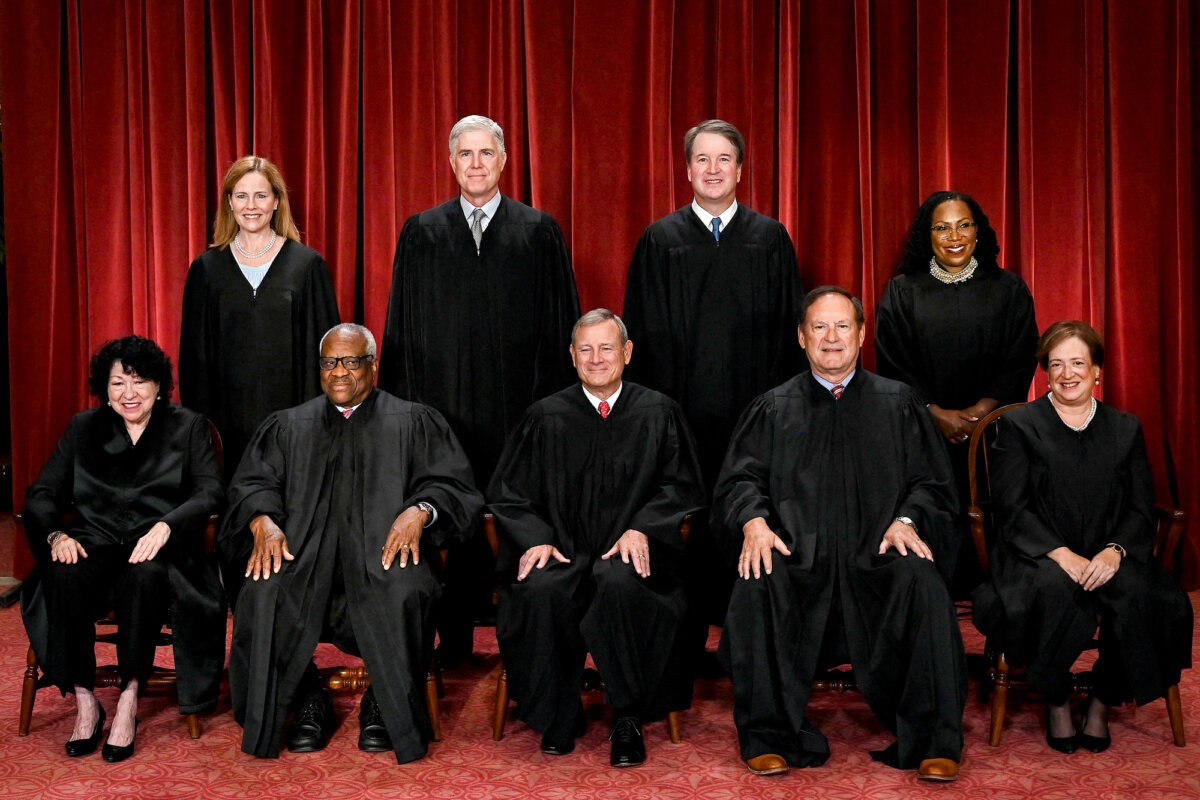
As the U.S. Supreme Court approaches its summer recess, the justices are expected to issue many critical rulings on immigration, presidential power, and other hot-button issues. The most anticipated ruling concerns President Donald Trump’s birthright citizenship policy, an effort to prevent U.S. citizenship from being automatically bestowed on the children of illegal immigrants.
Other important immigration-related cases are about whether the government is allowed to turn away asylum seekers at the border and whether it may revoke protections for Syrians and Haitians who say they fear returning to their homelands.
The court is also expected to issue rulings on whether boys may compete on girls teams and on a law that allows ballots received after Election Day to be counted.
Trump v. Barbara
The court heard oral arguments on April 1, probing whether Trump had violated the Constitution and federal law with his executive order restricting birthright citizenship.
The case, Trump v. Barbara, focuses on the 14th Amendment’s citizenship clause, which says, “All persons born or naturalized in the United States, and subject to the jurisdiction thereof, are citizens of the United States and of the state wherein they reside.”
Trump has said that the country’s current birthright citizenship policy was created to grant citizenship to freed slaves and their children, not to children born to temporary visitors.
Multiple federal courts disagreed, pointing to the Supreme Court’s 1898 decision in United States v. Wong Kim Ark. In that landmark decision, the Supreme Court said the 14th Amendment granted citizenship to a Chinese man whose parents were permanently domiciled in the United States.
The American Civil Liberties Union argued that the court’s reasoning lent itself to citizenship for the children of temporary visitors or illegal immigrants.
The Justice Department argued that the precedent had been misconstrued and that the 14th Amendment required a domicile or some kind of allegiance on the part of parents.
Overall, the justices seemed skeptical of the administration’s arguments. They’re also considering whether Trump’s policy violated the Immigration and Nationality Act, which Congress passed in the 20th century. The American Civil Liberties Union argued that the law, which used the same phrasing as the 14th Amendment, was intended to enact a broader definition of citizenship than the one Trump advanced.
Girls Sports
Another aspect of the 14th Amendment, known as the equal protection clause, came before the court when it considered West Virginia’s and Idaho’s laws banning male participation in female sports.
Two federal appeals courts ruled against the state laws, finding that they violated the equal protection clause by discriminating on the basis of sex and so-called transgender status. One of those courts, the U.S. Court of Appeals for the Fourth Circuit, said that West Virginia’s law also violated Title IX of the Education Amendments Act of 1972, which prohibits sex-based discrimination in federally funded educational institutions.
The states argued that their laws classifying sports teams by sex did not constitute unlawful discrimination. Oral argument in the cases, known as West Virginia v. B.P.J. and Little v. Hecox, occurred in January. Overall, the justices seemed inclined to vote in favor of the states.
Temporary Protected Status
On April 29, the court heard the Trump administration’s request to end temporary protected status (TPS) for Haitians and Syrians after lower courts blocked the move.
TPS is a designation that allows individuals from countries affected by armed conflict, natural disasters, or other extraordinary events to remain in the United States.
President Barack Obama’s administration granted TPS for Haitians and Syrians in the United States in 2010 and 2012, but former Homeland Security Secretary Kristi Noem revoked the status for them in 2025.
Multiple federal judges blocked Noem’s actions, saying that her decisions didn’t follow the proper procedures. One judge in Washington also said that her TPS revocation for Haitians was based on racial animus and violated the Constitution.
One of the Justice Department’s primary arguments is that the judges exceeded their authority in questioning Noem’s decisions. They pointed to language in federal law that states “there is no judicial review of any determination … with respect to the designation, or termination or extension of a designation” of temporary protected status.
Trump’s Firings
The Supreme Court is expected to issue two major decisions affecting the president’s ability to fire high-ranking officials.
At the beginning of his second term, Trump fired large numbers of federal staff alongside the heads of so-called independent commissions such as the Federal Trade Commission.
Several federal judges have blocked Trump’s terminations based on Humphrey’s Executor v. United States, a 1935 Supreme Court decision that said Congress could limit the reasons for which a president can remove various federal officials.
Trump appealed one of those rulings and argued that the 1935 decision was a bad precedent. Instead, he said, the president had greater authority under Article II of the Constitution.
The case, Trump v. Slaughter, focused on his attempt to fire former FTC Commissioner Rebecca Slaughter and was heard by the court in December 2025. During oral argument, the justices seemed more sympathetic to Trump’s position.
The following month, the justices heard Trump v. Cook, which focused on his attempt to fire Federal Reserve board member Lisa Cook.
On Jan. 21, the justices heard the president’s claim that he was allowed to fire Cook over allegations that she committed mortgage fraud before joining the Fed.
Trump said the alleged fraud should disqualify her from having control over monetary policy. Cook argued that the Federal Reserve Act limited her removal to “for cause” reasons and that the president couldn’t fire her for acts that took place before she assumed office.
The resulting decision could affect Trump’s firing authority and how courts view the independence of the Federal Reserve.
Hawaii Gun Law
The Supreme Court is expected to rule on a Hawaii gun control law in a case that could further clarify how the justices view the role of history in interpreting the Second Amendment.
In 2023, Hawaii passed a law that prohibited the carrying of a handgun by concealed carry permit holders on private property open to the public, unless the property owners explicitly consented.
It was one of several states to pass what some saw as workarounds to the Supreme Court’s landmark ruling in New York State Rifle and Pistol Association v. Bruen. That 2022 decision said that state laws had to be consistent with the nation’s history and tradition of firearm regulation.
A group of Hawaiians sued the state, alleging that the law flouted Bruen and lacked a basis in the nation’s history. Hawaii said the law protected private property rights and was similar to an anti-poaching law from 1771, as well as a black code from 1865.
When the U.S. Court of Appeals for the Ninth Circuit reviewed Hawaii’s regulation, it said those older laws were enough to show that Hawaii had a historical basis. More specifically, it said those laws were “dead ringers.”
By contrast, the Supreme Court indicated skepticism toward the law when it heard oral argument in January.
Accepting Ballots After Election Day
Can election officials count mail-in ballots that are received after Election Day? That was the question in Watson v. Republican National Committee (RNC), a case heard by the Supreme Court on March 23.
In the case, the RNC challenged a Mississippi law that allowed officials to count mail-in ballots received within a five-day grace period. Under the law, those ballots could be counted as long as they were postmarked by Election Day. The law was enacted in July 2020 during the COVID-19 pandemic to provide flexibility to voters.
Eighteen states accept mailed ballots received after Election Day if they are postmarked on or before Election Day, according to the National Conference of State Legislatures.
Federal law set the Tuesday after the first Monday in November in certain years as Election Day for federal offices.
The RNC told the Supreme Court that the law prevented officials from counting ballots after that date. Mississippi argued that the law required only that ballots be cast by that date, not that they be received by then.
Coordinated Campaign Spending
In another election-related case, the court is considering whether Congress violated the First Amendment by restricting how much political parties could coordinate their spending with candidates.
The case, National Republican Senatorial Committee (NRSC) v. Federal Election Commission (FEC), focused on the Federal Election Campaign Act of 1972 and a later amendment to the law.
The Democratic National Committee, which intervened in the lawsuit, backed the amendment’s restrictions on how much political party committees such as the NRSC could accept and spend to influence an election. It said the restrictions helped discourage quid pro quos in which donors give money with the expectation of being repaid somehow when the candidate took office.
During oral argument on Dec. 9, the NRSC argued the limits violated the First Amendment by interfering with free speech on political matters. Although the FEC was sued in this case, it sided with the NRSC before the Supreme Court.
Monsanto’s Weedkiller
On April 27, the court considered a case that could help Monsanto avoid thousands of lawsuits over its weedkiller known as Roundup.
The case, known as Monsanto v. Durnell, involved a Missouri man who developed non-Hodgkin lymphoma after exposure to Roundup. He and members of the Make America Healthy Again movement argued that a key ingredient, glyphosate, increased the risk of cancer.
In state court, a jury held Monsanto liable for allegedly failing to follow a state law that required companies to warn about consumer products. Monsanto told the Supreme Court that this verdict was based on a faulty application of state law.
Their argument centered on a legal doctrine known as preemption, the idea that federal law takes precedence over state law. It said that the Environmental Protection Agency had already approved glyphosate’s use without a cancer warning. It did so under a law known as the Federal Insecticide, Fungicide, and Rodenticide Act.
Monsanto said that because the EPA had not, under the act, deemed glyphosate to be carcinogenic and had not issued a cancer warning, laws such as Missouri’s were preempted and could not go beyond what the federal government already required.
Sam Dorman, Stacy Robinson, and Jackson Richman contributed to this report.
 Friends Read Free
Copy
Facebook
Tweet
Friends Read Free
Copy
Facebook
Tweet