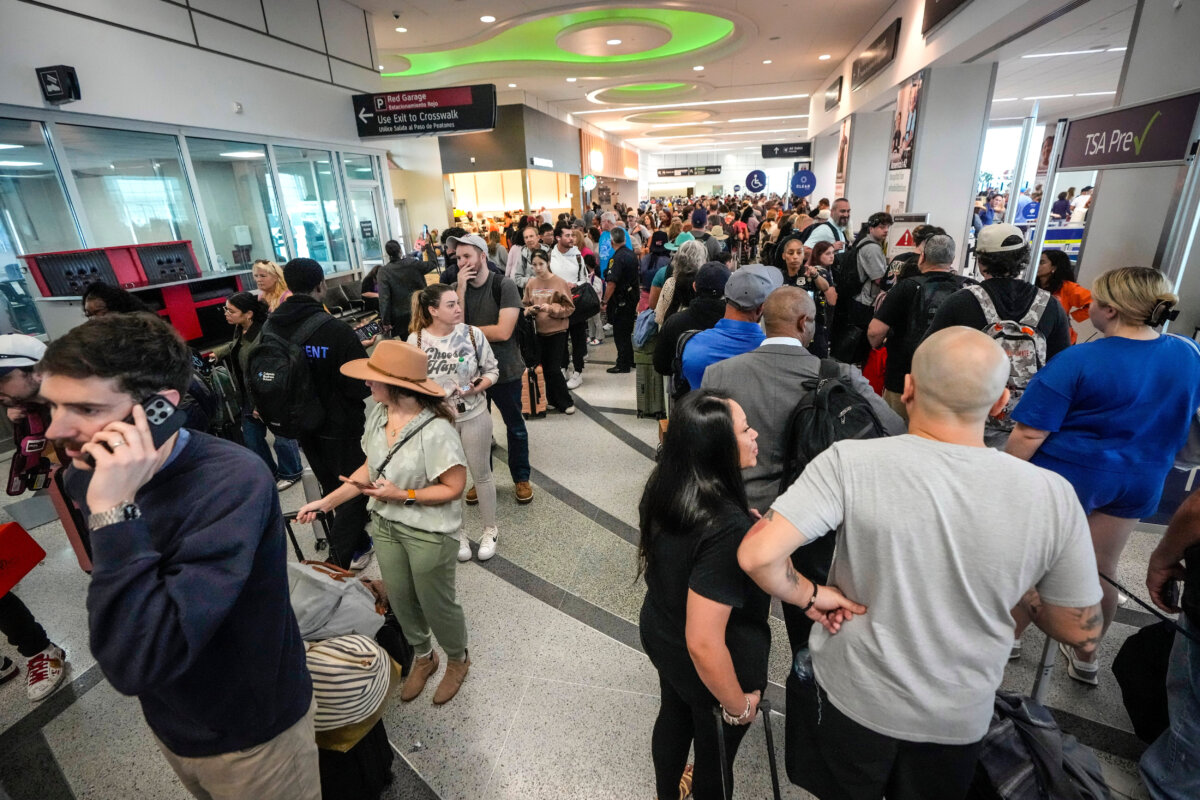

Travelers in the United States are facing significant delays at airports because of the ongoing federal government shutdown, the Transportation Security Administration (TSA) stated on March 8 in a post on social media.
“Today, travelers are facing TSA lines of up to nearly 3 hours long at some major airports,” Lauren Bis, deputy assistant secretary for public affairs at TSA, wrote on X. This has resulted in “missed flights and massive delays during peak travel.”
Referring to TSA officers, Bis said, “These frontline heroes received only partial paychecks earlier this month and now face their first full missed paycheck, leading to financial hardship, absences, and crippling staffing shortages.”
She called on Democrats to fund the Department of Homeland Security (DHS).
A recent travel update issued by William P. Hobby Airport in Houston, Texas, shared by the DHS states that passengers should arrive at least four to five hours before flight departure to allow enough time for TSA screening, with estimated wait times for the screening exceeding 180 minutes or 2.5 hours.
“Houston Airports urges passengers to remain flexible as the government shutdown may impact security operations from one day—and even one shift—to the next,” the post reads, advising travelers to get in touch with their airlines for further support.
The federal shutdown, which began on Feb. 14, is in its 23rd day. DHS funding issues arising from the shutdown have resulted in staff shortages.
On March 5, the House passed a bill to fund DHS. The vote was 221–209, with four Democrats joining all Republicans in voting for it.
However, Senate Democrats blocked the funding legislation, which received 51 votes with 45 opposed. Sixty votes are needed for the spending bill to move forward.
Immigration and Customs Enforcement (ICE) and Customs and Border Protection, which are part of the DHS, are funded through 2029 under the One Big Beautiful Bill Act. However, the TSA, the Federal Emergency Management Agency (FEMA), and Coast Guard are affected.
Democrats have demanded certain conditions that primarily apply to ICE operations to be met before allowing the funding bill to pass.
These include limiting immigration enforcement to targeted operations, requiring judicial warrants before entering private property, ending what they describe as indiscriminate arrests, verifying citizenship before detention, requiring agents to clearly identify themselves, and restricting operations in locations such as churches, schools, and medical facilities.
Flight Delays
As of March 8 at 9:40 p.m. EDT, there have been 7,233 flight delays and 673 cancellations at U.S. airports, according to data from FlightAware. On March 7, there were 9,693 delays and 1,339 cancellations.
George Bush Intercontinental Airport (IAH) in Houston asked passengers in a post on X to arrive early to make time for TSA clearance.
The Louis Armstrong New Orleans International Airport, which serves New Orleans and the Gulf Coast Region, stated in a March 8 post on X that there were “longer-than-average lines” at the airport because of a shortage of TSA workers.
The airport advised passengers to arrive at least three hours prior to their scheduled departure time to make sure there is enough time for security screening.
The Hartsfield-Jackson Atlanta International Airport also issued a warning in an X post, saying passengers could expect longer wait times at TSA checkpoints because of staffing constraints and the “residual impacts from two ground stops issued [on March 6].”
The Austin-Bergstrom International Airport had warned back in a March 5 post on social media that “unanticipated delays” could occur because of the partial federal shutdown.
In a March 8 statement, Chris Sununu, CEO of Airlines for America, a trade association of leading U.S. airlines, said that TSA officers are facing a zero-dollar paycheck this week and that the DHS shutdown was causing “significant strains” across the aviation system.
At some airports, TSA lines are two to three hours long, resulting in flights being delayed and passengers missing their timely travel, according to the CEO.
“The shutdown is having very real consequences, and hardworking federal aviation workers, the airline industry and our passengers are being used as a political football once again. This is simply unacceptable and un-American,” Sununu said.
“We are in spring break travel season and expecting record numbers of people to take to the skies. Airlines have done their part to prepare; now Congress and the administration must act with urgency to reach a deal that reopens DHS and ends this shutdown. America’s transportation security workforce is too important to be used as political leverage.”
 Friends Read Free
Copy
Facebook
Tweet
Friends Read Free
Copy
Facebook
Tweet