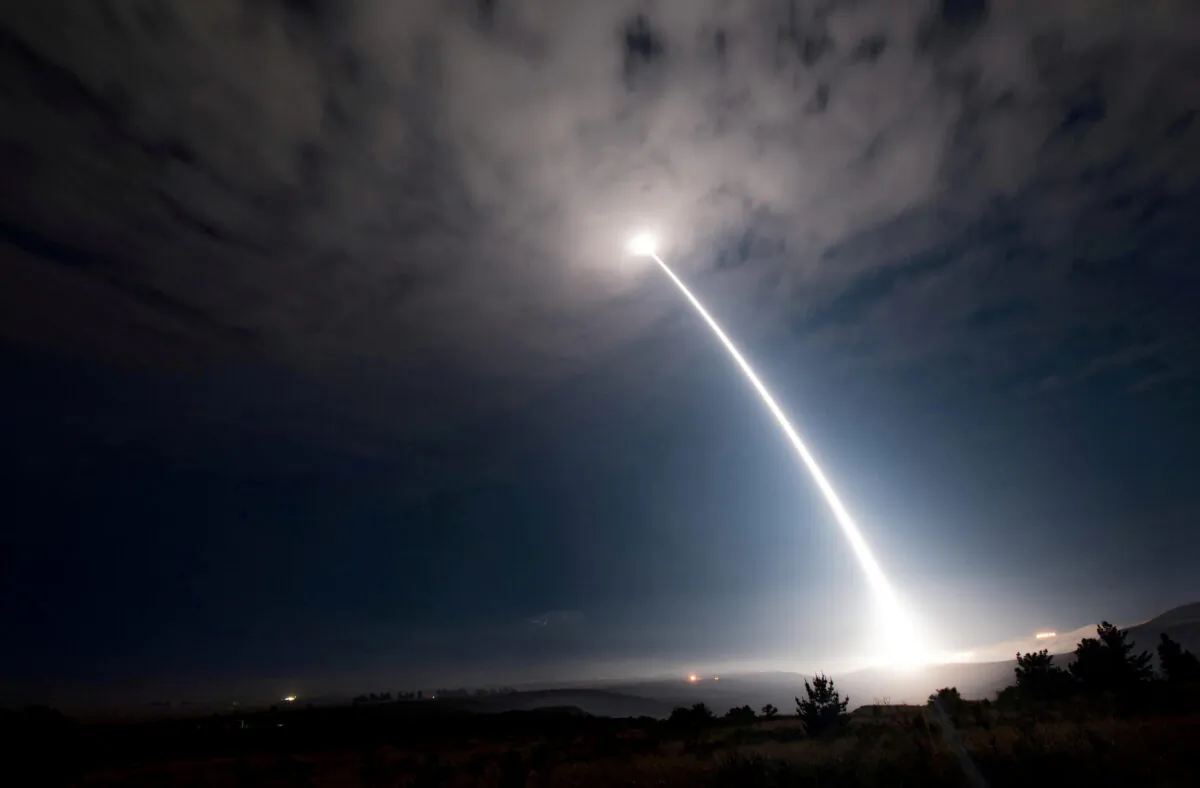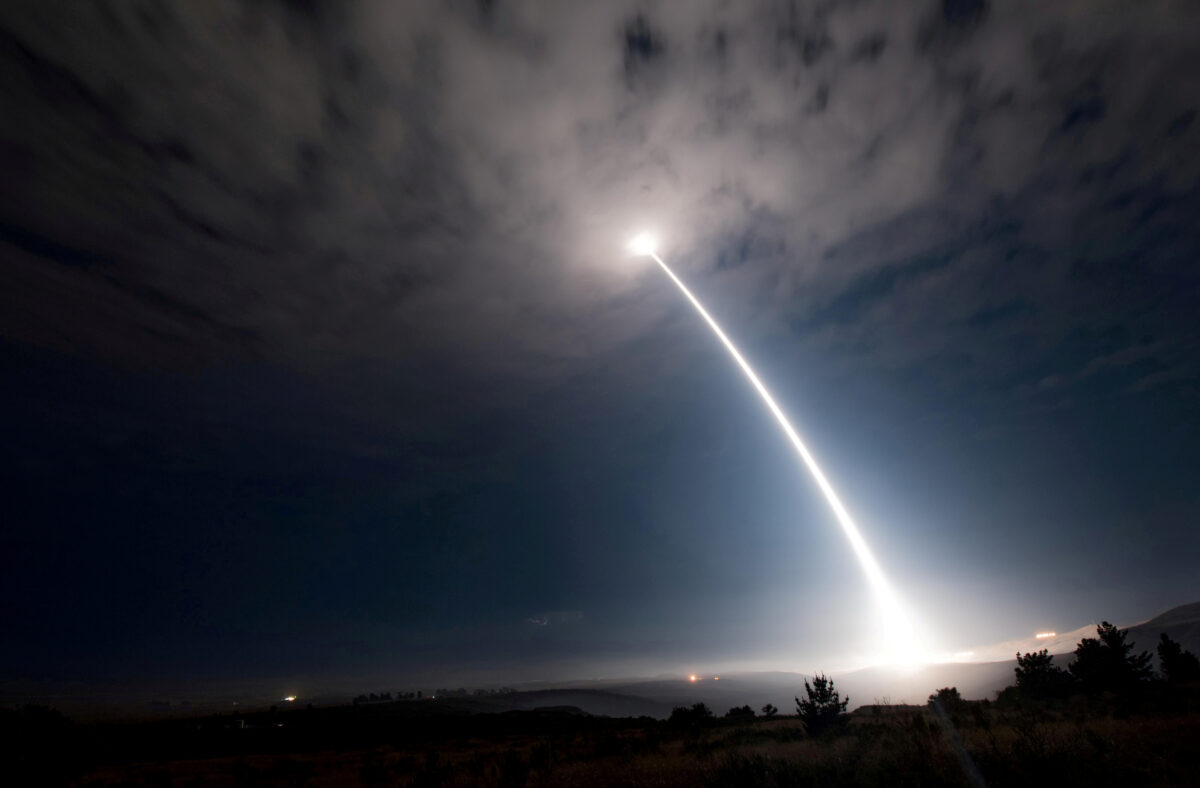

The Pentagon is seeking to spend more than $104 billion on modernizing the nation’s nuclear arsenal in the coming year.
The War Department’s fiscal year 2027 spending request allocates $71.4 billion for upgrading its triad of weapons systems—submarines, bombers, and intercontinental ballistic missiles (ICBMs)—and the Department of Energy’s proposed annual budget earmarks $32.8 billion for weapons development.
The proposed “nuclear enterprise” budget accelerates the $75 billion annual allocation recommended by the Congressional Budget Office in 2023 to fund a 30-year, $1.5 trillion modernization of the nation’s strategic posture. If adopted, it would increase nuclear weapons spending by nearly $30 billion from fiscal year 2025’s enacted budget and by more than $17 billion from this year’s authorizations.
“The urgency we face is heightened by an increasingly complex and challenging strategic environment,” Air Force Lt. Gen. Andrew Gebara, the Pentagon’s deputy chief of staff for strategic deterrence, said in April 22 testimony before the House Armed Services Committee’s Strategic Forces Subcommittee.
“This era is not a return to the Cold War.”
He said this era is defined by the challenge of “multiple, simultaneous nuclear-capable competitors” that now include China and North Korea and, potentially, Iran. Gebara also said Russia is continuing “to modernize and diversify its entire nuclear arsenal, while leveraging frequent coercive [tactical] nuclear threats during the conflict in Ukraine.”
Gebara was among five Department of War officials who joined the Department of Energy’s National Nuclear Security Administration (NNSA) chief, Brandon Williams, in testifying before the House panel on proposed nuclear weapons spending, one of many hearings that kicked off in April and will continue through the summer on 12 proposed appropriations bills that constitute the annual federal budget before the fiscal year begins on Oct. 1.
Sustaining the nation’s “nuclear enterprise” is a joint mission shared by the Pentagon and the Department of Energy (DOE): The NNSA is developing weapons and maintaining stockpiles while the Department of War hones strategic forces designed to deter and deliver nuclear attacks.
Since the end of the Cold War in the early 1990s, the United States has failed to keep pace with evolving threats in sustaining its nuclear deterrence in assured second-strike response capacity and tactical—or battlefield—advances that Russia, in particular, increasingly tout, the 2023 Congressional Budget Office assessment said.
“For several decades the United States did not develop and field new nuclear weapons or delivery systems, choosing instead to sustain or extend the life of existing ones,” the assessment stated. “Over the coming years, Congress will need to decide which nuclear forces the United States should field in the future and thus the extent to which the nation will continue to modernize those forces.”
The Trump administration is opting to do both, as President Donald Trump has threatened to withdraw from the 1996 Comprehensive Test Ban Treaty, citing alleged violations by Russia, China, and North Korea, and resume testing for the first time in nearly 40 years by 2028.
Reinforcing the Triad
The Trump administration’s proposed fiscal 2027 $1.5 trillion defense plan seeks a 44 percent—or $441 billion—increase in military allocations over this year’s enacted budget, approximately $71.4 billion of which is earmarked for strategic forces, nearly $10 billion more than fiscal year 2026’s $62 billion outlay.
The Pentagon’s spending plan outlines allocations for 12 nuclear weapons systems within the nation’s “triad” nuclear posture: land-based missiles, air-launched weapons, and sea-based armaments. It places a significant focus on updating warheads and diversifying nuclear-capable forces with new cruise missile technologies, and it includes a $20 billion investment in upgrading command-and-control communications.
The proposed budget earmarks $4.6 billion for transitioning from the Minuteman III ICBM, the massive warheads atop rockets launched into space from hardened silos, to Northrop Grumman’s Sentinel by the mid-2030s. That allocation is in addition to $2 billion for Minuteman maintenance and follows this year’s $5.3 billion Sentinel ICBM investment.
The Minuteman was developed in the 1950s, has been in service since 1962, and was last upgraded in the 1970s, Strategic Forces Chair Rep. Scott DesJarlais (R-Tenn.) said, recalling a recent visit to the 91st Missile Wing at Minot Air Force Base in North Dakota.
“Neither the Minuteman missile nor the infrastructure around it was designed to last this long,” he said. “The fact that the system remains effective today is due to the amazing effort and endurance of those we met—the young missileers, maintainers, and defenders. Their success at keeping a 55-year-old ICBM system alive is impressive, but I think what we’re asking of them is unfair. We owe them a better product.”
The War Department’s spending request outlines $6.1 billion for the B-21 Raider bomber, $2,9 billion for the F-47 fighter, and $16 billion for the AGM-181A stealth, nuclear-armed cruise missile that can be delivered by B-52s, B-21s, and F-35s.
“The B-21 Raider is the cornerstone of our nation’s future bomber force and is demonstrating tangible progress as it executes its flight test campaign,” Air Force Gen. Dale White, director of critical major weapon systems at the Pentagon, testified. “The B-21 Raider and the LGM-35A Sentinel are not merely upgrades; they are the essential guarantors of a credible U.S. nuclear deterrent for future generations.”
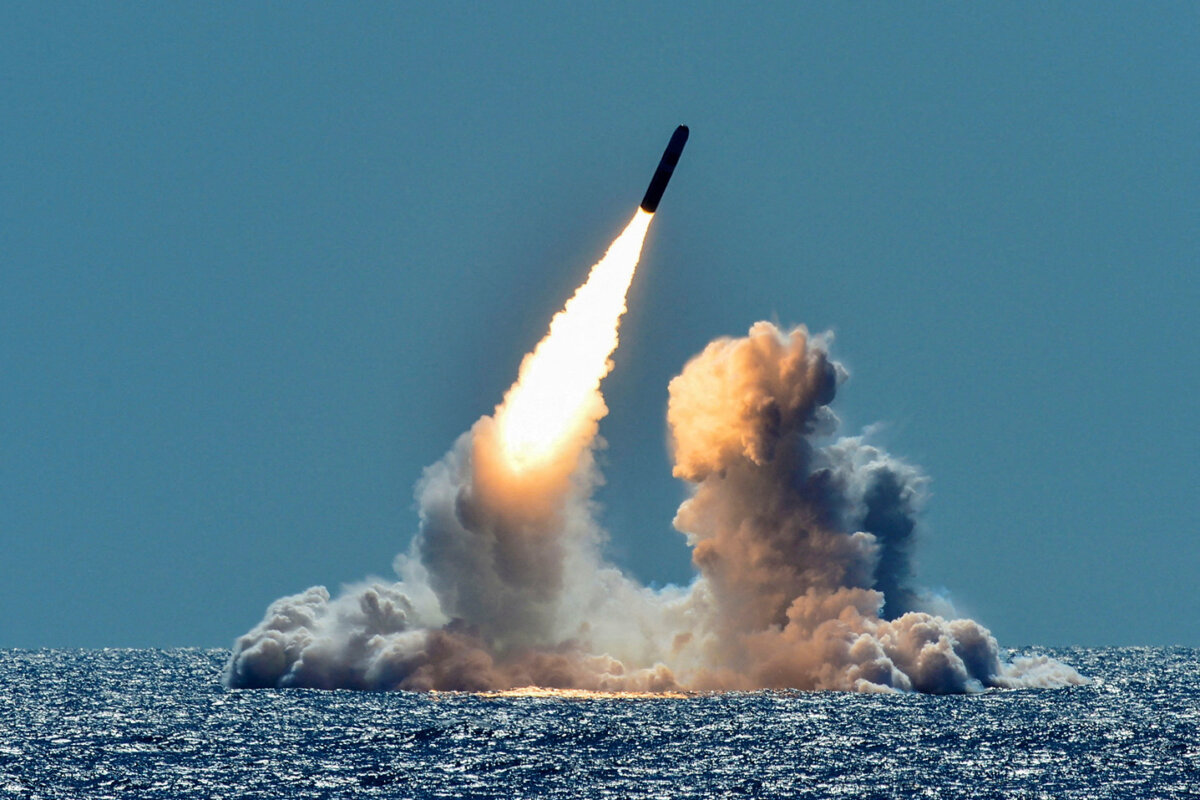
The proposed fiscal 2027 budget earmarks $16.2 billion for Columbia-class submarines and upgrades to Trident submarine-launched ballistic missiles (SLBMs), up from $11 billion in this year’s enacted spending, as part of a decades-long plan to deliver by 2028 the first of 12 new strategic submarines to replace the current 14-member Ohio class fleet.
“The U.S. nuclear triad’s most survivable leg is provided by the sea-based strategic deterrent,” U.S. Navy Strategic Systems Programs Director Vice Adm. Johnny Wolfe said in his testimony. “Our unwavering focus on designing, developing, and deploying the most advanced SLBM, [nuclear-armed, ‘low-yield’ sea-launched cruise missiles], and hypersonic technologies ensures the U.S. Navy maintains its competitive edge in an increasingly contested maritime domain.”

Money Well-Spent
The DOE’s proposed $53.9 billion fiscal 2027 spending request earmarks $32.8 billion for the NNSA, including more than $27.4 million for weapons development. The request increases NNSA funding by $3.6 billion while trimming $2.7 billion from non-defense allocations from this year’s enacted budget.
During an April 21 hearing before the Senate Energy and Natural Resources Committee, Energy Secretary Chris Wright said the NNSA plans to deliver “more new weapons … than any time since the Cold War.”
That effort includes seven “simultaneous weapons modernization programs” right now across weapons laboratories, “while ramping up [plutonium] pit production,” he said.
Included in that $32.8 billion is $8.8 billion for production modernization, $6.5 billion for stockpile management, $4.9 billion to accelerate plutonium pit construction, $655 million to upgrade uranium supply chains, $290 million to complete construction of a new uranium processing plant, and $140 million for the annual cost of building by 2030 the new High Explosives Science and Engineering Facility at the Pantex plant at Sandia National Laboratories in New Mexico.
“We want to accelerate those projects,” Wright said. “The previous efforts have been slower, have been behind schedule, and over budget. We want to change that. Our adversaries are moving quickly. Our threats are changing rapidly. We’ve got to look carefully at what we’re doing.”
The NNSA’s proposed allocation is more than 60 percent of the DOE’s budget, Sen. Tom Cotton (R-Ark.) said.
He said that many Americans would be surprised to learn that “one of the most important things” the DOE does is safeguard and expand the country’s nuclear weapons stockpile.
Cotton said many Americans do—and will, as the budget moves through summer reviews for before fall adoption—question, “Why do we spend so much money on weapons we never use?”
“Wrong on both accounts,” he said. “It’s a fairly small percentage of our overall budget. We just happen to be spending money for the first time on modernization projects, and they’re badly needed.
“And second, we do use our nuclear weapons. We’ve used them every single day for 81 years. There’s a reason why there hasn’t been a conflict on the scale of World War II since we first attained nuclear weapons.”
 Friends Read Free
Copy
Facebook
Tweet
Friends Read Free
Copy
Facebook
Tweet