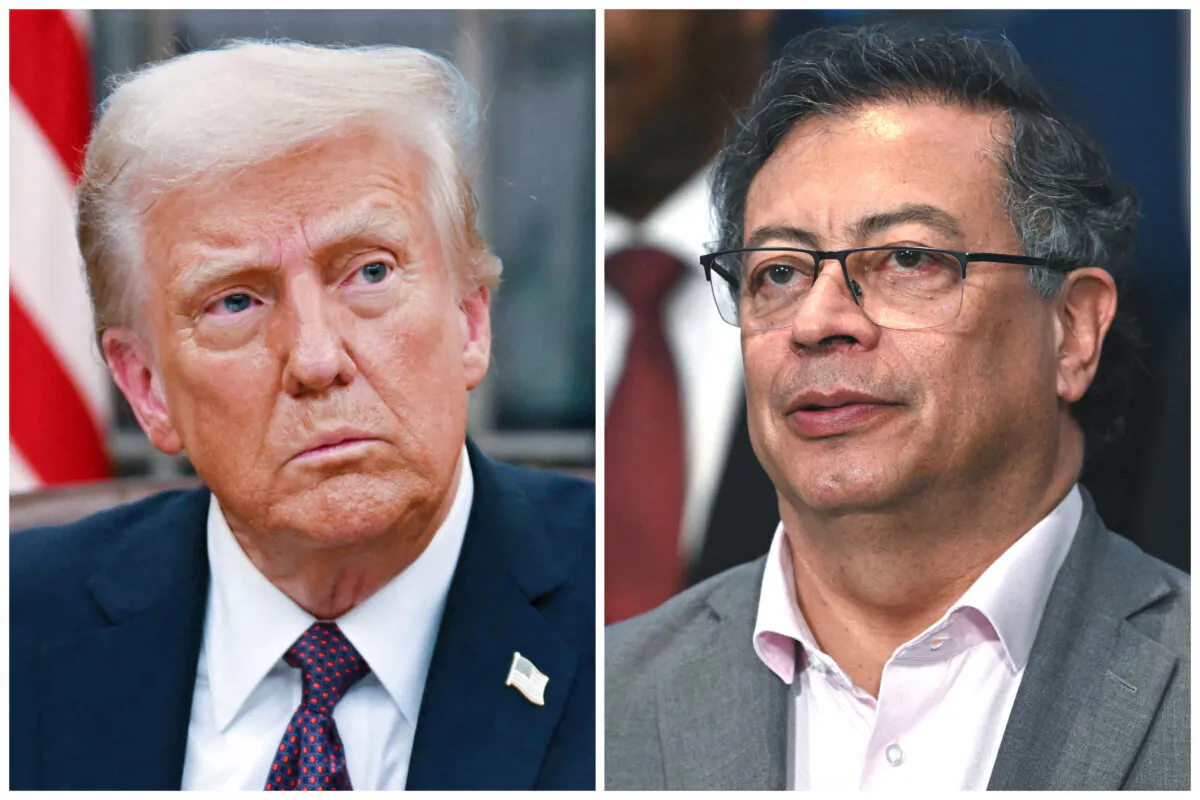


U.S. President Donald Trump will raise tariffs on Colombia after a public dispute with the nation’s president, who Trump labeled as an “illegal drug leader” earlier on Sunday.
“They don’t have a fight against drugs—they make drugs,” Trump told reporters aboard Air Force One while speaking about the issue, calling Colombia “a drug manufacturing machine” with “a lunatic” as president.
Trump said he would also be cutting off U.S. subsidies to the South American nation.
Trump also said new tariffs would be announced against Colombia sometime on Monday.
“President Gustavo Petro, of Colombia, is an illegal drug leader strongly encouraging the massive production of drugs, in big and small fields, all over Colombia,” Trump wrote on social media. “It has become the biggest business in Colombia, by far, and Petro does nothing to stop it, despite large-scale payments and subsidies from the USA that are nothing more than a long term rip off of America.”
Trump added that as of Oct. 19, all forms of payments and subsidies to Colombia from the United States will be cut off, alleging that drug production in that nation is intended for “the sale of massive amounts of product into the United States, causing death, destruction, and havoc.”
“Petro, a low rated and very unpopular leader, with a fresh mouth toward America, better close up these killing fields immediately, or the United States will close them up for him, and it won’t be done nicely,” Trump wrote.
Also on Oct. 19, U.S. War Secretary Pete Hegseth announced that the U.S. military had struck a drug-smuggling vessel on Oct. 17 and killed three occupants.
Hegseth said that the boat was connected to a guerrilla group based in Colombia.
“The vessel was known by our intelligence to be involved in illicit narcotics smuggling, was traveling along a known narco-trafficking route, and was transporting substantial amounts of narcotics,” he wrote in a post on X that included video of the strike.
The United States provided Colombia with more than $740 million in aid in fiscal year 2023 and another $580 million in fiscal year 2024, according to a government website.
The Colombian president replied in a statement that Trump “is being misled by his inner circle and advisors.”
“The main enemy of drug trafficking in Colombia in the 21st century was the person who exposed its ties to Colombia’s political establishment. That person was me. I recommend that Trump take a good look at Colombia and determine where the drug traffickers are and where the Democrats are,” he said.
The announcement was made one day after Petro accused the United States of murder following a U.S. strike on a boat in September against what Trump had said were “confirmed narcoterrorists.”
“US government officials have committed a murder and violated our sovereignty in territorial waters. Fisherman Alejandro Carranza had no ties to the drug trade, and his daily activity was fishing,” Petro wrote on social media on Oct. 18. “The Colombian boat was adrift and had its distress signal up due to an engine failure. We await explanations from the US government.”
In another post on Oct. 18, Petro said the Colombian boat that was hit in the U.S. strike on Sept. 16 had turned off and raised one of its engines in a sign of damage. He said the boat was “presumably” in his nation’s waters and that he was demanding that U.S. Attorney General Pam Bondi “act immediately.”
“Provide immediate protection to the victims’ families and, if they wish, associate them with the victims in Trinidad and Tobago to initiate legal proceedings around the world and in the U.S. courts,” he said in an English translation from Spanish.
On Sept. 15, Trump said that the U.S. military had conducted its second kinetic strike against “positively identified, extraordinarily violent drug trafficking cartels and narcoterrorists in the SOUTHCOM area of responsibility.”
The U.S. president said the strike, which resulted in three deaths, was conducted while the targets were in international waters headed toward the United States.
The strikes continued last week, and Trump said on Oct. 18 that the U.S. government is repatriating two survivors—one from Colombia and the other from Ecuador—from an Oct. 16 military strike on a submersible vessel in the Caribbean Sea.
“U.S. Intelligence confirmed this vessel was loaded up with mostly Fentanyl, and other illegal narcotics. There were four known narcoterrorists on board the vessel. Two of the terrorists were killed,” Trump wrote on social media. “The two surviving terrorists are being returned to their Countries of origin, Ecuador and Colombia, for detention and prosecution. No U.S. Forces were harmed in this strike.”
Trump and U.S. Secretary of State Marco Rubio first mentioned the strike during an Oct. 17 White House news conference with Ukrainian President Volodymyr Zelenskyy.
“It’s well known there’s an ongoing narco-terrorist operation the United States has been conducting,” Rubio said. “As far as details of any recent strikes, we’re not prepared here to announce all those details, but you’ll get that information here very shortly.”
The recent ramp-up in U.S. military strikes on suspected drug trafficking boats in the southern Caribbean has drawn pushback from some lawmakers who question the legal justifications and intelligence assessments guiding the policies.
“We still don’t know if the strikes are legal, and why the U.S. is not instead interdicting to get intelligence to disrupt narcotrafficking routes,” Sen. Tim Kaine (D-Va.) wrote on social media after the initial strikes in September.
Ryan Morgan contributed to this report.
 Friends Read Free
Copy
Facebook
Tweet
Friends Read Free
Copy
Facebook
Tweet