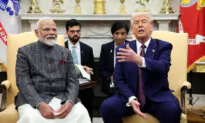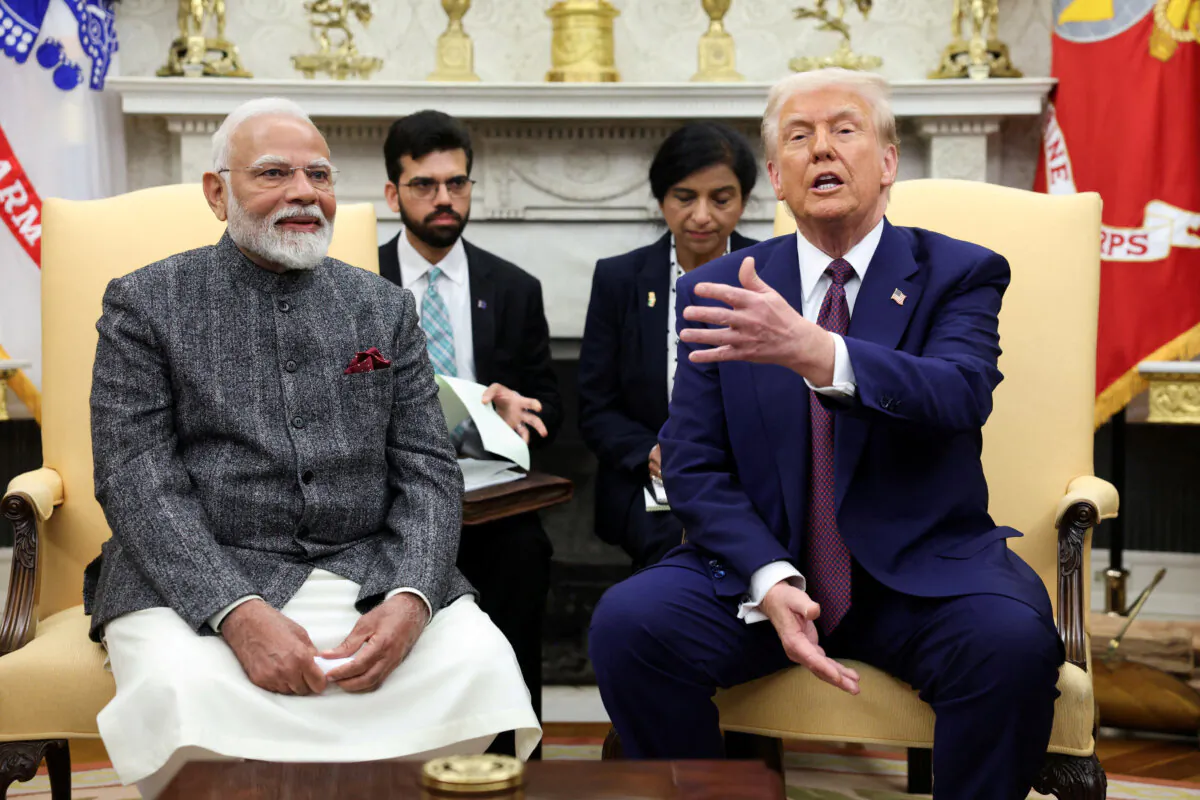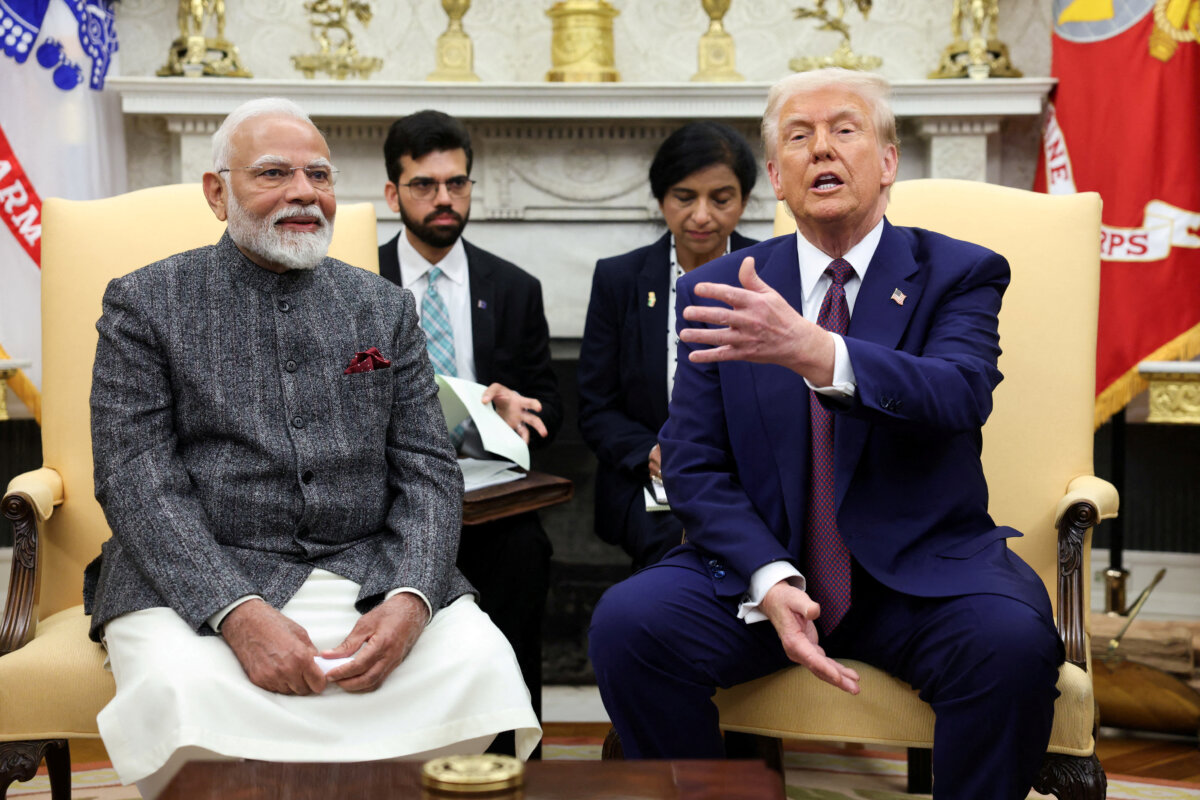

President Donald Trump said on July 30 that the United States will impose a 25 percent tariff on Indian goods beginning on Aug. 1, along with additional unspecified penalties, citing the country’s high trade barriers and continued reliance on Russian energy and arms.
The announcement, made in a Truth Social post, describes India’s tariffs as “among the highest in the world,” and Trump said the extra penalties would address New Delhi’s military and energy ties to Moscow amid the war in Ukraine.
“Remember, while India is our friend, we have, over the years, done relatively little business with them because their Tariffs are far too high … and they have the most strenuous and obnoxious non-monetary Trade Barriers of any Country,” he wrote.
Trump noted that India is among the largest buyers of Russian energy, providing Moscow with resources to continue its aggression against Kyiv.
The president teased the tariff move in remarks to reporters on July 29 on Air Force One, saying that India “has been a good friend” to the United States but that the country has charged “basically more tariffs than any other country.”
Although Trump has repeatedly urged India to allow more U.S. exports, talks were bogged down over agricultural and dairy products in particular, as India resisted any move to open those sectors.
According to the latest trade barrier report from the Office of the U.S. Trade Representative, India’s tariff rates can average more than 113 percent and reach 300 percent on sensitive agricultural lines. Applied rates on farm goods average about 39 percent, and the United States has also flagged nontariff barriers such as strict dairy import certifications, non‑GMO mandates, and burdensome customs procedures that complicate market access for U.S. exporters.
“India has considerable flexibility to change tariff rates for both agricultural and non-agricultural products at any time, creating tremendous uncertainty for U.S. workers, farmers, ranchers, and exporters,” the report reads.
India used its tariff flexibility in the 2019–2020 budget to raise duties on roughly 70 product categories—including agricultural goods, information and communication technology products, medical devices, paper, chemicals, and automotive parts—without prior notice or public consultation, affecting several major U.S. exports, according to the report.
Kevin Hassett, director of the National Economic Council, told reporters outside the White House on July 30 that Trump has grown frustrated with the lack of progress in trade talks with India and believes that the new tariff could “remedy the situation.”
Hassett said Trump and U.S. Trade Representative Jamieson Greer are expected to release more details soon on the additional penalty and remain hopeful that the move will prompt India to reconsider its trade practices.
“I think what’s going to happen is that India is going to cut their prices to the U.S. in order to maintain their market share. That’s what everybody else has been doing,” Hasset said.
“And then they might reconsider their practices, which have led to this higher rate, and, over time, I would guess that Indian firms will be onshoring production in the U.S., and Indians might even open their markets to us so that we reconsider a future trade deal.”
Trump’s announcement followed weeks of dialogue between U.S. and Indian officials dating back to early April, when the Trump administration first imposed a 26 percent tariff on Indian exports.
Commerce Secretary Howard Lutnick recently confirmed that Trump’s reciprocal tariffs on select countries will take effect on Aug. 1, with no further extensions and “no more grace periods.”
“Obviously, after Aug. 1, people can still talk to President Trump,” Lutnick said. “I mean, he’s always willing to listen.”
After months of negotiations, the United States reached a trade agreement on July 27 with the European Union. Under the framework, the United States will impose a 15 percent tariff on most European goods, a lower rate than Trump’s previous proposal of 30 percent to 50 percent.
“We’re doing them on the low end, not the high end, because we don’t want to hurt anybody,” Trump said. “This is probably the biggest deal ever reached in any capacity—trade or beyond. It’s a giant deal with lots of countries.”
Twenty-seven countries are members of the EU, which, under the new trade deal with Washington, agreed to collectively buy $750 billion worth of U.S. energy products over the next three years. EU member states have also committed to investing $600 billion in the U.S. economy.
 Friends Read Free
Copy
Facebook
Tweet
Friends Read Free
Copy
Facebook
Tweet