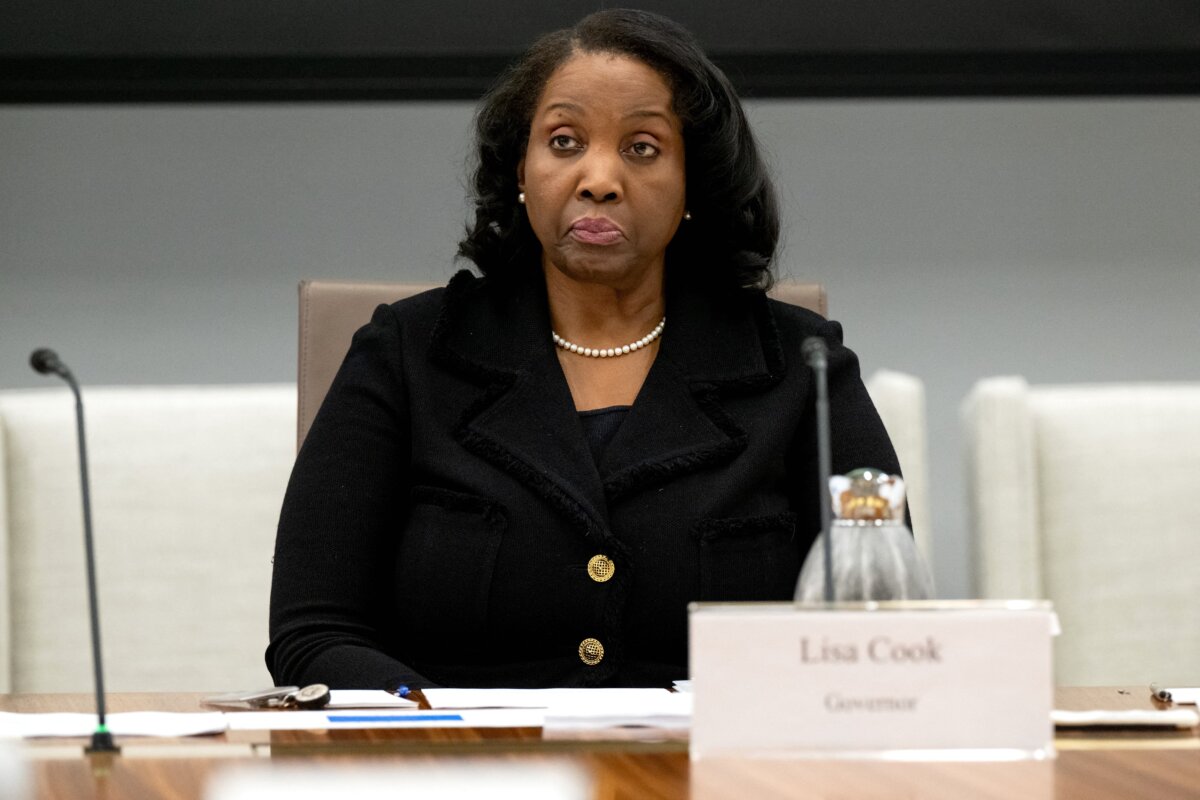

President Donald Trump stated on Aug. 22 that he will fire Federal Reserve Gov. Lisa Cook if she does not step down from her role at the U.S. central bank.
Earlier this week, Cook was publicly accused of mortgage fraud by Bill Pulte, chairman of the Federal Housing Finance Agency. He also sent an Aug. 15 criminal referral letter to Attorney General Pam Bondi and Special Attorney Ed Martin, alleging that she falsified “bank documents and property records to acquire more favorable loan terms” and lower interest rates.
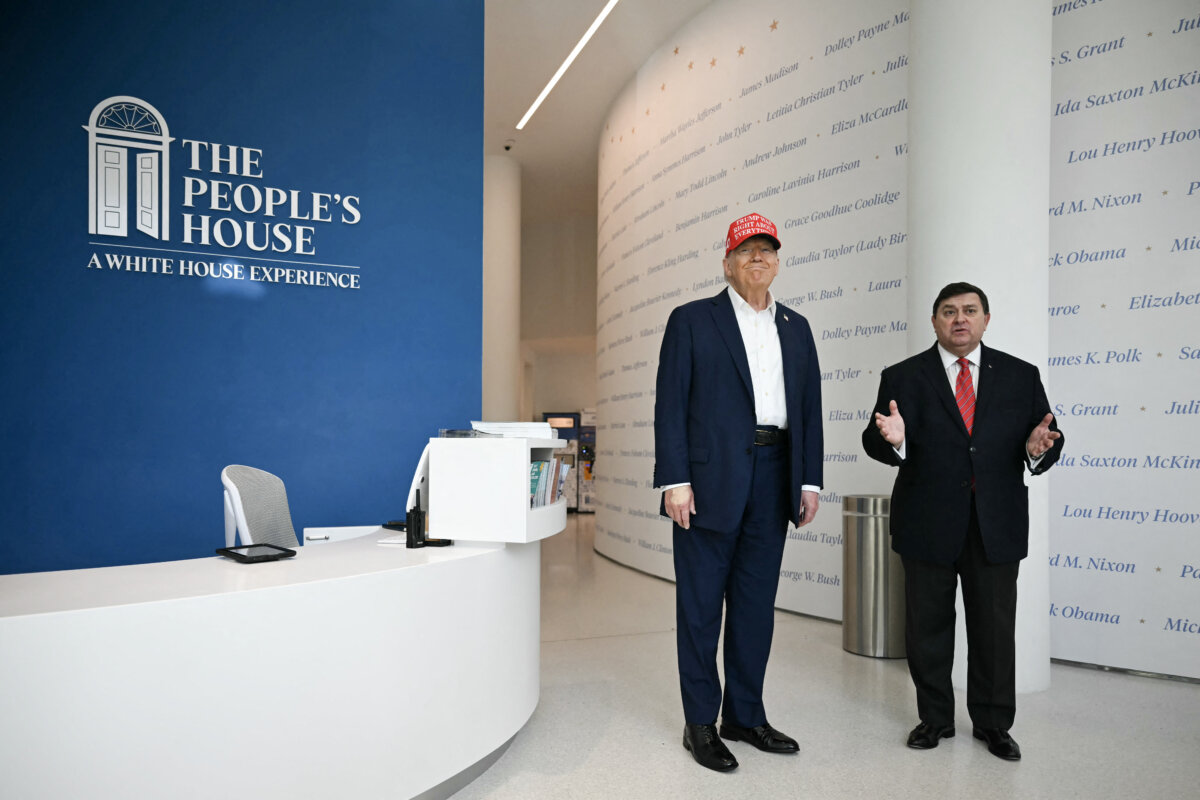
Briefly speaking to reporters during a visit to The People’s House, a museum of the White House, Trump said that “what she did was bad.”
“So I’ll fire her if she doesn’t resign,” the president said.
Trump had previously urged her to resign immediately, shortly after the allegations captured his attention.
“Cook must resign, now!” Trump wrote in an Aug. 20 Truth Social post.
Cook, appointed to the Fed Board by President Joe Biden in May 2022, has said that she does not intend to resign from her position.
“I have no intention of being bullied to step down from my position because of some questions raised in a tweet,” Cook said in a statement to The Epoch Times.
“I do intend to take any questions about my financial history seriously as a member of the Federal Reserve and so I am gathering the accurate information to answer any legitimate questions and provide the facts.”
Others, including Sen. Elizabeth Warren (D-Mass.), have weighed in on the matter.
The president, Warren said on social media, “cannot illegally fire independent Fed Board members.”
“Anyone can see he is trying to find a scapegoat for his failure to lower costs for Americans,” the ranking member on the Senate Banking Committee wrote in an Aug. 22 X post.
The current administration has been gradually reshaping the makeup of the Federal Reserve System.
Trump recently appointed Council of Economic Advisers head Stephen Miran as Fed Gov. Adriana Kugler’s temporary replacement. Additionally, the White House has been searching for a successor to Fed Chair Jerome Powell, whose term is set to expire in May 2026.
Cook has routinely sided with Powell and the majority of the Federal Open Market Committee in keeping interest rates unchanged within a target range of 4.25 percent to 4.5 percent. Like many of her colleagues, the Fed governor has advocated a wait-and-see approach to monetary policy before lowering the benchmark federal funds rate.
“As I consider the appropriate path of monetary policy, I will carefully consider how to balance our dual mandate, and I will take into account the fact that price stability is essential for achieving long periods of strong labor market conditions,” Cook said in prepared remarks at a June 3 Council on Foreign Relations event.
Her term lasts until January 2038.
The president’s latest remarks came as Powell signaled in his final speech at the annual Jackson Hole Economic Symposium that current economic conditions “may warrant” a cut in interest rates.
Despite pointing to a potential stagflation economic climate—an environment of high inflation, slower growth, and rising unemployment—the central bank chief suggested that officials would begin to adjust monetary policy.
“Our policy rate is now 100 basis points closer to neutral than it was a year ago, and the stability of the unemployment rate and other labor market measures allows us to proceed carefully as we consider changes to our policy stance,” he stated. “Nonetheless, with policy in restrictive territory, the baseline outlook and the shifting balance of risks may warrant adjusting our policy stance.”
Powell has been under pressure from Trump and senior administration officials for months to restart the institution’s easing cycle that has been on pause since January.
Investors cheered his comments, with the blue-chip Dow Jones Industrial Average soaring 846 points, or 1.89 percent, to a fresh all-time high. The tech-driven Nasdaq Composite Index surged by almost 400 points, or 1.9 percent. The broader S&P 500 picked up 97 points, or 1.52 percent.
New CME FedWatch Tool data indicate that the futures market is betting on a 91 percent chance of a quarter-point rate cut at the Sept. 17 policy meeting.
 Friends Read Free
Copy
Facebook
Tweet
Friends Read Free
Copy
Facebook
Tweet