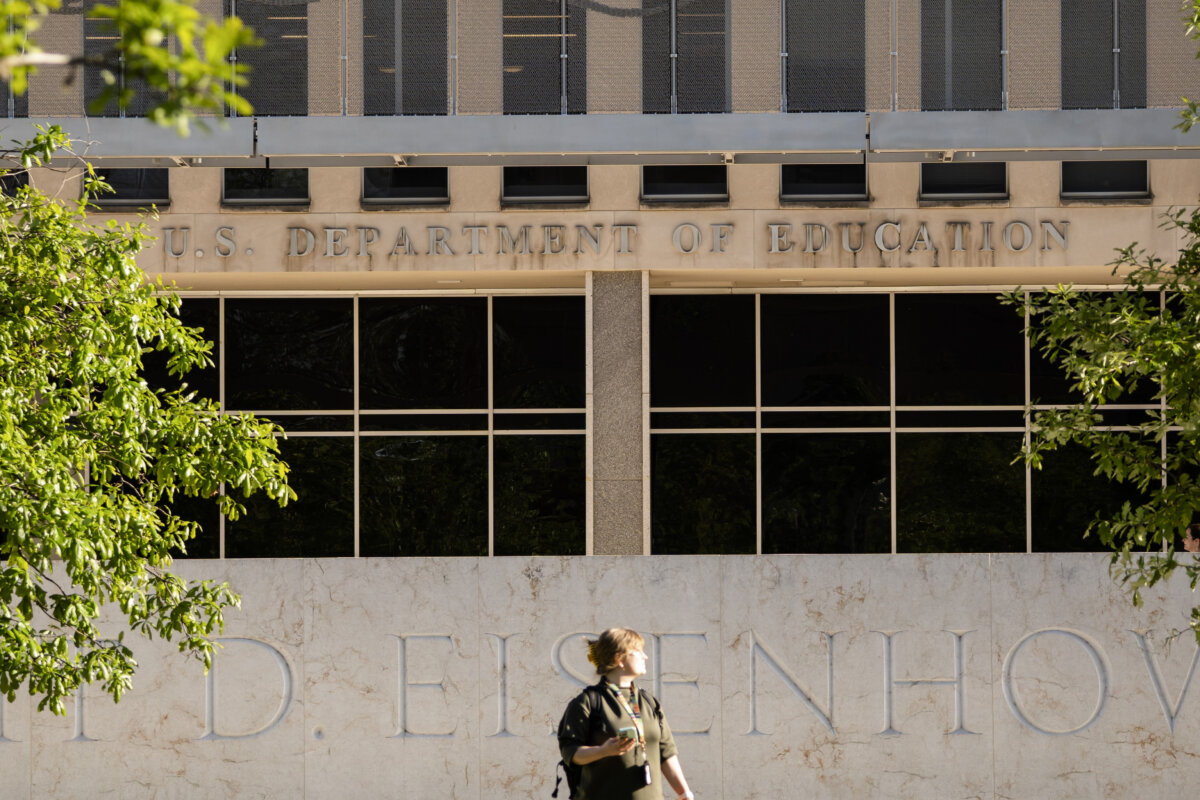

Most universities that were investigated over partnerships with a nonprofit organization accused of violating civil rights law have agreed to cut those ties, the U.S. Department of Education stated, as the Trump administration continues its push to remove diversity, equity, and inclusion (DEI) programming from higher education.
The department’s Office for Civil Rights announced in March 2025 that it would investigate 45 institutions over their partnerships with the PhD Project, a nonprofit that the government said offers academic support and networking opportunities to doctoral students but “limits eligibility based on the race of participants.”
Nearly a year later, the Office for Civil Rights said on Feb. 19 that all but 14 of the 45 universities under investigation have agreed to stop partnering with the organization.
According to the office, the 31 universities that reached agreements with the Office for Civil Rights had either already ended their relationship with the nonprofit or agreed to do so going forward. They also agreed to review their partnerships with other external organizations to ensure that those programs do not restrict participation based on race.
Negotiations are ongoing with the 14 additional schools, according to the Education Department.
“This is the Trump effect in action,” Education Secretary Linda McMahon said in a statement. “Institutions of higher education are agreeing to cut ties with discriminatory organizations, recommitting themselves to abiding by federal law, and restoring equality of opportunity on campuses across the nation.”
“We are hopeful that other institutions with similarly discriminatory practices will follow suit, paving the way for a future where we reject judging individuals by the color of their skin and once again embrace the principles of merit, excellence, and opportunity.”
Founded in 1994, the PhD Project hosts a conference every year to connect prospective business doctoral students from underrepresented backgrounds with academic networks. Its website says it has helped more than 1,500 people earn doctoral degrees.
The PhD Project came under criticism from DEI opponents and policymakers last year after Christopher Rufo, a senior fellow at the Manhattan Institute and a cultural critic, shared on X a notice about a 2024 conference saying that only those who “identify as Black/African American, LatinX/Hispanic American, or Native American/Canadian Indigenous” should apply.
The group has since stated that its programs are open to students of any race who are interested.
“Our vision is to create a broader talent pipeline of current and future business leaders who are committed to excellence and to each other, through networking, mentorship, and unique events,” it said in a statement to The Epoch Times. “The PhD Project was founded with the goal of providing more role models in the front of business classrooms and this remains our goal today.”
A day before announcing the PhD Project resolutions, the Education Department also settled a lawsuit by promising to end race-based criteria for the McNair Post-Baccalaureate Achievement Program, which is focused on supporting low-income, first-generation, and underrepresented students pursuing doctoral degrees.
The announcements involving McNair and the PhD Project came just weeks after the Education Department withdrew its appeal to the U.S. Court of Appeals for the Fourth Circuit in a lawsuit challenging the regulatory guidance that helped spur these investigations.
That guidance, issued in February 2025 in the form of a “Dear Colleague” letter, declared race-based scholarships, student support services, and other programming illegal under the principles implied by the U.S. Supreme Court’s 2023 ruling that banned public and private colleges from considering race in admissions.
By dropping the appeal, the department effectively accepted a lower-court ruling that found its guidance unconstitutional. The move, however, apparently does not mean that the administration has abandoned its goal of ending race-based programs at schools that take federal funding.
 Friends Read Free
Copy
Facebook
Tweet
Friends Read Free
Copy
Facebook
Tweet