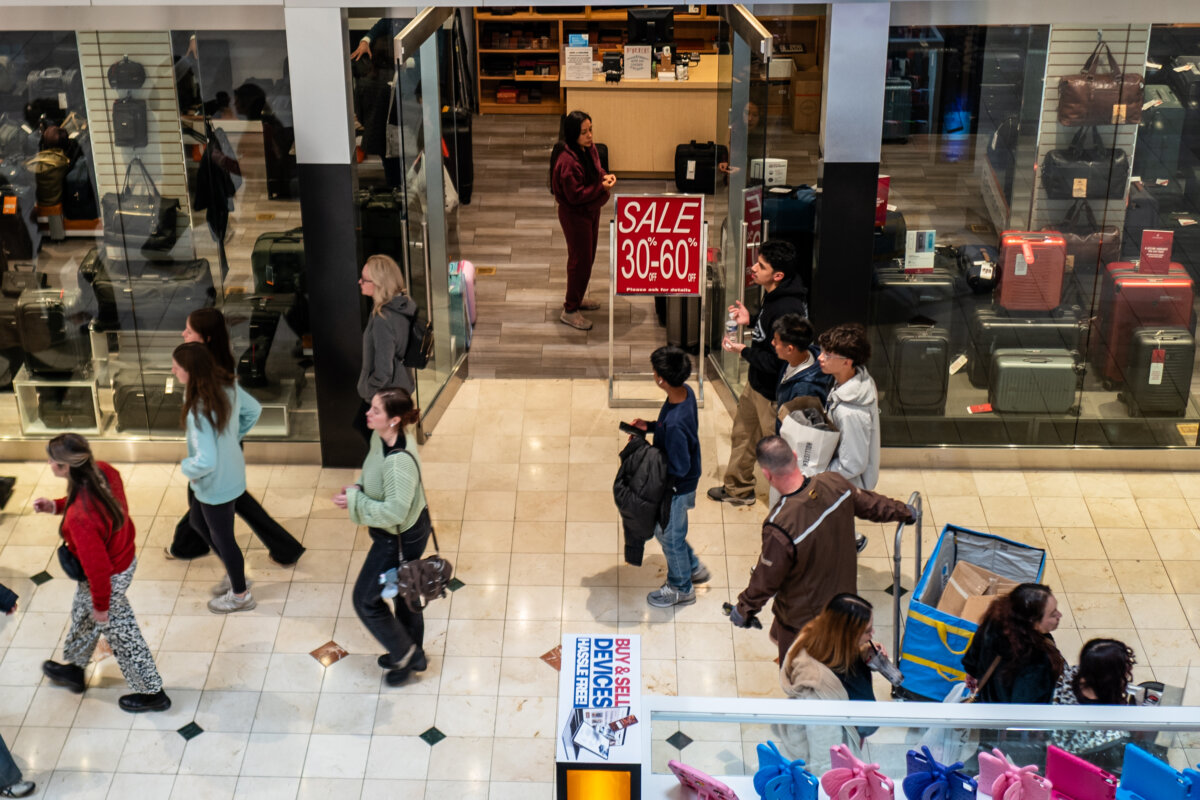

The consumer confidence index rose by 2.2 points in February from the previous month, driven by improved expectations regarding future economic conditions, think tank The Conference Board said in a Feb. 24 statement.
The index is calculated based on an online survey of Americans.
People younger than 35 remained the most optimistic age group, according to the board. For those aged 35 and older, confidence edged down. In terms of political affiliation, consumer confidence among Republican and independent supporters revived in February after a dip in the prior month. Democrats were identified as less optimistic.
The survey found that people were pessimistic about current economic conditions but more optimistic about expectations over the coming six months.
“The Present Situation Index—based on consumers’ assessment of current business and labor market conditions—decreased by 1.8 points to 120.0 in February,” the board stated.
“[In contrast,] the Expectations Index—based on consumers’ short-term outlook for income, business, and labor market conditions—rose by 4.8 points to 72.0.”
Improvements in labor conditions were already evident in January, according to recent data from the Bureau of Labor Statistics (BLS).
The U.S. economy added 130,000 new jobs for the month, far higher than the 70,000 new job additions anticipated by economists. The unemployment rate dipped to 4.3 percent in January from December 2025’s 4.4 percent, according to the agency.
The average hourly earnings of workers rose at a higher-than-expected pace of 0.4 percent in January, according to BLS data.
According to The Conference Board, consumers expect interest rates to remain higher over the next 12 months, with many predicting that stock prices will rise during this period.
As for buying various big-ticket items over the next six months, customer sentiment rose in February.
“Those who said ‘yes’ and ‘maybe’ to buying big-ticket items ahead increased, while the number of those saying ‘no’ declined,” the board stated.
“Used cars, furniture, TVs, and smartphones remained the most popular items within their categories for future purchases.”
Among services, anticipated spending on utilities, pet care, and gambling over the next six months saw an increase. In contrast, anticipated spending in most other service categories either declined or remained unchanged.
The Conference Board’s consumer sentiment numbers come as retail sales had unexpectedly stalled during the December 2025 shopping season, according to Census Bureau data published on Feb. 10.
Retail sales in December 2025 showed virtually no growth from November 2025, despite holiday buying—falling short of the consensus estimate of 0.4 percent growth. November 2025 saw a 0.6 percent jump in sales, the best monthly gain since July.
A Jan. 9 report from the Bank of America Institute stated that the three-month average card spending among lower-income households rose by just 0.4 percent year-over-year in December 2025, while the same metric jumped by 2.4 percent among higher-income households.
“With cost-of-living issues still looming, in our view, it’s likely that consumers were able to stretch their dollars and shop smart by looking for deals. Lower-income households, in particular, made more frequent and smaller purchases in order to make the holiday season bright,” the report reads.
Improving Affordability
During his Feb. 24 State of the Union address, President Donald Trump highlighted the administration’s recent efforts to improve Americans’ cost-of-living conditions.
Trump said his administration has secured agreements with tech companies, including a “ratepayer protection pledge,” under which these companies agree to pay more for electricity used to power data centers, thereby reducing the impact on utility consumers’ bills.
“We’re telling the major tech companies that they have the obligation to provide for their own power needs,” he said.
“They can build their own power plants as part of their factory, so that no one’s prices will go up and, in many cases, prices of electricity will go down for the community, and very substantially down.”
Trump called on Congress to pass legislation to ban Wall Street investment companies from buying up thousands of single-family homes to ensure affordability in the housing market.
The president also referenced initiatives to cut the cost of prescription drugs. Earlier this month, Trump announced the launch of the TrumpRx.gov website, which features medicines at discount prices.
For instance, the website currently offers the Bevespi Aerosphere inhaler for $51, down from the original price of more than $458. Ozempic pens, used for obesity management, are being sold for $199, far below the original price of more than $1,027.
 Friends Read Free
Copy
Facebook
Tweet
Friends Read Free
Copy
Facebook
Tweet