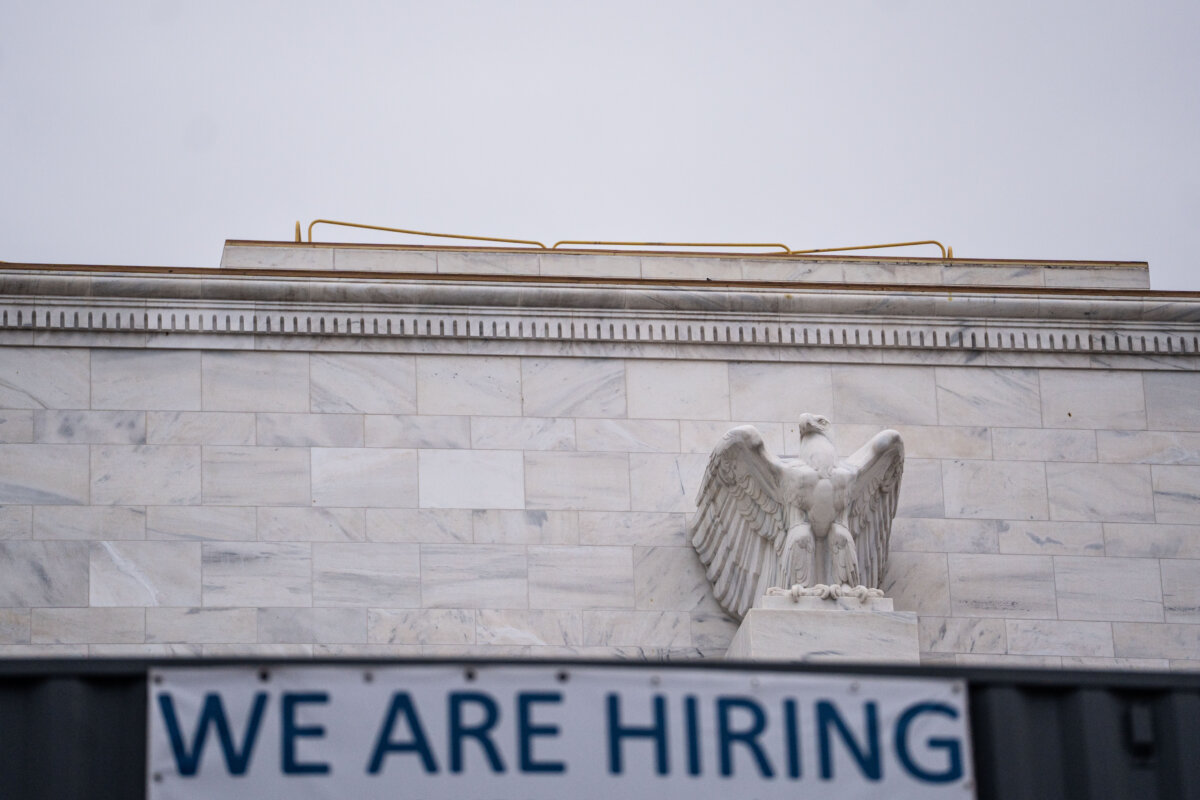

The U.S. economy created 130,000 new jobs in January, suggesting employment conditions could be improving following months of a sluggish labor market.
Economists had anticipated 70,000 new jobs.
The unemployment rate also slipped to 4.3 percent from 4.4 percent in December 2025—lower than the consensus forecast—according to data from the Bureau of Labor Statistics (BLS) released on Feb. 11.
The U.S. labor market could be turning a corner, as hiring momentum accelerated at the start of the year.
In January, the economy added 130,000 jobs, up from the previous month’s downwardly adjusted 48,000.
The consensus estimate suggested the country had created 70,000 positions to kick off 2026.
The unemployment rate fell to 4.3 percent, from 4.4 percent in December, the bureau reported.
This also came in below the market forecast of 4.4 percent.
Health care was the top industry for job creation, adding 82,000 roles last month. Social assistance payrolls also increased by 42,000. Both industries have accounted for a sizable share of payroll growth over the past year, and experts have attributed their growth to an aging population.
Construction added 33,000 jobs, a strong start for a sector in which there was little employment growth last year.
Federal government employment fell by 34,000, “as some federal employees who accepted a deferred resignation offer in 2025 came off federal payrolls,” the bureau said.
Federal payrolls are down by 327,000 since reaching a peak in October 2024.
As a result, the private sector created 172,000 new jobs, far higher than the 70,000 forecast.
Officials confirmed that the severe winter storms had little effect on the collection of the household and establishment survey.
Average hourly earnings surged at a higher-than-expected pace of 0.4 percent in January, up from the downwardly revised 0.1 percent in December. On a 12-month basis, average hourly earnings were unchanged at 3.7 percent, also higher than forecasts.
Average weekly hours ticked up to 34.3, while the labor force participation rate rose to 62.5 percent.
Full-time employment rocketed by 582,000, while part-time employment was little changed.
The number of people working two or more jobs fell by 285,000, to 8.769 million.
The nonfarm payrolls report was welcome news for the administration as a tranche of new government and private-sector data indicates that the U.S. labor market has struggled to maintain momentum.
Private payrolls increased by 22,000 in January, down from the previous month’s downwardly revised 37,000, according to payroll processor ADP. This came in below the consensus forecast of 48,000.
Layoffs accelerated at the start of 2026, as planned job cuts increased by 108,435—the highest January tally since 2009—according to a report from global outplacement firm Challenger, Gray and Christmas.
Demand for labor softened as job openings declined to 6.542 million.
The number of Americans filing applications for unemployment benefits rose by 22,000 to 231,000 at the end of January, driven by weather-related business disruptions.
“Slower hiring (not artificial intelligence) has disrupted the labor market, with the burden falling on younger people,” Paul Donovan, chief economist at UBS, said in a Feb. 11 note. “That has implications for economic patterns (slower fast food sales, higher student loan delinquencies) without being a major overall economic impact to date.”
Consumers were hesitant to spend in December, as retail sales stalled during the holiday shopping season.
Market Reaction
Wall Street celebrated the January jobs report, as U.S. stocks were firmly in the green.
The U.S. dollar index, a measure of the greenback against a weighted basket of currencies, registered modest gains. Yields on U.S. Treasury securities were green across the board, and the benchmark 10-year rose by more than 5 basis points, to about 4.2 percent.
“If the recent jitters in the stock market are due to concerns of a weakening labor market and/or economy that is headed toward a recession, this report should alleviate those concerns in the short run,” Northlight Asset Management Chief Investment Officer Chris Zaccarelli said in a note emailed to The Epoch Times.
“Until we see significant weakness in the labor market, the economy or corporate profits, we believe this is still a market where dips can be bought.”
The White House had tempered expectations a day earlier, warning of slower job growth due to lower population growth and higher productivity.
“So I think that you should expect slightly smaller job numbers that are consistent with high GDP growth right now,” National Economic Council Director Kevin Hassett told CNBC’s “Squawk Box.”
“And that one shouldn’t panic if you see a sequence of numbers that are lower than you’re used to, because, again, population growth is going down and productivity growth is skyrocketing. It’s an unusual set of circumstances.”
Annual Revisions Official
Employment growth was overstated by 898,000 in the 12 months preceding March 2025.
The preliminary revision, released in September 2025, suggested job creation was 911,000 more than initially estimated.
The annual benchmark revisions draw on the more comprehensive data provided by the Quarterly Census of Employment and Wages. Using this information allows bureau officials to correct inaccuracies, address biases, and incorporate detailed records from about 11 million businesses. By comparison, the Bureau of Labor Statistics’ monthly survey data cover approximately 121,000 employers, and each company is given three opportunities to submit data.
Economic observers had widely anticipated the overcount.
Federal Reserve Chair Jerome Powell, speaking to reporters at the post-meeting press conference in December, noted that job growth would be substantially adjusted downward, calling it a “systematic overcount.”
This is not the first time the bureau has overstated payroll growth. The final annual benchmark figure for April 2024 to March 2025 was negative 589,000.
Officials have said they may be able to reduce the discrepancies by adjusting the birth-death model.
The birth-death model estimates employment job gains from new businesses and losses from closures. Instead of relying on assumptions, the bureau will now incorporate real‑time information from the establishment survey.
 Friends Read Free
Copy
Facebook
Tweet
Friends Read Free
Copy
Facebook
Tweet