
The U.S. military has redirected 65 commercial vessels and disabled four ships while enforcing the naval blockade on the Iranian regime, according to U.S. Central Command (CENTCOM).
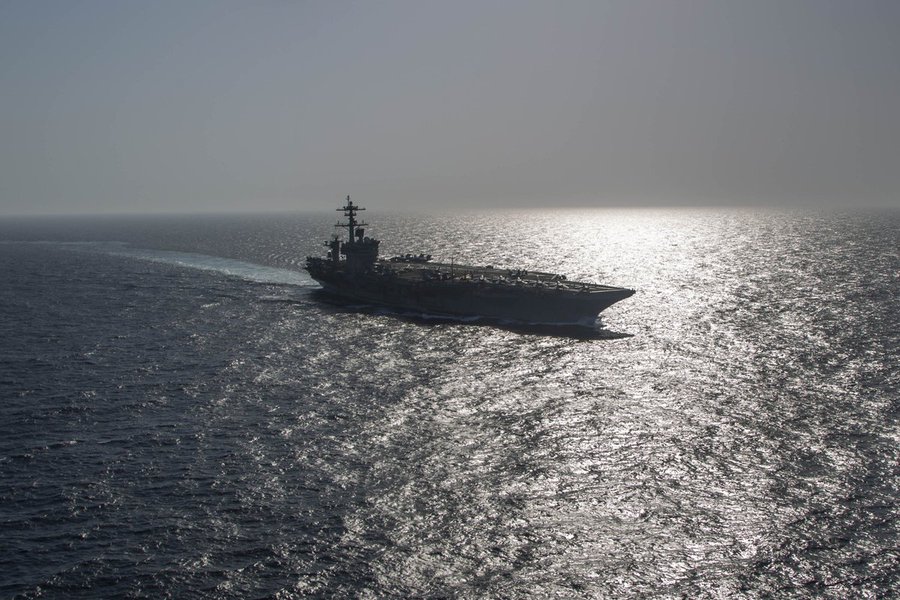
“USS Abraham Lincoln (CVN 72) continues operations in the Arabian Sea, including enforcement of the U.S. blockade against Iran,” CENTCOM said in a May 12 post on X.
On April 13, the United States imposed a blockade on vessels entering or exiting Iranian ports after the first round of peace talks between the two nations ended in failure. In a May 8 post on X, CENTCOM said that the blockade, which remains “fully in effect,” has seen enforcement actions across the Middle East and beyond. The United States has deployed more than 15,000 troops, more than 200 aircraft, and 20-plus warships to execute the mission.
CENTCOM said in a May 8 statement that USS George H.W. Bush disabled two Iranian tankers that were attempting to enter one of Iran’s ports located on the Gulf of Oman. The two vessels were disabled after U.S. forces fired munitions into the ships’ smokestacks.
Earlier, on May 6, USS Abraham Lincoln blockaded another Iranian vessel after firing multiple rounds from a 20 mm cannon gun that disabled the tanker’s rudder.
“U.S. forces in the Middle East remain committed to full enforcement of the blockade of vessels entering or leaving Iran,” said CENTCOM Commander Adm. Brad Cooper. “Our highly trained men and women in uniform are doing incredible work.”
The blockade is aimed at putting economic pressure on Iran.
The naval blockade cuts off the country’s ability to ship around $139 million in crude oil daily, depriving Tehran of critical oil revenues, according to an April 13 post by the Foundation for Defense of Democracies. The export of petrochemicals, minerals, and metals is also affected.
On the import side, the blockade cuts off Iran’s ability to import food, machinery, and other goods, putting inflationary pressure on the country’s economy.
Meanwhile, crude oil prices continue to remain elevated amid the conflict. The conflict has disrupted trade across the critical Strait of Hormuz, a waterway south of Iran that accounts for more than a fifth of global seaborne oil trade.
On Feb. 27, a day before the conflict began, Brent crude oil futures closed the day at around $72 per barrel. On May 13, oil was trading at $107.90 as of 6:30 a.m. ET.
Tensions between Washington and Tehran flared up on May 10 after President Donald Trump rejected Iran’s response to a peace proposal that was pitched by the United States.
In a May 11 post, ING Bank said that oil prices “remain highly sensitive to noise around Iran, highlighting the significance of the ongoing supply disruptions in the Persian Gulf.”
“While optimism for an imminent deal is fading, there remains a glimmer of hope that talks between Trump and Chinese President Xi later this week could yield positive results on Iran. The hope is that China can use its influence over Iran to push it closer towards a peace deal. Clearly, this is easier said than done,” the post reads.
Trump’s May 13 to 15 trip to China is expected to include talks about the Iran war. This is the first time a sitting U.S. president has visited China since 2017, when Trump went to the country during his first term.
Speaking to reporters outside the White House before departing for China, Trump said that while he will have a “long talk” with Chinese leader Xi Jinping about the Iran war, he does not see an absolute need for Beijing’s assistance to resolve the conflict.
“I don’t think we need any help with Iran. We’ll win it one way or the other. We’ll win it peacefully or otherwise,” Trump said.
Domestically, the national average price of regular gasoline was $4.51 per gallon on May 13, up from $4.12 a month back, according to data from the American Automobile Association. In six states—Illinois, Nevada, Alaska, Oregon, Hawaii, and Washington—prices exceeded $5 per gallon. Prices exceeded $6 per gallon in California.
On May 11, the Department of Energy (DOE) announced loaning out 53 million barrels of oil from the Strategic Petroleum Reserve to petroleum companies to ease the elevated oil prices.
According to the DOE, this is part of the 172 million-barrel release commitment made in March, aimed at stabilizing global oil supplies.
“Deliveries will begin immediately as the Department continues to move swiftly to address short-term supply disruptions and strengthen U.S. energy security,” the agency said.
 Friends Read Free
Copy
Facebook
Tweet
Friends Read Free
Copy
Facebook
Tweet