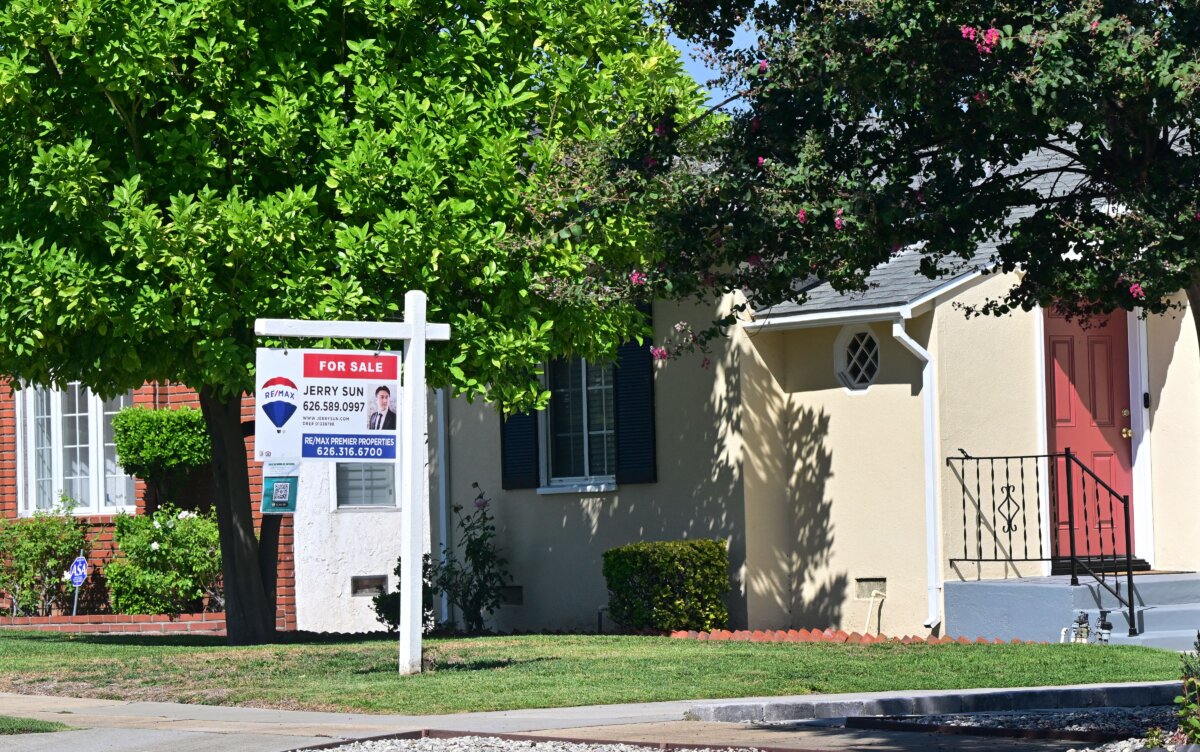

Homebuying demand across the United States is declining, with pending home sales falling to the lowest level since early April for the four weeks ending July 26.
Pending home sales refer to signed sales contracts that have not yet closed and are often seen as an indicator of future existing home sales. A lower figure suggests a cooling housing market, with diminished future closed home sales.
For the week ending July 26, pending home sales declined by 1.7 percent from the week ending July 19, real estate brokerage Redfin said in a July 30 report.
While tours of home listings are up 15 percent since the beginning of the year, this is lower than the 31 percent gain seen during the same period last year, the report said.
Redfin attributed the declining homebuying demand partly to rising mortgage rates, with the daily average rate hitting a peak of 6.85 percent last week, the highest level in more than a year.
Moreover, concerns about inflation and volatile oil prices, triggered by geopolitical tensions, are contributing to higher rates.
Since the U.S.–Iran war broke out in late February, the 12-month inflation rate jumped from 2.4 percent that month to 3.5 percent in June, hitting a peak of 4.2 percent in May.
Brent crude oil futures prices have also moved higher. Recently, President Donald Trump warned Iran that it would be hit very hard, with Tehran threatening that it would target countries helping Washington in the war.
While the labor market remains strong, with the U.S. economy adding more jobs than expected in June, the combination of higher mortgage rates and economic uncertainty is keeping many prospective home buyers on the sidelines, Redfin said.
The average weekly rate on a 30-year fixed-rate mortgage was 6.66 percent for the week ending July 29, which is the highest level since July 2025, according to data from Freddie Mac.
Despite the elevated mortgage rates, housing payments have eased, Redfin said in its statement. The median monthly housing payment for the four weeks ending July 26 was $2,575, which is the lowest level in three months.
There are currently hundreds of thousands more sellers in the housing market than buyers, giving house hunters negotiating power in many parts of the country.
“Rates are higher now, but bidding wars are unlikely, and buyers are often able to negotiate prices down and get concessions from sellers,” Bonnie Phillips, a Redfin Premier agent in Cleveland, said in the statement.
“Today’s housing market rewards patience over panic: If you can afford to buy, focus on finding a home you love and negotiating a good deal rather than trying to perfectly time mortgage rates.”
Home Building Situation
Builders have also been negatively impacted by housing market conditions. In the first half of 2026, builders sold fewer homes than in any similar period since 2017, according to a July 24 report from real estate marketplace Zillow.
Orphe Divounguy, senior economist at Zillow, said there has been a growing glut of homes under construction and those that have completed construction, making it harder to justify new projects financially.
Builders are now leaning toward providing more costly incentives while input costs keep rising. As a consequence, more builders are opting to sit out of the current market.
In a July 24 statement, the National Association of Home Builders (NAHB) said that affordability concerns continued to weigh down on the new home market last month.
The pace of new home sales fell 5.6 percent in June from a year ago. NAHB chairman Bill Owens attributed the recent decline in new home sales to elevated mortgage rates.
In June, 62 percent of builders offered some sort of incentives to buyers to secure sales, Owens said.
NAHB chief economist Robert Dietz said that new home sales are “gaining some momentum at the more affordable range of the market, with homes priced below $300,000 accounting for 23 percent of June sales, up from 16 percent a year earlier.”
“However, that price point is generally only achievable in markets with lower development and construction costs,” Dietz said.
 Friends Read Free
Copy
Facebook
Tweet
Friends Read Free
Copy
Facebook
Tweet