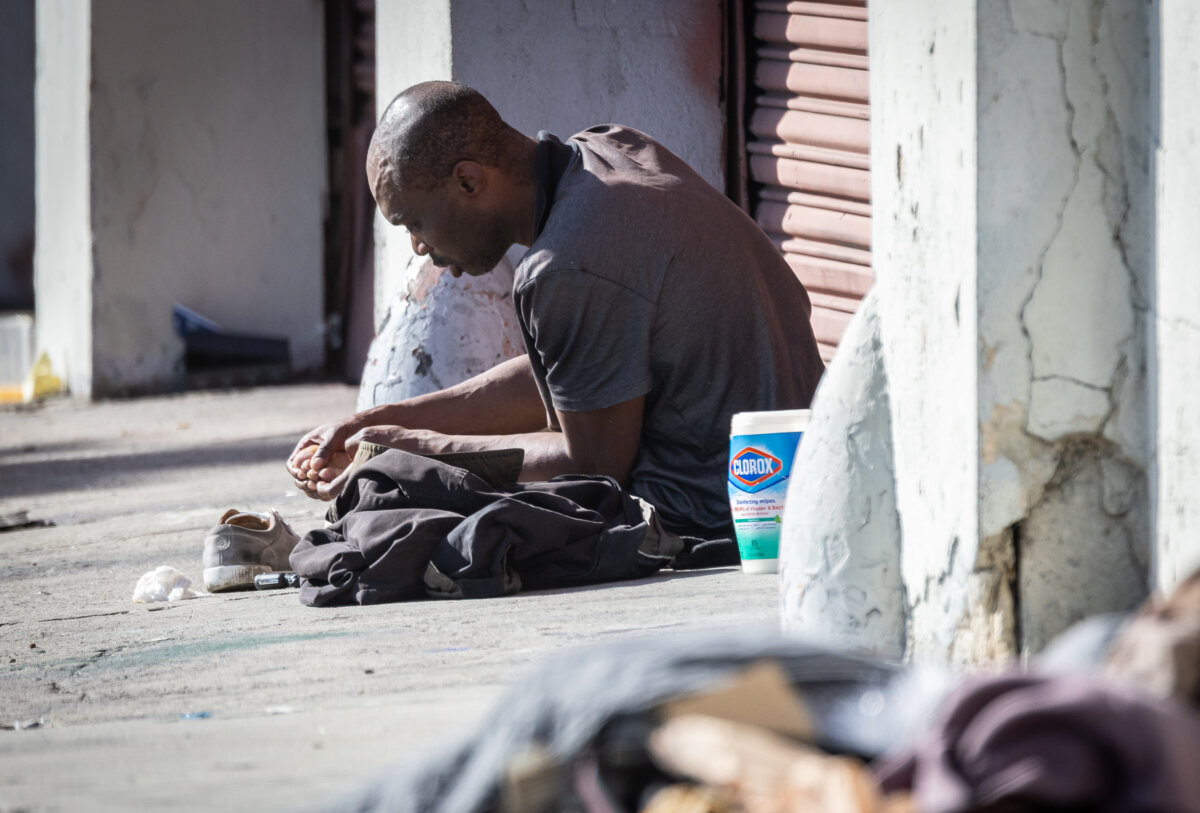

The Department of Housing and Urban Development (HUD) is inviting applications for a $4.04 billion funding program aimed at tackling homelessness, overhauling the program by ditching “Housing First” policies, and tying future funding to performance.
Earlier homeless assistance programs focused on Housing First policies, under which the priority was to grant homeless people immediate access to permanent housing without any preconditions. However, this was largely unsuccessful, according to HUD.
Chronic homelessness rose by 81 percent despite taxpayer-funded beds jumping by 151 percent between 2013, when Housing First policy changes began within HUD’s homelessness programs, and 2025, the department said last month.
The latest $4.04 billion Notice of Funding Opportunity (NOFO), issued for the Continuum of Care (CoC) homelessness assistance program for fiscal year 2026, shifts away from Housing First policies and focuses on ensuring that those receiving housing assistance take part in drug treatment programs, HUD said in a June 1 statement.
Regarding funding applications, HUD said it will support organizations that facilitate drug “treatment and recovery.”
“HUD is making resources available for housing assistance paired with wraparound services to advance recovery and self-sufficiency for homeless Americans. This includes a $1.3 billion investment in new projects, with a priority for Transitional Housing and Supportive Service projects.”
Transitional housing provides temporary housing to individuals and families, along with supportive services, aimed at ensuring these people successfully move to permanent housing. Supportive services can include employment assistance, life skills training, substance abuse treatment services, and education services.
The CoC program aims to end homelessness and provides funding to states, local governments, and nonprofits to rehouse homeless individuals, families, and youth, as well as people fleeing dating violence, domestic violence, stalking, and sexual assault.
More than 1.4 million individuals were either homeless or living in taxpayer-funded housing for the homeless across the country, according to a 2025 HUD report.
In its latest statement, the department said that $4.04 billion is “record level” funding being made available for CoC, and that the new NOFO is the “most competitive funding opportunity” in the history of the program.
The Housing First approach “failed Americans by warehousing the vulnerable without results,” HUD Secretary Scott Turner said.
“This ideology promised to end homelessness. Instead, billions of taxpayer dollars were spent while homelessness increased to record levels. Housing alone will not solve a crisis driven by addiction and mental illness. Under President Trump’s leadership, HUD is making necessary reforms to put recovery first,” Turner said.
Trump’s Order
HUD’s new CoC funding opportunity follows a July 24 executive order signed by President Donald Trump—Ending Crime and Disorder on America’s Streets.
The Trump administration assesses that chronic homelessness is often driven by addiction and mental illnesses. The issue has led to safety concerns in many cities, with the order asking local governments to redirect homeless people toward “long-term institutional settings for humane treatment through the appropriate use of civil commitment.”
The order instructed the HUD secretary to take “appropriate actions” to ensure accountability in grants related to homelessness assistance and transitional living programs, including by ending support for Housing First policies, which “deprioritize accountability and fail to promote treatment, recovery, and self-sufficiency.”
At the time, the National Homelessness Law Center criticized the order, saying that it “deprives people of their basic rights and makes it harder to solve homelessness.”
The administration’s policies “will increase the number of people forced to live in tents, in their cars, and on the streets. This order does nothing to lower the cost of housing or help people make ends meet,” the group said.
In an April 30 statement announcing the June 1 CoC NOFO, the Housing Department said that the number of people living on the streets remained at “crisis levels.”
“HUD is committed to reforming its homelessness programs,” the department said, adding that Housing First policies have “failed at great cost to those suffering on our streets and to working American taxpayers.”
“HUD intends to rebalance the CoC program to focus on a diversity of solutions and treating the underlying causes of homelessness. HUD is thus increasing its investment in Transitional Housing, supportive services, and Supportive Service Only (SSO) projects such as street outreach, childcare, outpatient addiction treatment, and job training.”
 Friends Read Free
Copy
Facebook
Tweet
Friends Read Free
Copy
Facebook
Tweet