
Representatives of NASA and Russia’s space agency Roscosmos met on Thursday in a rare meeting and committed to continuing cooperation in endeavors such as the International Space Station (ISS).
The meeting was held between NASA’s acting administrator Sean Duffy and Roscosmos chief Dmitry Bakanov at the Kennedy Space Center in Florida. This was the first time since 2018 that the heads of the two space agencies have met in person.
The two parties “discussed further work on the ISS, cooperation on lunar programs, joint exploration of deep space, [and] continued interaction on other space projects,” Roscosmos said.
NASA said on Thursday that the two chiefs “discuss continued cooperation and collaboration in space.” It did not provide further details.
Bakanov said the space agencies were not willing to abandon the level of cooperation achieved since the Apollo-Soyuz mission in 1975, according to an Aug. 1 post by TASS, the Russian state-backed news agency.
“In fact, the Soyuz-Apollo mission was the starting point. Today, the International Space Station is a successor to that project. We have been successfully working together. You know about the Russian and US segments of the ISS, and seat-swap flights. We have things to build upon. We would in no way want to discard [this legacy],” Bakanov said.
Duffy said he understands that shared projects cannot be halted. Political decisions on the matter will be made later on, he added.
Both space agency heads agreed to continue using the ISS until 2028, Bakanov said, adding that the agencies will work together on the deorbiting process of the space station until 2030, according to a July 31 TASS post.
NASA and SpaceX had announced plans to retire the ISS in July last year. SpaceX is scheduled to direct the ISS into a controlled reentry into Earth by 2030 using a variant of its Dragon Cargo spacecraft.
Regarding the meeting, Bakanov said that “direct contact with the heads of Roscosmos and NASA was vital.”
“Sean Duffy helped us get the opportunity to come here for the joint launch of our mission, in which cosmonaut Oleg Platonov will head to the International Space Station with American astronauts,” he said.
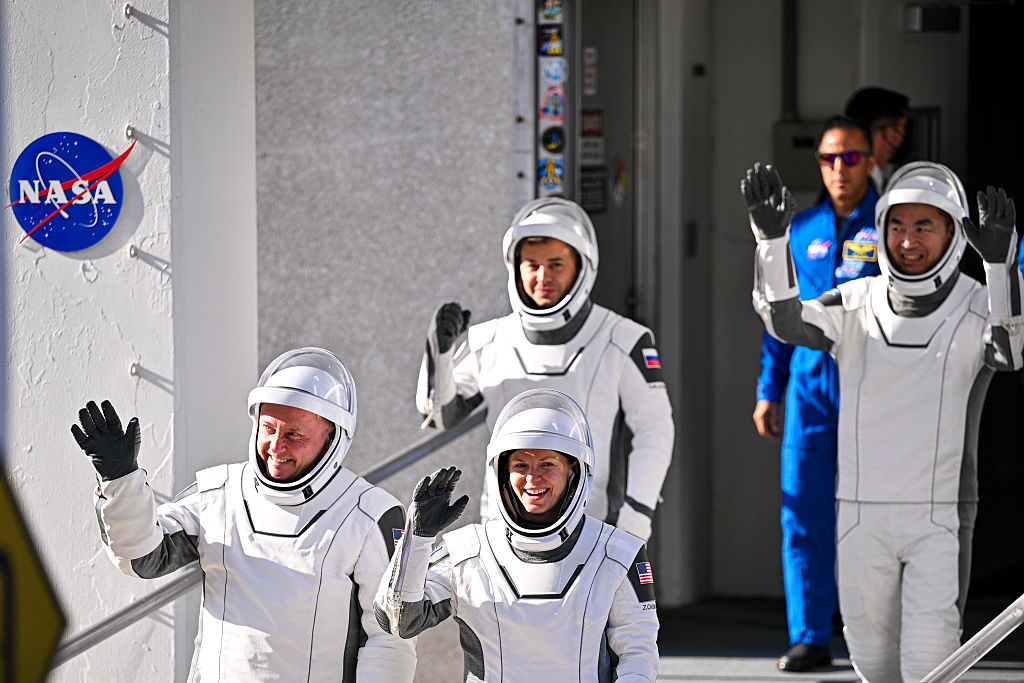
The meeting coincided with the scheduled launch of four astronauts to the ISS on Thursday aboard a SpaceX Falcon 9 rocket and the Crew Dragon spacecraft, Endeavour.
The team comprised two Americans, a Russian, and a Japanese. The launch, however, had to be scrubbed just 67 seconds prior to lift-off due to the weather.
The mission was rescheduled to Friday. In an Aug. 1 post on X, SpaceX confirmed that the launch was successful, posting a video of the liftoff.
The meeting of American and Russian space agency heads, and talks about cooperation, comes as U.S. officials raise concerns about the threat posed by Moscow in the space domain.
During a May 15 security summit, Space Force Chief of Space Operations Gen. B. Chance Saltzman warned that America’s adversaries, Russia and the People’s Republic of China (PRC), were militarizing space.
Russia and China have capabilities such as “grabbing satellites, pulling them out of operational orbit … certainly missile technology and anti-satellite kinetic capabilities—it could also extend there,” he said.
Months prior to invading Ukraine, Russia “demonstrated a kinetic kill capability: an anti-satellite missile destroyed a satellite,” he said. “This is 14 years after the PRC demonstrated the same thing.”
Saltzman suggested that Russia was looking to deploy nuclear weapons in space, which he warned would not end well for the world.
“This idea of putting a nuclear weapon into orbit. The Russians are demonstrating reckless, aggressive behaviors with regard to how they intend to contest the space domain that will have far-reaching impacts beyond any localized military effect,” said Saltzman.
The Space Force was established as a result of a directive signed by President Donald Trump in February 2019, during his first term.
During a Jan. 13 speech at the Center for Strategic and International Studies, former Secretary of the Air Force Frank Kendall had suggested that the Space Force would be a key factor in mitigating future threats posed by Russia and China.
Reuters contributed to this report.
 Friends Read Free
Copy
Facebook
Tweet
Friends Read Free
Copy
Facebook
Tweet