
Senators are pushing this week for bipartisan legislation that would ban Chinese vehicles from the U.S. market, as President Donald Trump meets with Chinese leader Xi Jinping in Washington.
The effort is led by Sens. Elissa Slotkin (D-Mich.) and Bernie Moreno (R-Ohio), who are aiming to win unanimous Senate approval for it this week.
“Whether you are a Democrat or Republican, no one wants Chinese cars in America,” Slotkin said at a Capitol Hill press conference on Wednesday.
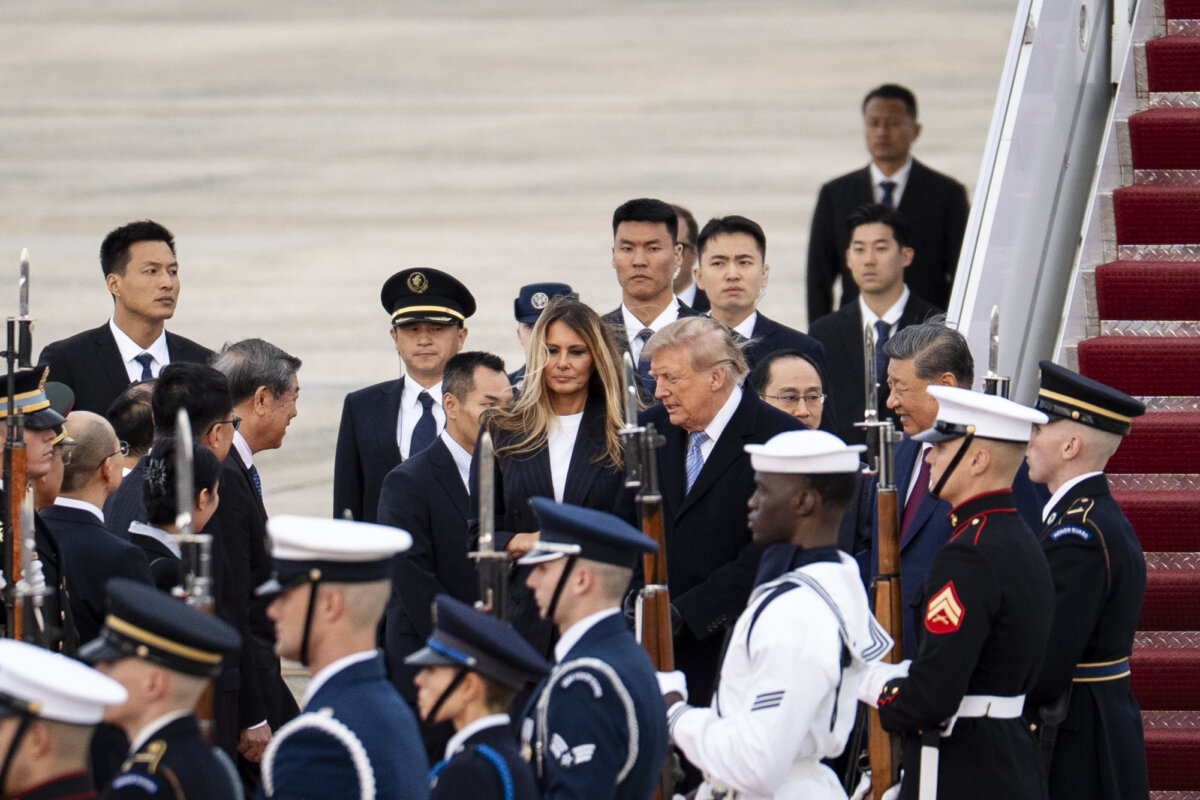
Trump is meeting with Xi in Washington this week to address a wide range of trade issues.
Moreno and Slotkin introduced the Connected Vehicle Security Act to the Senate on April 29. A companion House bill from Reps. John Moolenaar (R-Mich.) and Debbie Dingell (D-Mich.) followed on May 11.
As of Sept. 24, the House Bill has 110 sponsors split between Democrats and Republicans.
The bills aim to prohibit the import, sale, and operation of vehicles manufactured in China (or any other country of concern) and ban the use of Chinese-developed connected vehicle technologies, such as software and data systems, on American roads.
“Chinese cars are a serious threat to America’s national security and Michigan’s economic security,” Slotkin said in an April 29 statement.
She said that Chinese cars are “surveillance packages on wheels, with the ability to collect on American citizens and sensitive sites.”
“The Chinese Communist Party’s playbook of heavily subsidizing their product, underselling the competition, and then having a monopoly over that sector puts Michigan’s auto industry and our millions of workers at risk,” she added.
U.S. automakers Ford, Honda, and Stellantis have publicly supported the bill.
“Modern vehicles are rolling computers, and when their software or hardware is subject to Beijing’s control or influence, they pose unacceptable risks, from data collection to potential remote interference,” Scott Paul, president of the Alliance for American Manufacturing, said in a May 29 statement.
The Biden administration in early 2025 prohibited the sale and import of connected vehicle hardware and software systems, as well as completed connected vehicles, from China and Russia.
“If China wanted to come in and open a plant to build their cars here, I’d be OK with that,” Trump said in a Sept. 11 interview on Fox News program “The Ingraham Angle.”
“Japan does it, but they hire our people.
“The big thing is they hire our people. They use our people. What I don’t want is them to build in Mexico … build it inexpensively and ship it across the border.”
He said that Chinese vehicles are destroying the European car market.
“If you go to Europe, you look at what’s going on. It’s like an avalanche of Chinese cars,” Trump said.
Senate Minority Leader Chuck Schumer (D-N.Y.) and Slotkin also called for blocking Chinese access to advanced U.S. artificial intelligence (AI) chips and chip-making equipment.
“President Trump must draw a hard line,” Schumer said in a statement on Wednesday.
“Do not weaken America’s export controls. Do not give China greater access to the advanced chips and chip-making equipment it needs to close the gap with the United States.”
Schumer said the sales could weaken the U.S. lead in AI and called for Senate action on three bipartisan bills to tighten export controls.
Schumer said Trump is giving away the United States’ greatest advantage in the AI race by “greenlighting the sale of advanced AI chips to China.”
Slotkin said allowing Chinese companies to come into the United States and manufacture and sell Chinese cars would devastate the country’s manufacturing.
“It is the beginning of the end of auto manufacturing in the United States, and therefore, the end of our manufacturing base,” Slotkin said.
She added that Democrats wouldn’t allow that to happen.
Tom Gantert and Reuters contributed to this report.
 Friends Read Free
Copy
Facebook
Tweet
Friends Read Free
Copy
Facebook
Tweet