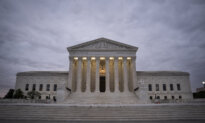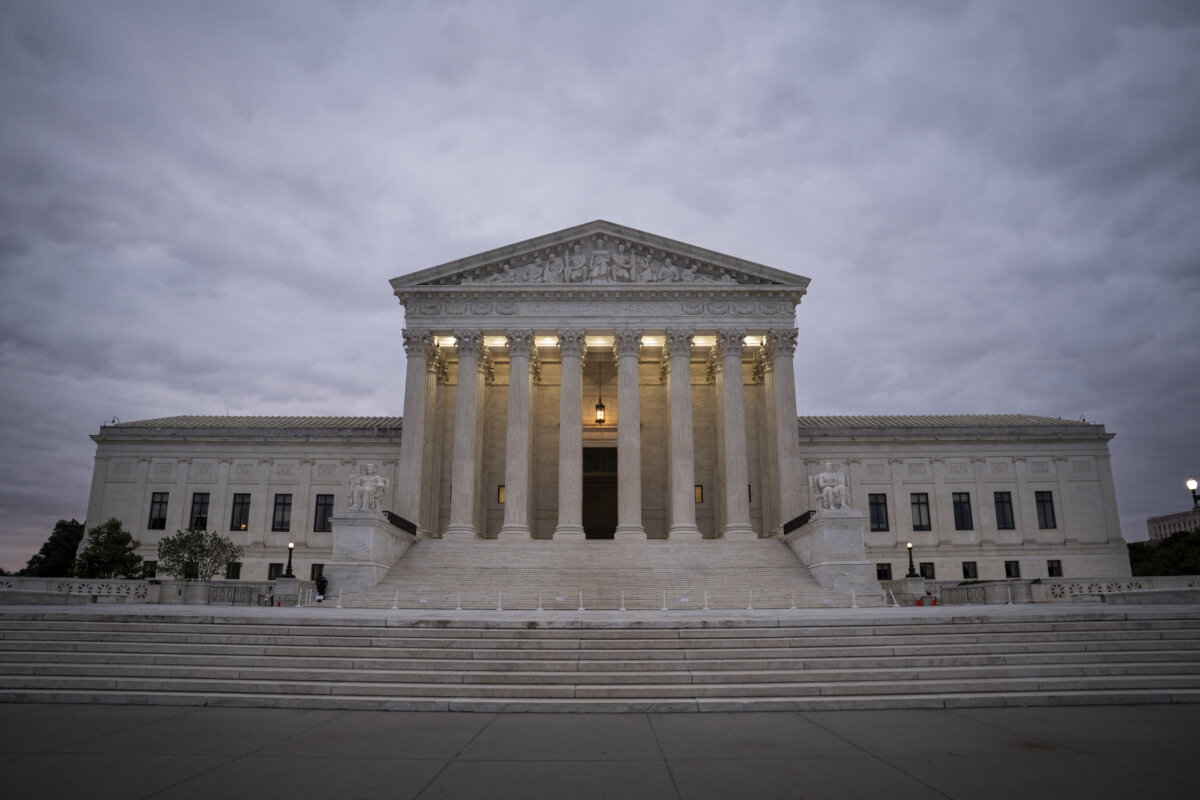

The U.S. Supreme Court has decided not to overturn a lower court ruling that barred Alabama from using nitrogen gas to carry out the execution of a death row inmate who was convicted in 1998 for killing two people during a robbery.
The high court on Thursday evening voted to decline the state’s petition and did not provide an explanation for its decision. Justices Clarence Thomas, Samuel Alito, and Neil Gorsuch indicated they would grant Alabama’s request to lift an injunction on the execution method but did not issue a written dissent.
Jeffery Lee was convicted of capital murder in the murders of two people, Jimmy Ellis and Elaine Thompson, as he robbed a pawn shop in Orville, Alabama, in 1998. A trial court later said he should be sentenced to death.
Responding to the high court’s decision, Alabama Attorney General Steve Marshall said that it is tantamount to a “miscarriage of justice, not for us, but for Jimmy Ellis and Elaine Thompson, who Jeffery Lee brutally and senselessly murdered and left on the floor of their place of business.”
“Tonight I am also keeping their families in mind, many of whom were prepared to witness the final act of justice be served,” he added.
Marshall, a Republican, said that his office will “never stop seeking justice” for the families of Lee’s victims, adding that Alabama will move in a manner to make sure Lee’s “lawful sentence is carried out.” He did not elaborate.
In the lower court ruling, U.S. District Judge Emily C. Marks issued the decision permanently enjoining the state from executing Lee by nitrogen gas. Lee was scheduled to be executed on Thursday at an Alabama prison.
“Lee has shown by a preponderance of the evidence that the protocol constitutes cruel and unusual punishment in violation of the Eighth Amendment,” Marks said in her opinion.
Previously, the Supreme Court has allowed executions involving nitrogen hypoxia to move forward. In October 2025, the high court blocked a request from Alabama death row inmate Anthony Boyd to stop his execution via nitrogen gas, allowing the execution to proceed.
Justices Elena Kagan, Sonia Sotomayor, and Ketanji Brown Jackson issued a dissent, with Sotomayor suggesting the execution method is inhumane because it kills via suffocation.
“Your mind knows that the gas will kill you,” Sotomayor wrote. “But your body keeps telling you to breathe.”
But in a separate case involving another death row inmate, Kenneth Eugene Smith, Marshall’s office wrote in an appeal to the Supreme Court that death via nitrogen gas, or nitrogen hypoxia, “is painless because it causes unconsciousness in seconds.” The office cited medical experts for the argument.
The Supreme Court sided with the state and declined to block Smith’s 2024 execution from proceeding. He became the first person to be executed via nitrogen hypoxia in the United States.
Nitrogen gas has been used in eight executions nationally. Seven of those were in Alabama and one in Louisiana. Other states that include lethal gas as an authorized method are Arizona, Arkansas, California, Mississippi, Missouri, Oklahoma, and Wyoming.
Lethal injection, meanwhile, remains the primary method in which an execution is carried out in states where the death penalty is legal. Twenty-eight states and the federal government authorize the use of lethal injection, in which an inmate has one or more deadly drugs injected into their body as they are strapped to a gurney, according to the Death Penalty Information Center.
Idaho, Mississippi, Oklahoma, Utah, and South Carolina have authorized the use of firing squads, and Florida and North Carolina both have laws allowing any constitutional method of execution to be used if necessary. Tennessee authorizes the use of methods like firing squads if its primary methods are found unconstitutional.
A spokesperson for Alabama Gov. Kay Ivey’s office did not immediately respond to a request for comment on Friday.
The Associated Press contributed to this report.
 Friends Read Free
Copy
Facebook
Tweet
Friends Read Free
Copy
Facebook
Tweet