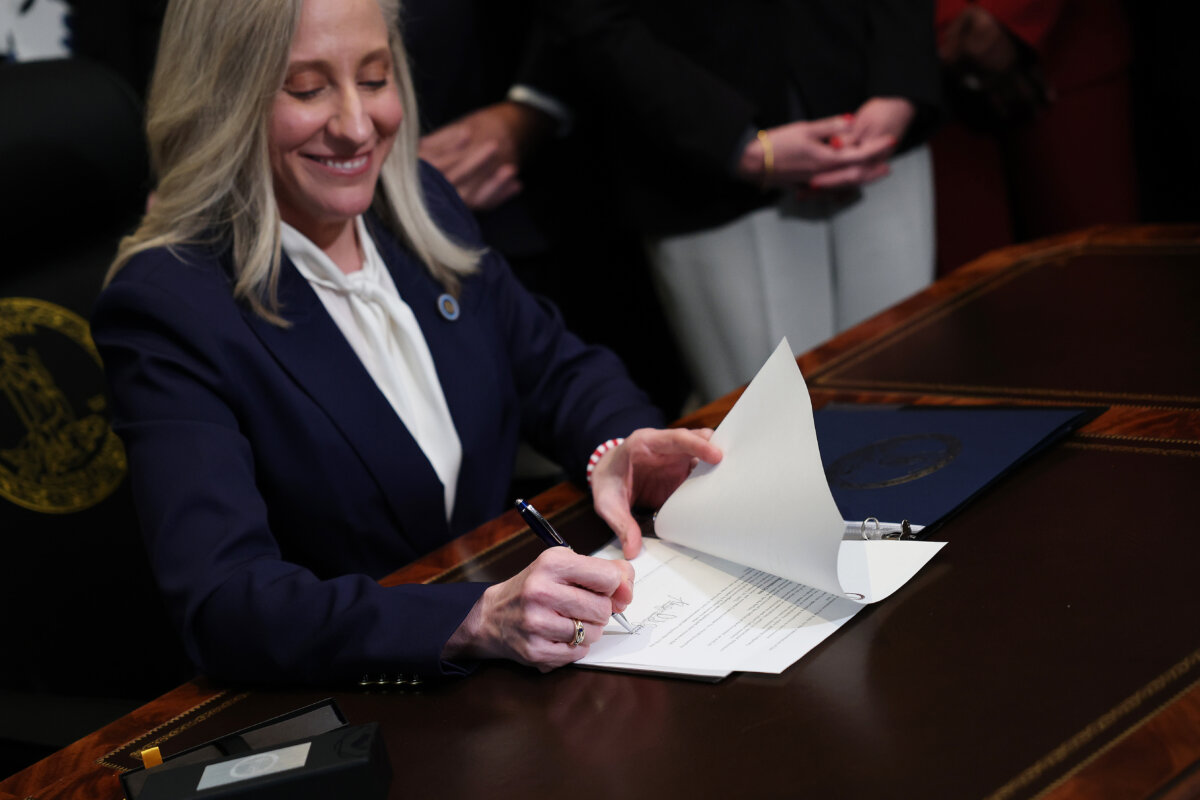

Virginia Gov. Abigail Spanberger signed a directive on Feb. 4 that ordered the state’s police departments to end partnerships with U.S. Immigration and Customs Enforcement (ICE) for arresting illegal immigrants.
The agreements had allowed Virginia’s state and local law enforcement officers under ICE’s supervision to detain suspected illegal immigrants, both during ICE operations and when they were imprisoned for separate offenses. Former Gov. Glenn Youngkin had instituted the agreements, which Spanberger described as drawing tax dollars away from state priorities.
The agreements, which fall under Section 287(g) of the Immigration and Nationality Act, have been criticized by Democrats across the country amid their opposition to President Donald Trump’s mass deportation policy.
“Section 287(g) Agreements, per the language of the agreements, improperly cede accountability and discretion over Virginia law enforcement to the federal government,” Spanberger’s order reads. “Virginians deserve to have their state and local law enforcement resources devoted to the safety and security of their communities, not federal civil immigration enforcement.”
Currently, police in 39 states have Section 287(g) agreements with ICE. Seven other states—Washington, Oregon, California, Illinois, New Jersey, Connecticut, and Maine—have banned such agreements, according to ICE.
Democratic legislators in several states have proposed repealing their 287(g) agreements with ICE or banning future ones. Both houses of the Maryland General Assembly on Feb. 3 passed separate bills that would ban such agreements in the state.
Republicans from Virginia criticized Spanberger’s action.
“A core function of [law enforcement’s] mission is to protect Virginia communities, and I believe cooperation between local, state, and federal officials helps accomplish that goal,” Rep. Morgan Griffith (R-Va.) wrote in a statement. “Governor Spanberger’s action to terminate 287(g) agreements directly undermines this goal and potentially pits local communities, state law enforcement and federal law enforcement against each other.”
The Virginia Republican Party also weighed in: “Spanberger is attempting to turn Virginia into a sanctuary jurisdiction,” it wrote on social media.
Spanberger also signed an executive order on Feb. 4 that presented six new principles for law enforcement activity in Virginia. One principle was that “Virginia law enforcement does not engage in fear-based policing, enforcement theater, or actions that create barriers to people seeking assistance in their time of need.”
In Minneapolis, where the administration has launched Operation Metro Surge to conduct immigration enforcement arrests, many protests have been organized against federal law enforcement officers during their operations, leading to tense interactions, including the fatal shootings of protesters Renee Good and Alex Pretti, who were killed on Jan. 7 and Jan. 24, respectively.
In Congress, the Democratic caucuses of both houses have demanded reforms to ICE operations in exchange for supporting a bill to fund the Department of Homeland Security for the current fiscal year. Their lack of support led to a partial government shutdown from Jan. 31 to Feb. 3.
 Friends Read Free
Copy
Facebook
Tweet
Friends Read Free
Copy
Facebook
Tweet