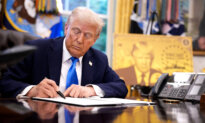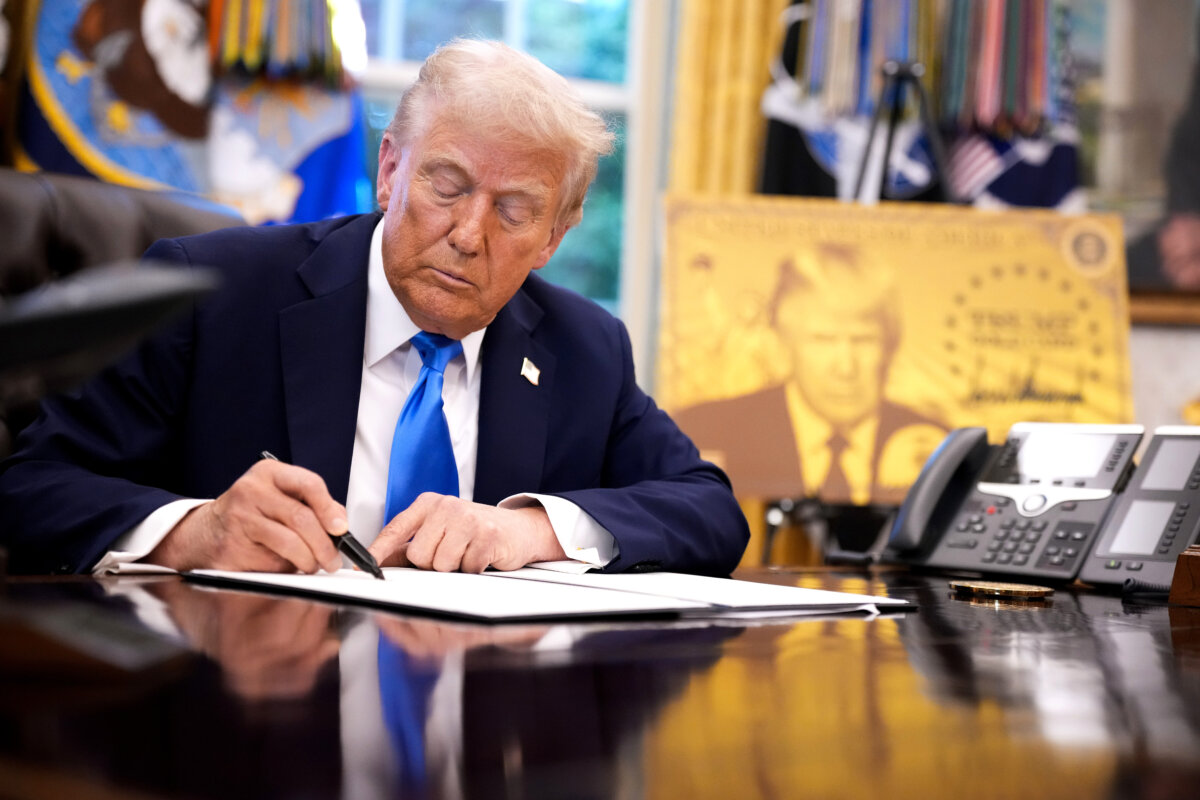

President Donald Trump announced on Sept. 19 a new fee structure for obtaining an H-1B visa.
Companies will now have to pay a one-time fee of $100,000 for importing a foreign worker under this program.
Here’s what we know.
What Is an H-1B Visa?
The H-1B visa program allows U.S. companies to import foreign workers to fill jobs that require “specialized knowledge and a bachelor’s degree or higher in a directly related specific specialty (or its equivalent).”
Employers file a request, naming the employee and position to be filled, and pay a series of fees to bring the new worker on board. The coveted visa lasts for three years and can be renewed for an additional three years.
It can be extended further if the applicant is in the process of acquiring his or her permanent residency (green card).
Established by Congress in 1990, the program is widely used by technology sector employers, but it may also be used in such fields as architecture, engineering, theology, or the arts.
About 400,000 applications were approved in 2024, according to the Pew Research Center.
Because of the large number of successful applicants, the visas are assigned through a lottery system by the U.S. Citizenship and Immigration Services (USCIS).
There is a congressionally mandated cap on the number of these visas given each year: 65,000 through the regular H-1B program, and another 20,000 through an exemption program for jobs that require an advanced degree.
What Are the New Rules?
Trump’s proclamation tacks a one-time $100,000 fee onto applications for an H-1B visa.
Commerce Secretary Howard Lutnick initially said the $100,000 fee would be annual, but the White House later clarified that this would be a one-time cost.
The new rules took effect on Sept. 21, but do not apply to current H-1B holders or those who submitted applications before that date.
Previous H-1B fees, which have generally been paid by the employer, included a $215 registration fee and $780 processing fee to get the ball rolling.
Another $750 to $1,500—depending on employer size—was required by the American Competitiveness and Workforce Improvement Act of 1998, which funds scholarships and training programs for U.S. employees.
Employers have to pay an additional $4,000 if they have 50 or more workers and more than half of them are using H-1B visas.
The president’s $100,000 add-on is in effect for one year, but he may choose to renew it.
Why the Changes?
Trump’s announcement claims that many companies are taking advantage of the system by laying off their U.S.-citizen workforce and replacing those workers with cheaper H-1B employees.
One company “reduced its workforce by approximately 27,000 American workers since 2022, while being approved for over 25,000 H-1B workers since FY 2022,” the proclamation states.
When announcing the change, Trump told reporters in the Oval Office that the point of the change is to incentivize companies to “hire American.”
“The whole idea is, no more will these big tech companies or other big companies train foreign workers,” Lutnick said.
“They have to pay the government $100,000, then they have to pay the employee, so it’s just not economic. If you’re going to train somebody, you’re going to train one of the recent graduates from one of the great universities across our land.”
Who Is Most Affected?
Tech companies are expected to be the hardest hit.
According to USCIS data, Amazon was awarded the largest number of H-1B permits in 2025. It was followed by other tech giants such as Google, Apple, Meta, and Microsoft.
These were mostly distributed in California, Texas, New York, and New Jersey.
In 2024, most approved applications—about 71 percent—were from India. China came next, constituting about 12 percent of beneficiaries.
What Are Critics Saying?
The Indian Ministry of External Affairs reacted to the change with a statement on Facebook, saying the move may result in “humanitarian consequences by way of the disruptions caused for families.”
Rep. Suhas Subramanyam (D-Va.) said the move is a mistake in Trump’s immigration policy.
“They’re completely messing up the legal immigration system,” he said in an interview with The Epoch Times’ sister media outlet NDTV.
Subramanyam said he has been trying to streamline the H-1B process to make renewals easier and put H-1 B holders on a path to U.S. citizenship.
“It’s going to mean that we’re not going to attract the best and brightest around the world to come help fill our workforce gaps,” he said of the policy change.
 Friends Read Free
Copy
Facebook
Tweet
Friends Read Free
Copy
Facebook
Tweet