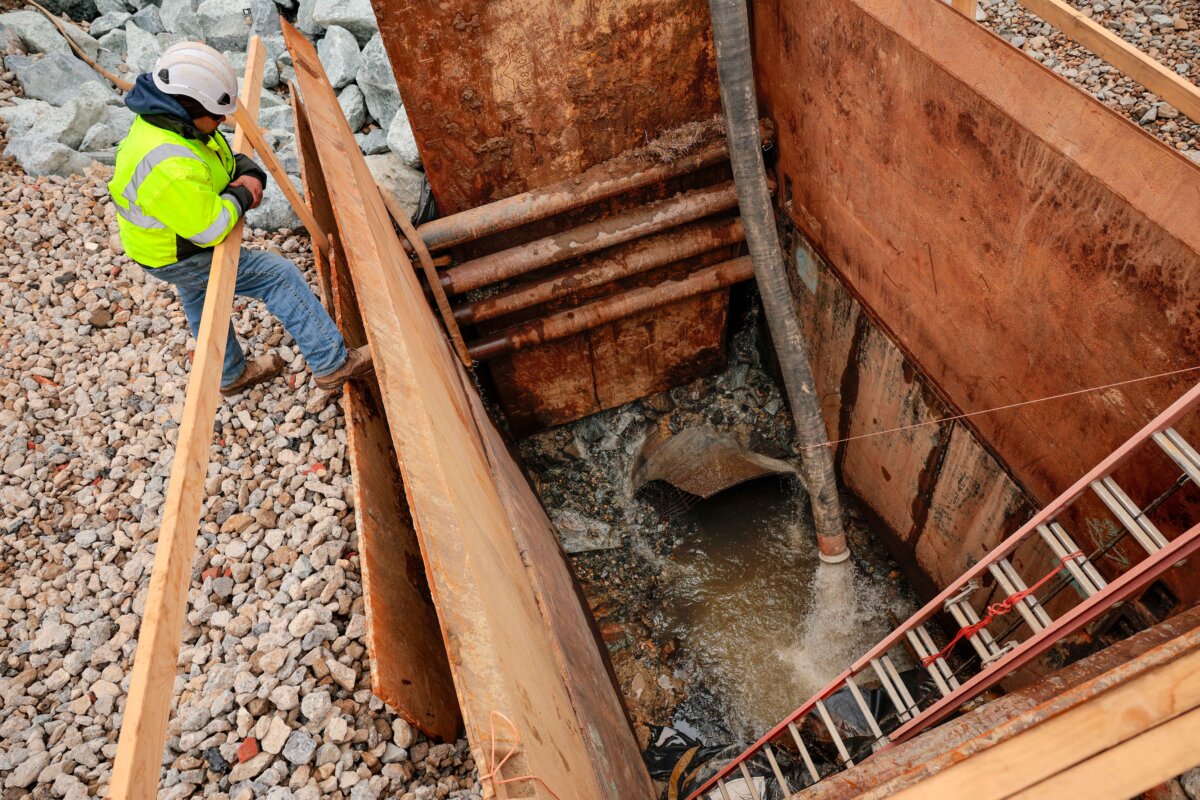

A collapsed sewage pipe spilled hundreds of millions of gallons of wastewater into the Potomac River in January, resulting in an ongoing environmental disaster. Although utility workers have managed to mitigate further leaks, full repairs are expected to take weeks.
President Donald Trump responded this week by calling for more decisive action from local leadership.
Here’s what we know about the spill and how authorities are responding:
What Happened?
The problem began with the collapse of the 72-inch Potomac Interceptor sewer line on the evening of Jan. 19. The spill, which occurred in Montgomery County Maryland, came during an ice storm that hammered the East Coast.
Although round-the-clock utility crews were dispatched to fix the leakage, it took until Jan. 24 to activate an emergency bypass system for rerouting the wastewater, DC Water CEO David L. Gadis said in a statement.
By Feb. 6, DC Water estimated that around 243 million gallons of wastewater—the equivalent of 368 Olympic-sized swimming pools—had overflowed into the Potomac River. Most of the overflow occurred during the first five days before the bypass system was installed.
The Potomac Interceptor was installed more than 60 years ago. Following a briefing with the D.C. City Council on Tuesday, Gadis told reporters that renovations were initially scheduled for this summer. The collapse occurred before that could happen.
President Donald Trump blamed the spill on the “gross mismanagement” of Maryland Gov. Wes Moore and other local Democratic leaders in a Truth Social post on Feb. 16.
“It is clear Local Authorities cannot adequately handle this calamity,” Trump said, adding that he would direct federal agencies to assist with the disaster. The next day, the president offered to assist if Moore, D.C. Mayor Muriel Bowser, and Virginia Gov. Abigail Spanberger “politely” ask him for help.
A spokesman for Moore said the responsibility fell on the federal government’s shoulders.
“Since the last century, the federal government has been responsible for the Potomac Interceptor, which is the origin of the sewage leak,” Moore’s press secretary, Ammar Moussa, said in a statement. “Apparently the Trump administration hadn’t gotten the memo that they’re actually supposed to be in charge here.”
Moussa also said the governor’s office would collaborate with the federal government.
Spanberger and Bowser’s offices did not respond to a request for comment.
The Recovery
An update by DC Water on Monday explained that extra high-capacity pumps were installed over the weekend, but full repairs to the damaged line may take between four and six weeks. Although no overflows impacting surface waters have been reported since Feb. 11, the threat remains until the site is fully repaired.
DC Water said the next step in the clean-up process is to install a steel bulkhead gate to isolate the busted section of the pipe, and pump out the remaining wastewater in the area.
Recovery efforts are also being hampered by the discovery of a rock dam near the ruptured pipe. That will have to be removed before crews can assess the damage for repairs to be completed. It’s also unclear how stable the surrounding soil will be, which might add further complications.
In a letter, advocacy group Potomac Conservancy thanked DC Water and its crew for their efforts to minimize the harm. They added that the collapse “makes it clear that outdated and weak infrastructure remains one of the most significant threats to the Potomac River’s health, and that accountability, transparency, and follow-through are essential.”
Once repairs are completed, DC Water plans to begin a revamp of the Potomac Interceptor line, making it more durable in the long-term.
“The rehabilitation will use a combination of slip lining—installing new pipe sections to line the inside portions of the existing pipe—and applying a high-strength geopolymer lining to reinforce and strengthen sections of the pipe where slip lining is not possible,” DC Water said.
That project may take 9–10 months to complete.
Ongoing Effects
On Feb. 13, DC Department of Energy and Environment said drinking water operated from a separate system and remained safe, but warned that humans and pets should stay away from the river. Fishing should also be avoided.
The government’s main concern was contamination from E. coli bacteria. Anything above 410 units per milliliter is considered unsafe by the Environmental Protection Agency. Initial tests, conducted by the University of Maryland and environmental group Potomac Riverkeeper Network, showed levels as high as 143,000 in some areas downstream of the broken pipe.
Those numbers have dropped significantly since the beginning of February, though the spring thaw might cause them to spike again, University of Maryland microbiologist Dr. Rachel Rosenberg Goldstein said in a statement earlier this month.
“Although most people are not swimming in the frozen river in February, bacteria can survive in freezing temperatures and become active again when temperatures rise,” she said.
 Friends Read Free
Copy
Facebook
Tweet
Friends Read Free
Copy
Facebook
Tweet