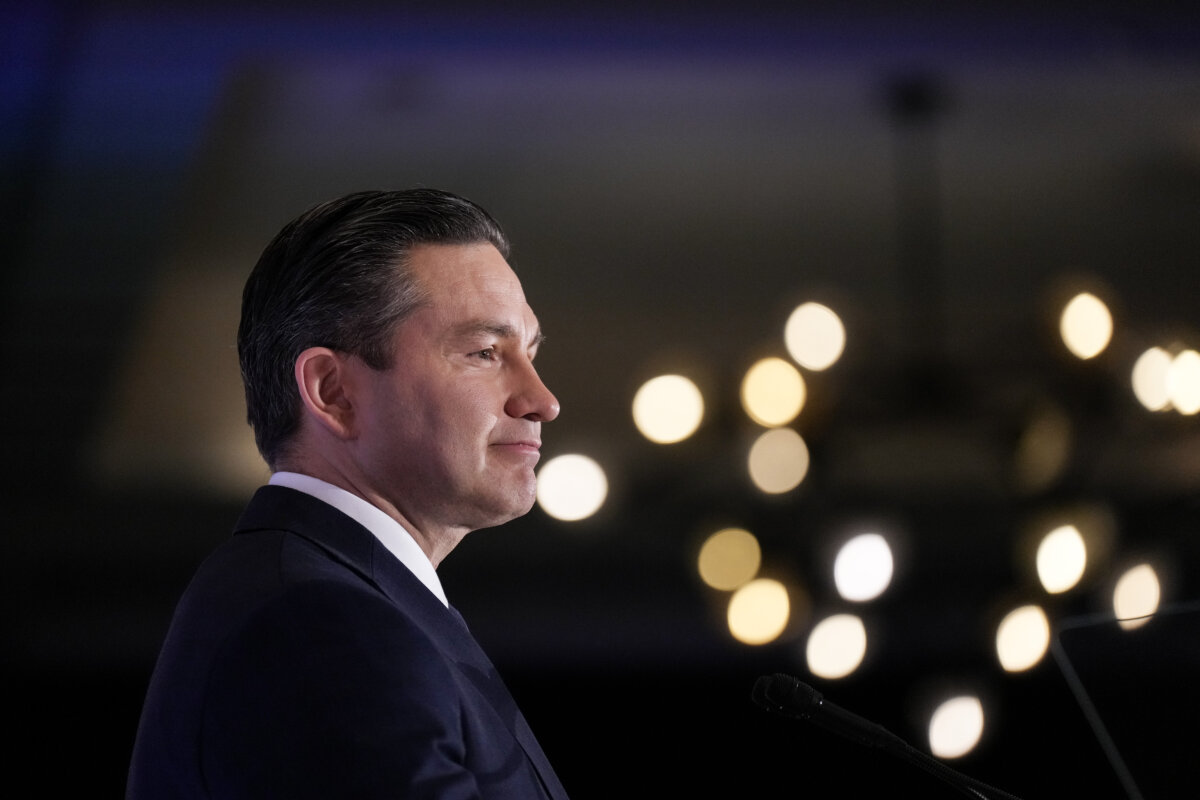

Conservative Leader Pierre Poilievre’s Feb. 26 speech at the Economic Club of Canada focused on strengthening Canada’s domestic economy and expanding resource development to gain greater leverage globally, including with the United States.
Poilievre also cautioned against developing a “dependency” on China, saying Beijing can’t serve as a “substitute” for Washington.
He went on to outline a series of proposals and policy visions for how to make the country stronger.
Here’s a look at the top five takeaways of the Conservative leader’s address.
‘Stronger at Home’
Addressing the gathering and in a follow-up session, Poilievre said Canada needs to focus on elements within its control and become stronger both economically and militarily.
The Conservative leader said that Canada needs to build up its military, resource development, homebuilding, and control over the technology it creates in order to gain more leverage geopolitically and economically.
“These four pillars form our plan to make Canada stronger at home, so that we can have unbreakable leverage abroad,” Poilievre said of his party’s platform. “The path to sovereignty is focusing relentlessly on what is within our power.”
Poilievre emphasized that Canada can’t control what the U.S. president “says or does,” noting that Prime Minister Mark Carney has expressed the same view.
Poilievre added that his party is willing to work together with the Liberal government in the best interests of Canada ahead of the review of the U.S.-Mexico-Canada Agreement (CUSMA/USMCA) in July.
“We will work together where we can. We will oppose where we must, because loyal opposition is not just our job title. It is our national interest,” he said, while proposing an all-parties working group to prepare for the review.
Accelerate Permitting, Cut Red Tape
Poilievre said a stronger Canada could rapidly be created if the government speeds up permitting for resource exploration and energy, and cuts red tape and regulation he says is stifling Canada’s economic potential.
“Some of the worst tariffs imposed on Canada today are those imposed by the government here,” Poilievre told the attendees in Toronto. “The problem is not that these countries block our products from coming in. It’s that our own government blocks our products from getting out.”
In particular, Poilievre said long approval timelines for mines, energy exploration, and homebuilding are holding Canada back economically.
“We have the second-slowest building permits anywhere in the [Organisation for Economic Co-operation and Development],” he said. “It now takes 19 years to get a mine approved.”
To address slow permitting, Poilievre said Ottawa needs to scrap what he called “anti-development laws,” and deliver permits in six months or less.
“Canada does not lack workers or capital,” he said. “What we lack are permits.”
In terms of specifics, Poilievre reiterated his calls to repeal the Impact Assessment Act, as well as get rid of the industrial carbon tax. He also said Ottawa should rapidly grant permits to a soon-to-be-proposed crude oil pipeline from Alberta to the B.C. coast under the “special powers” granted in the Building Canada Act.
“For context, that one pipeline would increase our overseas exports more than the total exports that we have to the People’s Republic of China today,” he said.
Don’t Become Dependent on China
Poilievre criticized Ottawa’s deepening ties with Beijing, cautioning against forming a dependency on China or seeing the country as a potential substitute for the United States.
“Canada should talk and trade where prudent, but never make the mistake of confusing engagement with dependency,” he said. “China is not a substitute for the United States of America.”
The Tory leader made a distinction between the Chinese regime and ordinary Chinese citizens, noting the Chinese Communist Party has been adversarial to Canada.
“We seek no fight with China or its people, who make up a brilliant and extraordinary civilization,” Poilievre said. “But its government and its proxies have kidnapped our citizens, stolen our technology, interfered in our elections, and pushed fentanyl into our streets.”
Ottawa and Beijing signed an agreement-in-principle on Jan. 16, cutting tariffs on Chinese electric vehicles from 100 percent to 6.1 percent for up to 49,000 imports into Canada in the first year, in return for China slashing retaliatory tariffs it had placed on Canadian agriculture and seafood products.
While in China, Carney said he is seeking a “strategic partnership” with Beijing, and that relations between the two countries are entering a “new era.”
Tariff-Free Auto Pact
Emphasizing his belief that Canada should prioritize the trade relationship with the United States over China, Poilievre went on to pitch a new auto pact that would bar Chinese vehicles from coming into Canada in return for a tariff-free deal for Canadian vehicles exported to the United States.
“The Americans have made it clear that they do not want Canada to become a backdoor entry point for China,” he said. “In short, here’s the deal. We should agree to keep Chinese vehicles out if Americans agree to let Canadian vehicles in.”
Poilievre said that the profitability of Canada’s automotive industry requires it to be closely integrated with the United States.
“We ultimately have to recognize that our auto industry requires integration with the United States of America,” he said.
The issue is expected to feature as a prominent part of the upcoming review of CUSMA this July, with U.S. Trade Representative Jamieson Greer calling Canada’s EV deal with China “problematic.”
Defence Boost and Arctic Sovereignty
The Conservative leader also emphasized that Canada should “build faster” to meet the needs of modern warfare and defence readiness.
He particularly pointed to Canada’s military procurement system, saying it must become faster and more agile.
“We must build faster,” he said, referencing Ukraine, where military technologies are “designed, adapted, and put into use in mere days.”
Poilievre said that while he doesn’t expect Canada to develop the kind of ad-hoc military innovations as on the Ukrainian battlefield, he does want Canada to think “less like bureaucrats and more like MacGyver.”
Poilievre also brought up Canada’s military presence in the vast territory of the Canadian Arctic, saying this presence must be significantly upgraded in terms of personnel, infrastructure ,and military capability.
“We must also reassert our control and our dominance over the Canadian Arctic,” Poilievre said. “We have only 300 full-time troops in Canada’s Arctic, an area the size of the European Union. That means one soldier for every 15,000 kilometres.”
The Liberal government says it will meet NATO’s military spending requirement of 2 percent of GDP this year, and has signalled support for a future increase toward 5 percent.
Carney also announced his government’s defence industrial strategy last week, allocating $6.6 billion in part to ramp up domestic military manufacturing capabilities.
 Friends Read Free
Copy
Facebook
Tweet
Friends Read Free
Copy
Facebook
Tweet