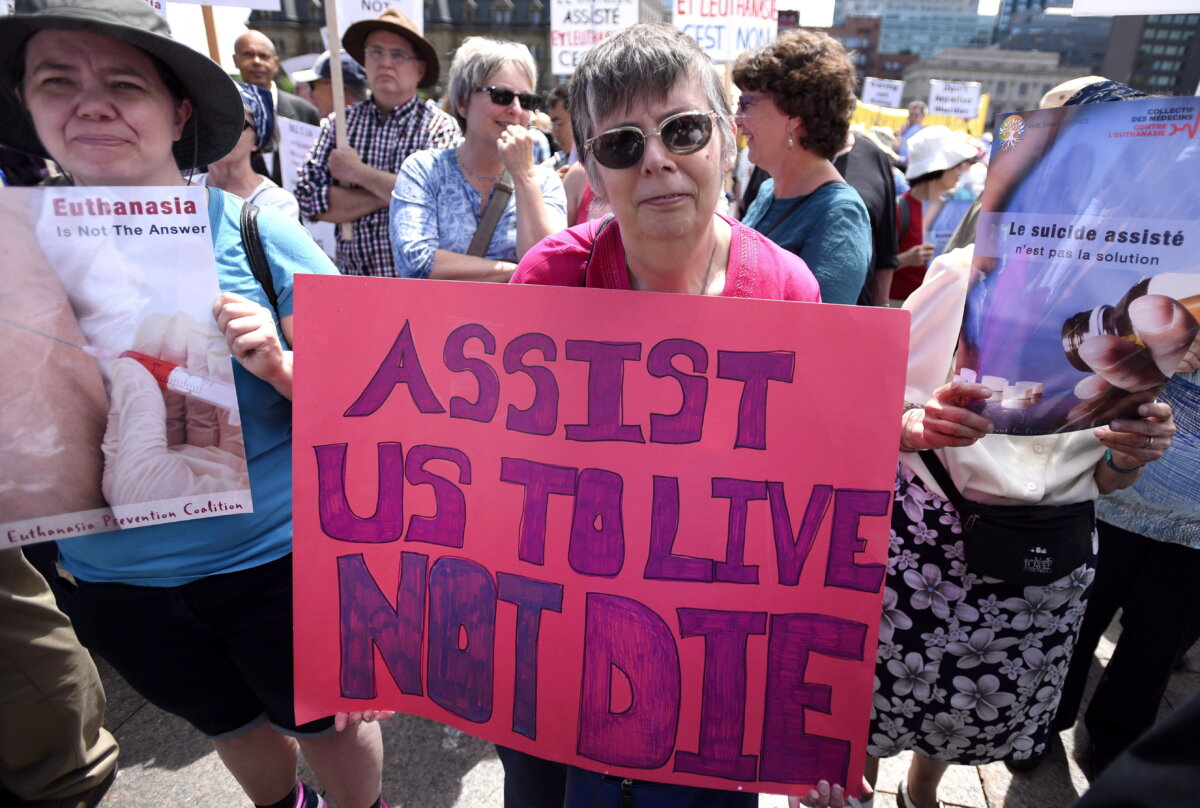

Members of a non-profit coalition who oppose euthanasia held a news conference Oct. 28 in support of a private member’s bill that would outlaw providing medical assistance in dying (MAID) to somebody who is suffering solely from mental illness.
The Euthanasia Prevention Coalition (EPC) spoke in support of Conservative MP Tamara Jansen’s private members Bill C-218, which was introduced in June and is currently in second reading in the House of Commons. It would prevent MAID from being expanded to include individuals diagnosed solely with mental illness.
“What fuels support for MAiD is not that people believe that some patients should die,” said EPC president Gordon Friesen, but rather that they have the choice to make “free, informed, competent and adult choices.”
It’s obvious, he said, that “euthanasia for the mentally ill does not fit that description. For the symptoms of mental illness often make that sort of choice impossible.”
Canada legalized medically assisted death in 2016 for those suffering from terminal and critical medical illness or physical conditions. An expansion to MAiD, Bill C-7, which would potentially allow it as an option for those diagnosed solely with mental illness was passed into law by parliament in 2021 under the Trudeau government.
Canada legalized MAID in 2016 for adults suffering from grievous and irremediable medical conditions. In 2021, Parliament passed Bill C-7, which expanded eligibility to those whose natural death is not reasonably foreseeable. The legislation under the Trudeau government would have extended MAiD access to people whose sole condition is mental illness. It said further consultation and deliberation was needed “to determine whether it is appropriate and, if so, how to provide medical assistance in dying to persons whose sole underlying medical condition is a mental illness in light of the inherent risks and complexity of the provision of medical assistance in dying in those circumstances.”
The provision was set to take effect in 2024 but was delayed last year until March 2027 for further review by physicians and lawmakers.
An attempt to repeal the potential expansion fell short by just 17 votes in 2023 with unanimous support from Conservative, Green, and NDP MPs and blanket opposition by Liberal MPs.
Nearly half of Canadians who asked for MAID in 2023 and whose death was not expected in the near future listed “isolation or loneliness” as a reason for requesting MAID, according to the Fifth Annual Report on Medical Assistance in Dying in Canada.
Friesen said there has been “an aggressive marketing of death” as part of MAiD, leading to over 16,000 cases of euthanasia last year alone. He said it is particularly troubling when those who are in “acute psychiatric distress” are offered assisted suicide.
EPC executive director Alex Schadenberg told the news conference his organization has received many letters from mental illness sufferers who are relieved MAID wasn’t available for them during their crises. Family doctor Paul Saba said it’s not possible for a mentally ill individual to provide informed consent in a decision to end their life.
Canadian Forces combat veteran Kelsi Sheren said that for those who suffering from mental illness, euthanasia is not a choice but instead a form of “coercion.”
“When I was 18 years old, I decided to put the uniform on,” said Sheren. “I understood that I might die for my country, but what I didn’t understand was that…one day, my own government would quietly offer to help me do it.”
She said, “When somebody is drowning in trauma and desperation, that’s not a choice, that’s coercion, wearing a polite face. I’ve spoken with veterans who have reached out for help and asked for therapy, for hope, for treatment, and what they got instead was an offer to end their life.”
 Friends Read Free
Copy
Facebook
Tweet
Friends Read Free
Copy
Facebook
Tweet