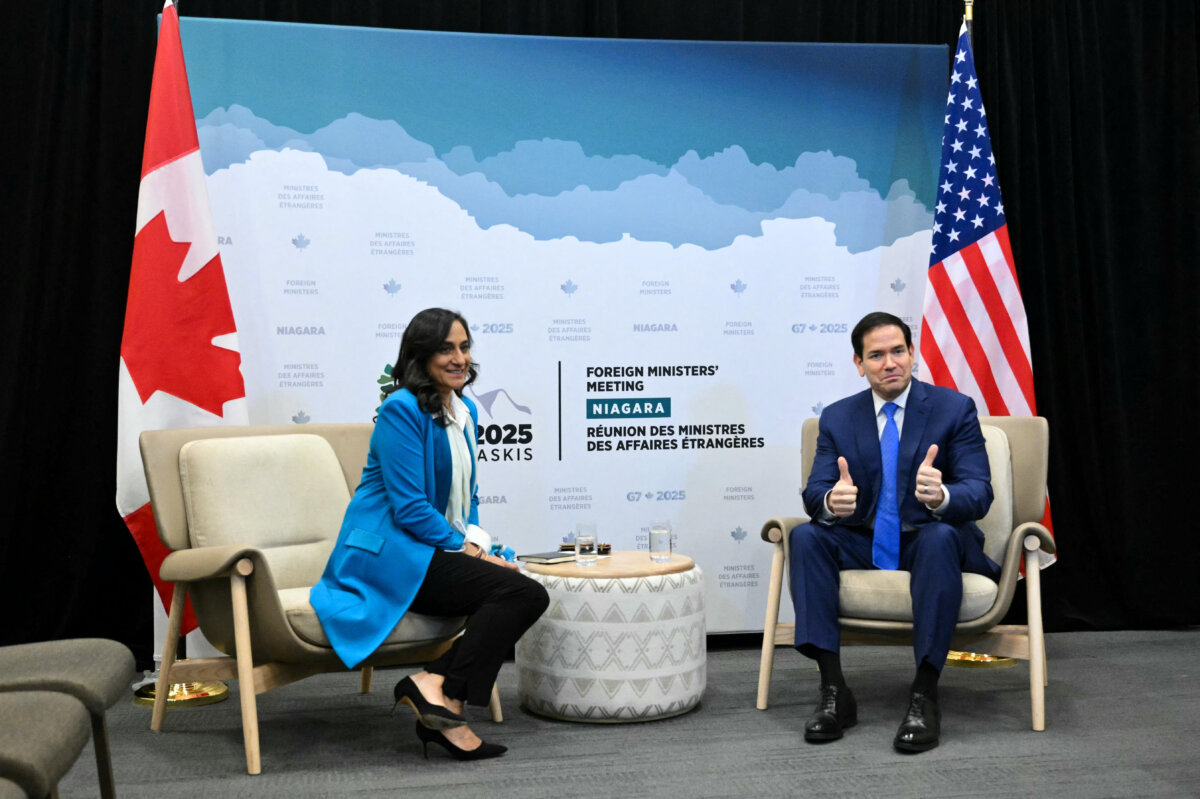

Foreign Affairs Minister Anita Anand says she did not address stalled trade negotiations between Ottawa and the United States during her meeting with her U.S. counterpart at the G7 summit this week.
Anand said she met with U.S. Secretary of State Marco Rubio on the margins of the G7 in the Niagara region this week to discuss a variety of foreign affairs issues, but said the trade relationship between Canada and the United States didn’t come up.
Anand was asked several times during a Nov. 12 press conference in Niagara-on-the-Lake, Ont., if she spoke with Rubio about Canada-U.S. relations. But Anand said trade talks are the jurisdiction of Canada-U.S. Trade Minister Dominic LeBlanc, adding that she stayed in her lane by focusing on issues like Arctic sovereignty.
“Issues relating to trade fall within the purview of my colleague Dominic LeBlanc, and that’s where they remain, as they should,” Anand said. “I’m representing Canada’s interests as the foreign minister, and I maintained Canadian interests and the Canadian position on a number of very serious issues that represent the interests of Canadians.”
U.S. President Donald Trump halted negotiations with Canada last month after an Ontario-sponsored ad campaign used a speech from former U.S. President Ronald Reagan to criticize tariffs.
Prime Minister Mark Carney has apologized for the ad and he and Trump appeared cordial at a recent global leaders’ meeting in South Korea, but the negotiations have yet to resume.
Reporters highlighted the apparently amicable exchange between Carney and Trump during the South Korea meeting and inquired why Ottawa, Anand included, is not advocating for a return to the negotiating table.
“Diplomacy doesn’t happen on a specific timeline,” Anand replied. “I know that my colleague, Minister LeBlanc, is working hard on this file every single day, and I am here to talk about the work that the G7 ministers are doing together with outreach partners.”
Anand hosted a Nov. 11-12 meeting of her G7 counterparts from France, Germany, Italy, Japan, the United Kingdom, and the United States as well as the High Representative of the European Union. Anand also invited Australia, Brazil, India, Mexico, Saudi Arabia, South Africa and South Korea to take part.
She concluded Canada’s G7 presidency by emphasizing the importance of maritime and energy security, critical minerals, and economic resilience, topics that she called “very serious issues.”
International Law and Intelligence
Strikes conducted by the United States on boats in the Caribbean loomed over the two-day meeting, leading Anand to respond to questions concerning Canada’s viewpoint on the situation.
U.S. Secretary of War Pete Hegseth said U.S. forces struck a pair of drug trafficking vessels in the eastern Pacific on Nov. 9, as part of an ongoing military campaign along the coast of South and Central America.
U.S. forces have bombed at least 19 alleged drug boats operating around Latin America since September. The death toll stands at 76, including the six people killed in the weekend strike.
Anand was asked by reporters about a CNN report that Canada had told the United States it does not want its intelligence being used to help target boats for lethal strikes.
Anand said Canada continues to share intelligence with its southern neighbour through Operation CARIBBE, a counter-narcotics operation aimed at intercepting drugs intended for North America, but emphasized that this is the extent of Ottawa’s participation.
“We’re continuing to monitor the situation, but we have no involvement in the operations,” she said.
Anand said the United States “has made clear that it is using its own intelligence,” adding that she did not raise the topic with Rubio.
Rubio didn’t address Canada’s intelligence involvement in the operation when questioned by reporters during a press conference at the Hamilton International Airport at the conclusion of the G7 summit. He described the CNN report as a “false story.”
“What’s happening now is people with a business card that has a government email on it become sources [and]… they’re not even in the know,” Rubio said. “So they either have an agenda or they want to make themselves important, and it’s been a plague of story after story that’s either inaccurate or misleading, and that falls in the category of both, that story does.”
Foreign Policy
The G7 leaders issued a joint statement following the summit, addressing various geopolitical issues, such as the tenuous ceasefire in Gaza and security concerns in the Indo-Pacific region. The statement also touched upon maritime security and the need for economic resilience.
The press release articulated strong backing for Ukraine after Russia once again struck the Ukrainian power grid and took control of regions in the southern area of the country.
Anand said Ukraine was a major topic of discussion during her meeting with Rubio, and noted the pair also discussed “a path to peace in the Middle East, and how we can work together in order to push forward that peace.”
The ongoing crisis in Haiti and Arctic sovereignty were also key issues during the discussion, she said.
“These are significant issues that rightfully concern the secretary of state as well as the Minister of Foreign Affairs of this country, and that’s exactly what we focused on,” Anand said.
The Canadian Press contributed to this report.
 Friends Read Free
Copy
Facebook
Tweet
Friends Read Free
Copy
Facebook
Tweet