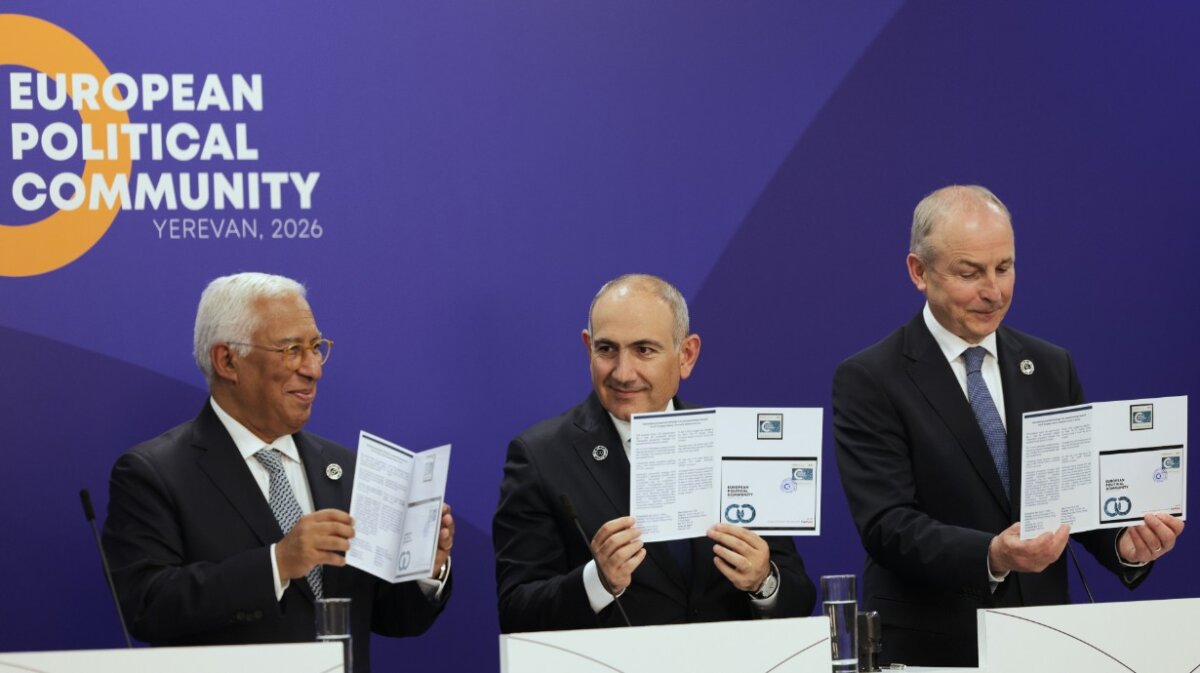
The European Union and Armenia have signed a joint declaration bringing them closer and supporting the former Soviet republic’s “sovereignty, resilience, and comprehensive reform agenda.”
The declaration, along with the signing of a connectivity partnership, is another sign of Armenia slipping out of Russia’s orbit.
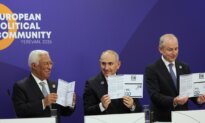
The declaration was signed at the end of a summit in the Armenian capital, Yerevan, which was attended by EU leaders, as well as British Prime Minister Keir Starmer, Ukrainian President Volodymyr Zelenskyy, and Canadian Prime Minister Mark Carney.
The summit was the eighth gathering of the European Political Community (EPC), and involved discussions on European security issues and the Iran war.
On May 4, EU Council President Antonio Costa thanked Armenian Prime Minister Nikol Pashinyan for “the courageous political decisions he has taken to bring Armenia closer to the European Union.”
“The direction of travel is unmistakable,” Costa said, adding that it was “vital to strengthen Armenian democracy and fight external interference and misinformation.”
On May 5, the president of the European Commission, Ursula von der Leyen, also signed a digital connectivity partnership with Armenia. She said Armenia had to counter information manipulation, hackers, and interference from foreign powers.
“Our new EU partnership mission will support you in countering these cyberthreats and disinformation,” von der Leyen said.
The EU is already giving Yerevan 270 million euros ($318 million) to “advance Armenia’s socio-economic reform agenda, strengthen sectoral cooperation, and promote investments in energy, transport, and the private sector.”
The statement says this amount will grow, and that EU investments in Armenia are expected to reach 2.5 billion euros ($2.94 billion).
Fallout From 2020 War
The declaration comes days after the EU passed a wide-ranging resolution that backed the rights of Armenians from the Nagorno-Karabakh region and condemned what it called Azerbaijan’s “unjust detention of Armenian prisoners of war.”
Azerbaijan recaptured Nagorno-Karabakh during a six-week conflict in 2020, in which thousands of soldiers from both sides were killed. It ended with a ceasefire brokered by Russia, which has historically viewed the South Caucasus region as its backyard.
In August 2025, U.S. President Donald Trump hosted the leaders of Armenia and Azerbaijan at the White House, where they signed joint declarations ending decades of conflict.
On May 1, Azerbaijan summoned the EU’s ambassador and protested the EU resolution.
The Azerbaijani foreign ministry described it as “unfounded and biased,” and said Karabakh Armenians had left the region of their own volition.
Azerbaijani President Ilham Aliyev attended the EPC summit as a remote participant.
Armenia, which is overwhelmingly Christian, has historically sought protection from Russia against its Turkish, Azerbaijani, and Iranian neighbors, which are Muslim-ruled countries.
It was a Soviet socialist republic between 1920 and 1990, and remained close to Moscow for three decades after the collapse of the communist empire.
But after losing the Second Nagorno-Karabakh War and seeing Russia invade Ukraine in February 2022, Armenia has cooled its ties with Moscow.
The Armenian authorities have accused Russian peacekeepers in Nagorno-Karabakh of failing to protect ethnic Armenians who have remained in the region after it was reconquered by Azerbaijan.
Moscow has rejected the accusations, arguing that the peacekeeping mandate did not authorize its troops to intervene.
Armenia froze its participation in the Russian-led Collective Security Treaty Organization in 2024. The following year, the parliament in Yerevan passed a law formally declaring the country’s intention to seek EU membership.
Armenia joined the International Criminal Court (ICC) in 2023, a move that the Kremlin said was an “unfriendly step.”
The ICC has issued an arrest warrant for Russian President Vladimir Putin, accusing him of being responsible for the abduction of thousands of Ukrainian children.
The EU resolution passed on April 28 called on the bloc to “step up financial and technical assistance to Armenia,” with a focus on “strengthening institutional resilience, energy security, digital governance and economic diversification.”
Armenia remains a member of the Eurasian Economic Union (EEU), a single market that includes Russia, Belarus, Kazakhstan, and Kyrgyzstan. When Pashinyan met with Putin in Moscow earlier this year, the Russian president warned him that he would have to choose whether to stay in the EEU or join the EU.
Pashinyan has been in office since 2018 and faces elections in June.
Armenia’s shift is counter to what is happening in neighboring Georgia, where Prime Minister Irakli Kobakhidze suspended EU accession talks in November 2024.
The Associated Press and Reuters contributed to this report.
 Friends Read Free
Copy
Facebook
Tweet
Friends Read Free
Copy
Facebook
Tweet