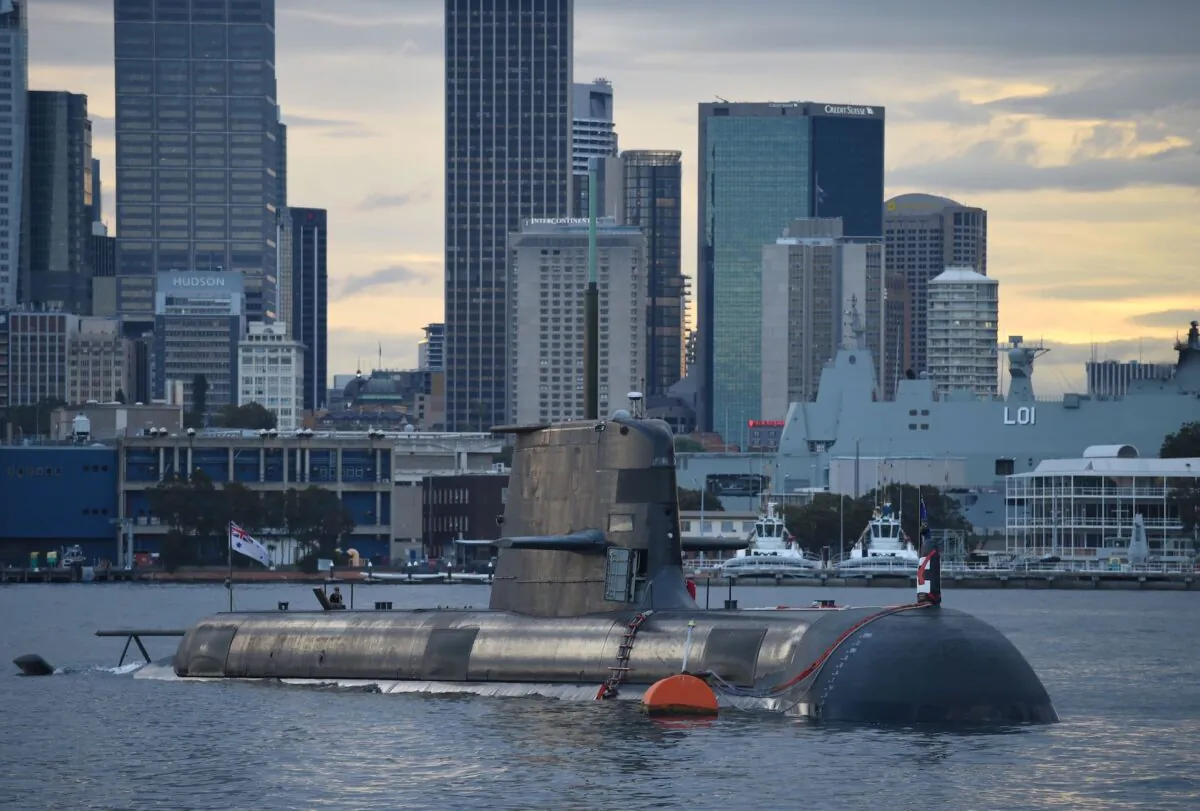

A plan to keep Australia’s ageing submarine fleet afloat until the arrival of replacements procured under the AUKUS agreement has been criticised by the auditor-general.
In March, the Defence Department recommended that instead of modifying and replacing obsolete equipment on the vessels that they move towards “refurbishing and maintaining existing systems.”
The Australian National Audit Office (ANAO) found in a detailed report on the project that, while it is under budget this year, it had “missed milestones” and failed to meet efficiency standards.
The initial contract, awarded in February 2022, has been amended 53 times and increased from $125 million to $813 million.
“By February 2026, Defence had spent $693 million on project definition and design activities and related equipment procurements to replace key systems and extend the service life of the Collins-class submarines,” the ANAO notes.
In terms of spending, it says Defence had “committed substantial funding without demonstrating commensurate progress against contracted milestones.”
Poor planning and implementation of the Life of Type Extension (LOTE) project mean that, 10 years after the decision to start it, Defence was “not well placed” to demonstrate that it will achieve its goal of maintaining the submarines’ capability and operations until 2048, as originally planned.
Part of the reason for the project’s failures to date was an early decision to align work on the 1980s-designed Collins-class vessels with the Attack-class submarines—including the adoption of common designs, systems and equipment—that had been ordered from France in a $90 billion deal.
When the federal government cancelled that order and signed up to AUKUS, there was no longer a need for that alignment.
However, the report finds that “following the cancellation of the Attack-class program, Defence did not adequately reassess the project scope to reflect the changed circumstances” or present the government with alternatives until earlier this year.
“As a result, substantial further expenditure has been incurred, delays have accumulated, and capability risks have remained.”
The first submarine was supposed to receive the planned upgrades in June of this year, but the ANAO says Defence is currently behind schedule.
Defence Minister Richard Marles initially announced that life of type extension work will commence with HMAS Farncomb at the end of this month, the first of six submarines to receive an extension.
“Extending the life of all six Collins class submarines is critical to maintaining that edge as we transition the Navy from conventional to nuclear-powered submarines,” he said, saying the government was committing up to $11 billion for LOTE maintenance and the workforce required to maintain this capability.
Systems like motors and engines, that are decades old, will nevertheless not be replaced in all six boats.
Instead, each will be assessed, and contractor Australian Submarine Corporation will repair what’s needed, in the hope that the submarines, which have a lifespan of about 28 years, will last into the late 2030s and early 2040s as Australia waits for the AUKUS vessels to arrive.
Defence said it has agreed to all five of the recommendations made by the auditor-general, including that all risks and delivery approaches are reassessed.
“Defence’s primary focus has been to maintain continuity of capability and avoid a capability gap, which has, in practice, constrained the extent to which comprehensive reassessment of underlying assumptions, risks and alternative options could be undertaken,” the response reads.
“Defence is strengthening its processes to ensure that future strategic shifts trigger more structured and timely reassessment alongside continued delivery.”
 Friends Read Free
Copy
Facebook
Tweet
Friends Read Free
Copy
Facebook
Tweet