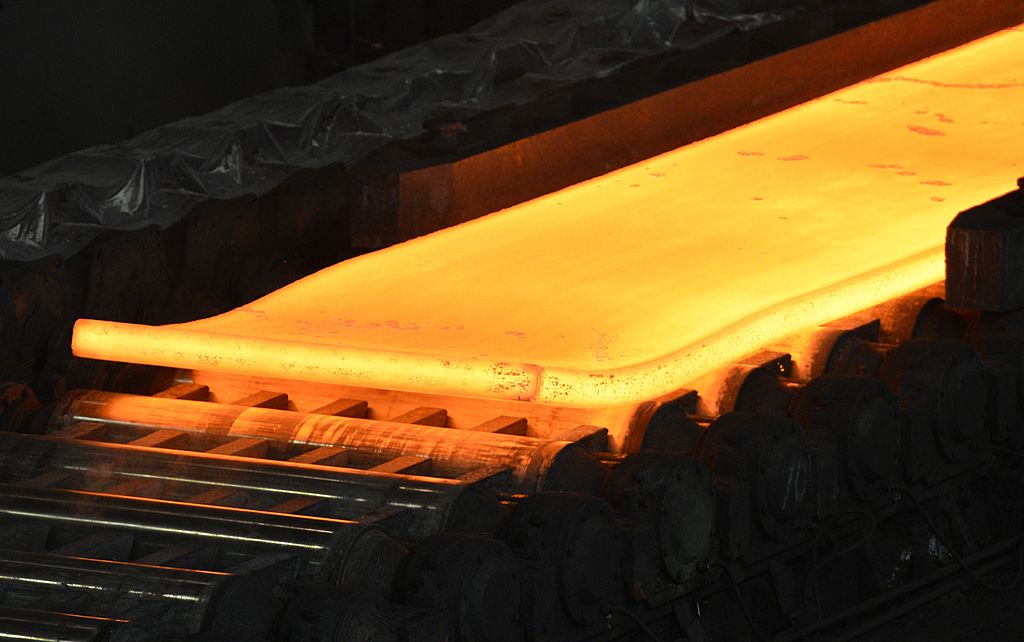

The Albanese government has imposed tariffs of up to 82 percent on imports of hot-rolled coil steel from China.
The move comes in the wake of a report from the Anti-Dumping Commission, which found the exports received unfair government subsidies and were being dumped on the Australian market.
“The commissioner is satisfied that the injury experienced by the Australian industry over the investigation period has been caused by dumped and subsidised exports of the goods by Chinese exporters and that injury is material,” the Commission said in its report (pdf).
“Exports of the goods from China in relation to all exporters from that country were dumped during the investigation period, and the volume of dumped goods and the margin of dumping were not negligible,” it said.
The Commission also found that steel exports had been heavily subsidised by the Chinese Communist Party (CCP) during the investigation, with four Chinese companies receiving lower tariffs than the rest.
Minister Signs Off Tariff
Industry Minister Tim Ayres signed off on the duties earlier this week. The application for a review was brought by Bluescope Steel, the sole local manufacturer of hot-rolled coil steel, in 2024, arguing that cheap imports unfairly affected its ability to compete in the Australian market.
Hot-rolled coil steel is a vital component in Australian construction, car manufacturing, and appliance production.
“The systemic underselling and price undercutting caused the Australian industry to experience price depression and suppression that it would not have otherwise experienced if not for the offers for the sale of dumped and subsidised goods,” BlueScope said in its complaint (pdf).
Its Port Kembla Steelworks is the largest manufacturer and supplier of flat steel in Australia by volume, and produces slab, hot-rolled coil, and plate products.
Concerns have long been held by successive Australian governments about the dumping of cheap Asian steel on the Australian market, with former minister Christopher Pyne having established an inquiry into the issue in 2016, when he said 80 percent of the Commission’s investigations were about cheap Asian steel and aluminium.
China Warns Australia of ‘Negative Impact’
The CCP tried to argue that, since Australia is the largest supplier of iron ore to China, Bluescope’s claim that the price of raw materials in China was artificially low “is effectively arguing that Australia’s iron ore has been sold to China at ‘dumped’ prices.”
In a letter (pdf) to the Commission, Fan Xi, first secretary of the CCP Ministry of Commerce’s export division, noted that Australia’s iron ore industry is “deeply interwoven” into China’s steel industry and supply chain cooperation is essential.
He then called on Australia to “refrain from negatively impacting the stable and healthy cooperation between the industries of both countries” and to avoid the “misuse of trade remedy measures”, which he said targeted the legitimate rights and interests of Chinese exporting companies.
Industry at a ‘Critical Juncture’
Despite the CCP’s arguments, the Australian Steel Institute (ASI) warned in November 2025 that cheap steel imports were forcing local businesses to shut down, with more than a dozen steel fabrication companies closing in western Sydney alone over the previous 18 months.
ASI Chief Executive Mark Cain said the industry was at a “critical juncture,” due to “an unprecedented surge in imports that threatens the viability of domestic manufacturing capacity built over decades.
“Due to its vulnerable state, the Australian fabrication industry also faces a threat of suffering further serious injury, which will, if not countered, ultimately result in the full loss of sovereign manufacturing capability,” he warned.
More than 80 percent of Australia’s iron ore exports are to China, with a value of $385 billion (US$278.8 billion) in the 2025 financial year, according to the Australian National University.
If China were to retaliate against Ayres’ decision, it could place further downward pressure on iron ore pricing. In January, the CCP imposed a 55 percent tariff on imports of Australian beef.
“We have acted to make sure that our anti-dumping regime is fit for purpose because we’re backing Australian manufacturing because it delivers good jobs in suburbs here like Smithfield, industrial regions like the Hunter Valley and Central Queensland, right around Australia,” Ayres told ABC News back in January.
The Anti-Dumping Commission is currently reviewing imports of aluminium from China.
 Friends Read Free
Copy
Facebook
Tweet
Friends Read Free
Copy
Facebook
Tweet