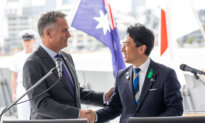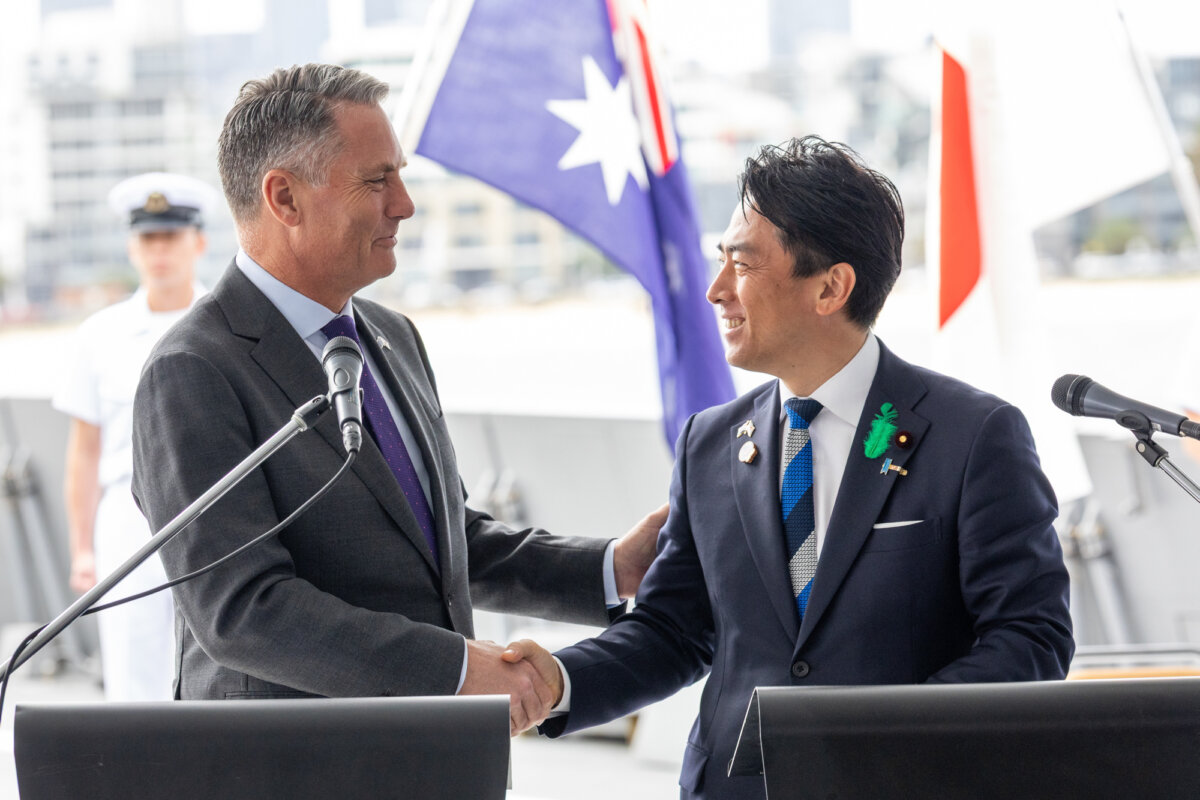

The defence ministers of Australia and Japan have concluded wide-ranging talks by signing contracts for the first 3 of 11 Mogami-class frigates, to be built by Mitsubishi Heavy Industries (MHI) at a cost of around AU$10 billion (US$7.4 billion).
The Japanese option was selected last August, beating the German Thyssenkrupp-manufactured TKMS MEKO A-200.
The upgraded frigate has a range of up to 10,000 nautical miles (18,520 kilometres) and a 32-cell Vertical Launch System that stores and launches missiles vertically from below-deck armoured cells.
Unlike older rail-launched systems, VLS enables rapid firing of different missile types (anti-air, anti-submarine, surface-to-surface) in any direction without rotating the launcher.
The Australian version will differ from those in use by Japan, which have 16-cell VLSs.
They will also be larger, at roughly 6,200 tonnes, compared to the early 5,200-tonne models. Both utilise a 30-knot stealth design with long-range anti-ship capabilities, but Australia’s variant is specifically aimed at replacing aging ANZAC-class frigates for high-end combat, requiring greater missile depth.
Australia’s ships will also feature enhanced sensors and radar.
MHI will build three of the stealth frigates, while Australia’s Austal will manufacture eight in Western Australia. The first of the Japanese-built warships is scheduled for delivery in 2029 and to enter service the following year.
The units sent to Australia will be equipped with surface-to-air and anti-ship missiles, be capable of operating the Navy’s MH-60R Seahawk maritime combat helicopter, and be crewed by 92 Royal Royal Australian Navy sailors and officers.
The signing of the agreement comes amid deepening defence cooperation between the two countries in the Asia-Pacific region, both of which are close allies of the United States. Tokyo and Canberra are also both members of the Quad security bloc, led by the U.S.
When the deal was first signalled in late 2025, the Center for Strategic and International Studies (CSIS) said the development in shipbuilding cooperation between Australia and Japan would “boost Australia’s naval capabilities, enhance interoperability between the two countries, reinforce deterrence against China’s growing influence in the Indo-Pacific, strengthen Australia’s shipbuilding industrial base, and deepen supply chain cooperation between Australia and Japan.”
Strengthened Military Ties
Aside from formalising the frigate contract, the “Mogami Memorandum” commits both countries to strengthening their military ties, including through “closer industrial cooperation” in defence.
“Our surface fleet is more important than at any time in decades,” Defence Minister Richard Marles said in a statement. “The decision to acquire upgraded Japanese Mogami-class frigates accords with the Albanese government’s commitment to more than double the size of the Navy’s surface combatant fleet.
“In the 2026 Integrated Investment Program released this week, the government committed to the investment of up to $20 billion over the decade into general-purpose frigates [which will] help secure our maritime trade routes and northern approaches as part of a larger and more lethal surface combatant fleet.”
Japanese Defence Minister Koizumi Shinjiro said closer defence coordination was vital as both countries faced an “increasingly severe security environment.”
In a joint statement, the ministers acknowledged Australia and Japan’s “shared responsibility to work with partners to uphold regional security through arrangements that protect our shared interests and shape a region governed by rights and rules, not fear or force.”
They also pointed to “serious concerns about the situations in the East China Sea and the South China Sea.”
Both countries said they “strongly opposed unlawful maritime claims, militarisation of disputed features and other dangerous and coercive activities in the South China Sea, and “expressed concern about instances of unsafe and unprofessional behaviour by the People’s Liberation Army and its other maritime forces.”
The Australian government has committed to defence expenditure of $887 billion over the coming decade, with an aim for it to reach 3 percent of gross domestic product by 2033/34.
 Friends Read Free
Copy
Facebook
Tweet
Friends Read Free
Copy
Facebook
Tweet