
U.S. and Australian leaders have pledged to speed up defence cooperation during high level talks.
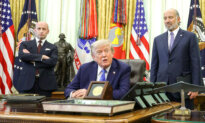
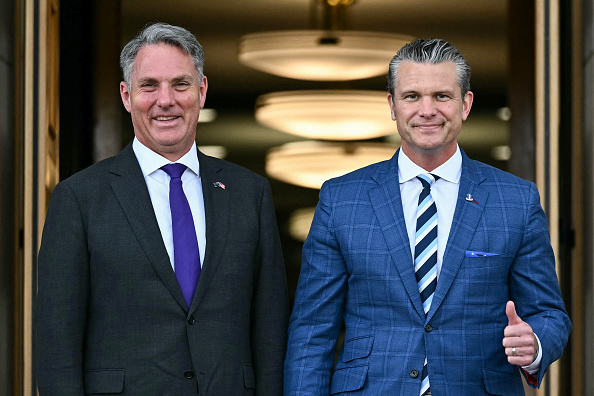
Australia’s Defence Minister Richard Marles met U.S. Secretary of War Pete Hegseth at the Pentagon and Vice President JD Vance on Sept. 2.
A Pentagon readout of the Hegseth meeting said “both leaders agreed to accelerate force posture initiatives at Australian bases, bolster cooperation in combined logistics, and build greater interoperability through joint exercises.
“They also discussed progress on defense industrial cooperation to enable shared capacity for guided weapons and next-generation capabilities.”
Hegseth and Marles also discussed strengthening deterrence in the Pacific and progress on AUKUS.
“The Secretary and Deputy Prime Minister also spotlighted advancements in the AUKUS partnership and welcomed the recent arrival of U.S. Navy sailors in Western Australia to support the commencement of Submarine Rotational Force3West activities in 2027,” the Pentagon readout said.
AUKUS is a trilateral security pact signed by Australia, the United States, and UK in 2021. Pillar One of the deal aims to arm Australia with nuclear-powered submarines, at a total cost of up to A$368 billion.
Meanwhile, Hegseth stressed the need for allies to pull their own weight on defence, while also commemorating the 75th anniversary of the ANZUS Treaty.
Marles described the conversations as “highly productive,” in comments to reporters. It was his first United States trip since he announced Australia’s latest National Defence Strategy in April.
US, UK Submarine Force on Track for Permanent Presence
Australia’s Marles also said U.S personnel were already stationed at HMAS Stirling in Western Australia and preparing the base for the Submarine Rotational Force-West—a permanent U.S. and UK submarine presence.
Marles said the rotation remains “on time and on track” for the end of next year.
In response to questions about whether the U.S. would still hand over submarines given its construction constraints, Marles pointed to the joint benefits of AUKUS.
“What AUKUS is doing is providing more sea days for the Virginia-class fleet for the United States Navy, and more sea days’ worth than a single submarine,” he said.
Calls for Strait of Hormuz to be Open
Marles also said he spoke with Vance and Hegseth about the Iran War, but did not “go into details” on the discussion.
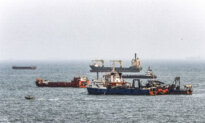
“What Iran has done in terms of seeking to restrict the movement of shipping through the Strait of Hormuz is completely inconsistent with the U.N. Convention on the Law of the Sea. It’s completely unacceptable,” he said.
Australia would also support the U.S. goal of curtailing Iran’s ability to acquire nuclear weapons.
“We’ve also said from the get-go that reducing Iran’s nuclear ambitions is an important measure to be taken as well, and that’s been at the heart of our posture and respect of the conflict in Iran from the beginning …” Marles said.
The war between the United States and Iran started on Feb. 28 after surprise strikes on military installations and leadership.
For months, the Iranian regime has held out, while disrupting global trade by blockading the Strait of Hormuz.
On Sept. 2, U.S. President Trump claimed the vital waterway was under U.S. control and aired the idea of changing the name to the “Trump Strait.”
On critical minerals, Marles said the meetings with Vance and Hegseth also covered the U.S.-Australian critical minerals agreement signed almost a year ago.
That deal has already unlocked $4 billion in investment for secure supply chains, Marles said.
 Friends Read Free
Copy
Facebook
Tweet
Friends Read Free
Copy
Facebook
Tweet