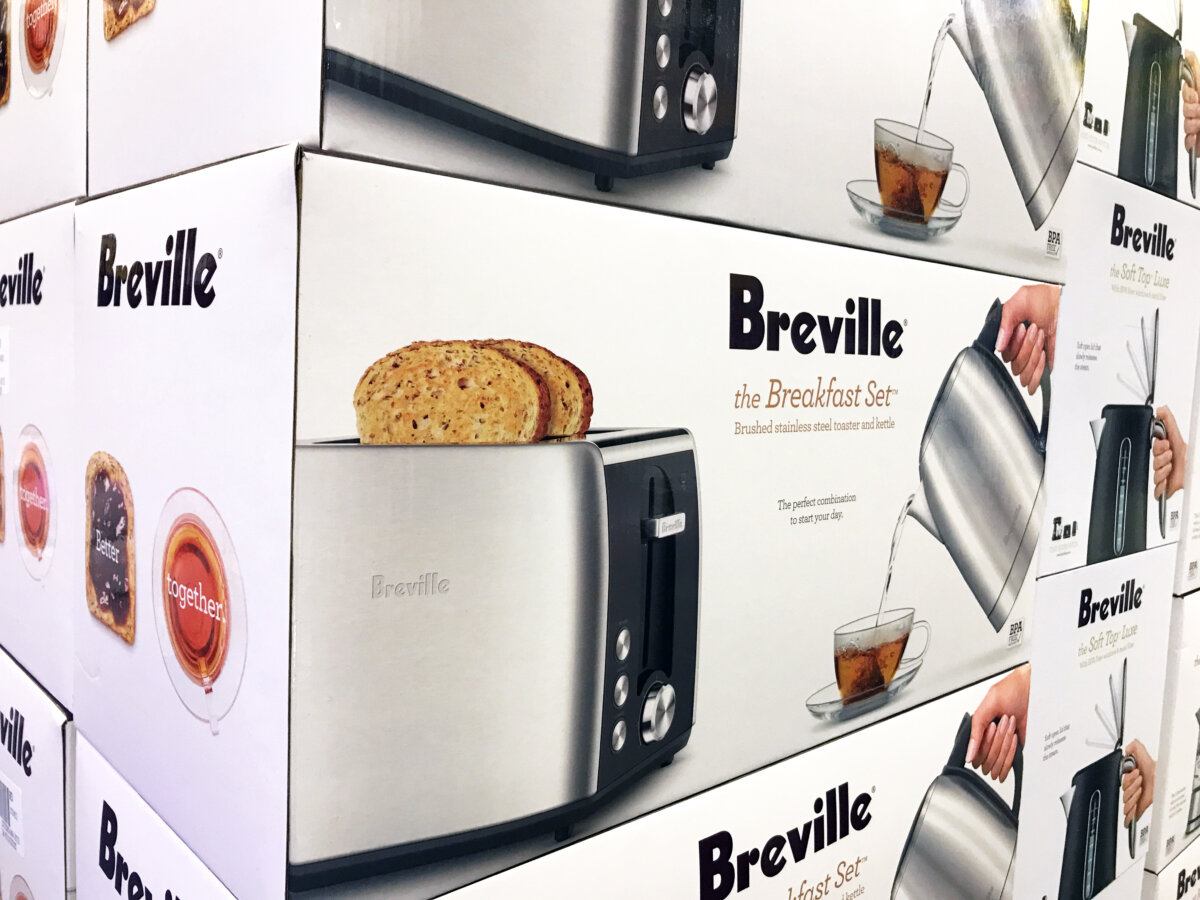

Major Australian kitchen and coffee appliance manufacturer Breville has been steadily shifting manufacturing of U.S.-bound products out of China to avoid tariffs from the Trump administration.
The global company, famous for inventing the sandwich press, revealed in its latest financial results that Breville and Sage branded 120-volt products sold in North America were now manufactured in Southeast Asia and Mexico.
In contrast, the 240-volt products sold in Europe, the Middle East, Africa, Asia Pacific, and South America were still made in China.
The Trump administration’s tariffs on Chinese goods remain at a 30 percent baseline, subject to a 90-day truce expiring on Nov. 10, 2025.
Additionally, Section 301 tariffs apply, ranging from 7.5 to 25 percent on household appliances including coffee machines and blenders with further increases under review.
The administration has also kept a keen eye on “transshipments” with the threat of a 40 percent additional tariff—transshipments involve rerouting prodcuts to other countries to hide their origin to avoid tariffs.
“Across the year Europe, Middle East and Africa (EMEA) and Asia Pacific continued their healthy trajectory while the Americas became more dynamic with the introduction of the evolving U.S. administration’s global tariff program,” said Breville CEO Jim Clayton.
“This bifurcated reality required rapid, forward-leaning tactical execution for the Americas, while maintaining the steady cadence of progress on multi-year strategic initiatives.”
The company said it saw an 11.8 percent increase in its revenues from the Americas in the financial year ending 2025.
How it Started?
On April 3, Breville announced it would make “tactical adjustments” to its manufacturing locations in response to the Liberation Day tariffs.
At the time, the company said 90 percent of its products were manufactured in China, with 45 percent of products sold into the United States.
Breville said at the time they were looking at “initial target locations” of Mexico, Indonesia and Cambodia to diversify their manufacturing base.
“This project may adjust as facts on the ground evolve. Regardless of the ultimate location, the group will benefit from added geographic diversification in its manufacturing base,” the company said at the time (pdf).
“The group will continue to make tactical adjustments, where appropriate, to lessen the potential short-term impacts from any new tariffs.”
“While we continue to manage the short-term challenges—as we did throughout the COVID period—our primary focus will remain the continued execution of our global, long-term growth strategy. Nothing today changes that strategy,” said Clayton
Breville Diversifying From China Market
During its latest investor update on Aug. 20, Breville also revealed most of the company’s profit was now generated outside of China.
“As of today, approximately 65 percent of US Gross Profit Dollars are made from products manufactured outside of China (Europe, Southeast Asia and Mexico), which is up from 15 percent at the beginning of the manufacturing diversification program,” Breville stated in its results presentation.
Breville expects this to increase to 80 percent.
“By the end of the 1H26, non-China production is expected to represent approximately 80 percent of US Gross Profit Dollars.
“The manufacturing diversification program will continue into the 2H26 and [financial year] 27,” the company said.
Breville reported a net profit after tax (NPAT) of $135.9 million (US$87.4 million) in the 2025 financial year, up 14.6 percent on the previous financial year.
Revenue increased 10.9 percent to nearly $1.7 billion.
 Friends Read Free
Copy
Facebook
Tweet
Friends Read Free
Copy
Facebook
Tweet