
Australia will aim to cut greenhouse gas emissions by 62 to 70 percent by 2035, in what the Albanese government is calling the most ambitious climate pledge in the nation’s history.
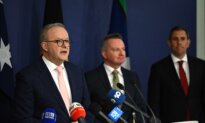
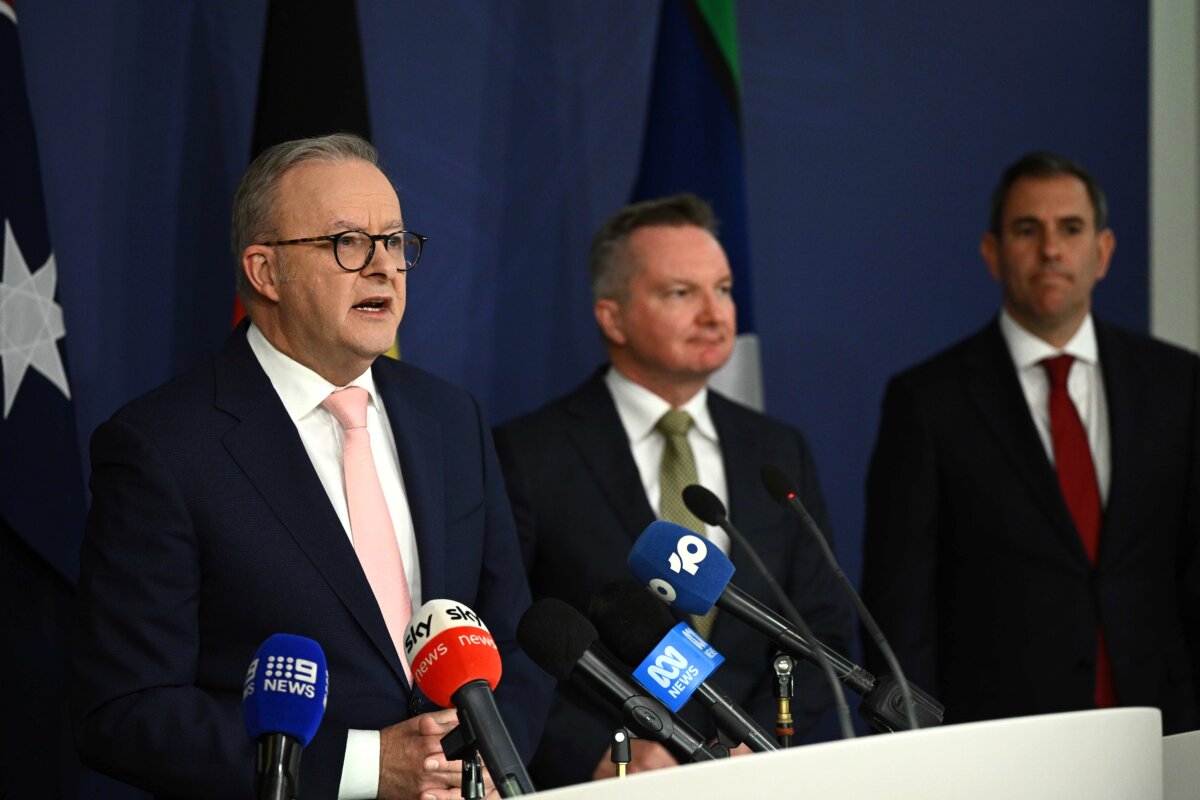
Prime Minister Anthony Albanese confirmed the target in Sydney on Sept. 17, flanked by Treasurer Jim Chalmers, Energy Minister Chris Bowen, and Climate Change Authority Chair Matt Kean.
“This is a responsible target, backed by the science, backed by a practical plan to get there and built on proven technology,” Albanese said.
“This is the right target to protect our environment, to protect and advance our economy and jobs, and to act in our national interest for future generations.”
The announcement comes days before Albanese departs for New York to present the target at the United Nations General Assembly.
Kean said the blueprint was built on 500 submissions, 560 meetings, and sector-by-sector modelling. He argued the transition is an opportunity, not a burden.
“There is a path that will deliver benefits and savings, not costs,” he said, adding the target range positions Australia as a global climate leader.
Around $9 Billion in New Spending Commitments
The government paired the pledge with major funding commitments.
An extra $2 billion will flow to the Clean Energy Finance Corporation to accelerate renewable projects. Another $5 billion will establish a Net Zero Fund under the National Reconstruction Fund to help heavy industry decarbonise and expand low-emissions manufacturing.
Other measures include $1.1 billion for clean fuel production, $40 million to speed up kerbside and fast EV charging, $85 million for household and business energy efficiency programs, and $50 million to help community sports clubs cut emissions.
“These commitments provide the framework for industry and investors to move decisively,” Bowen said, positioning the package as a signal to capital markets as well as voters.
Bowen Outlines Path to 2035
Bowen said the new target was backed by a “serious, credible, robust plan” designed to steer Australia’s economy and energy system beyond 2030.
“We’re releasing that path, together with the six sector plans that we’re releasing today, which show industry and investors what the government thinks is the most feasible decarbonisation pathway beyond 2030,” Bowen said.
Those plans include the CEFC recapitalisation, the Net Zero Fund, cleaner fuels, EV charging, and support for sports clubs to cut energy bills and emissions.
A new “demand statement of opportunities” and expanded energy performance tools like NABERS and NatHERS will also be introduced.
“All this together amounts to a serious, credible, robust plan which will help us achieve our targets. And when we took office in 2022, we inherited 10 years of denial and delay, a government which had spent 10 years arguing about whether climate change is real,” Bowen said.
According to estimates, Australia’s emissions have fallen about 27 percent from 2005 levels, but the new target marks a sharp lift in ambition.
Until now, projections suggested a 51 percent cut by 2035.
Disorderly Net Zero Path ‘Costlier’: Treasurer
Treasurer Jim Chalmers argued the target is as much an economic strategy as a climate plan.
He said Treasury modelling showed a 65 percent cut by 2035 would deliver higher wages, stronger growth and lower energy prices than delaying action.
“Under a disorderly transition, there would be lower wages and higher electricity prices,” Chalmers said.
The modelling suggests real wages will be 2.5 percent higher in 2050 and GDP per person $2,100 higher than if no target were set. In contrast, waiting until the 2040s to catch up would leave the economy $1.2 trillion smaller and households worse off.
Jobs, Exports and Investment on the Line
The government’s pledge comes amid heavy lobbying from corporate Australia. More than 350 companies have urged a stronger 2035 target, citing Deloitte analysis that found the economy could be $370 billion larger with a 75 percent reduction.
Deloitte estimated such a goal could add 69,000 jobs a year, attract $20 billion in new investment annually, and boost exports by $190 billion by 2050.
The Business Council of Australia, however, has warned that meeting even the government’s new target could require as much as $530 billion in capital, along with faster planning approvals and urgent regulatory reform.
The Opposition’s Internal Tussle Over Net Zero
As government commits to higher targets, the climate debate inside the Liberal Party continues to burn, with senior right faction figures warning Opposition Leader Sussan Ley that a renewed net zero pledge could fracture her team.
It began with Shadow Home Affairs Minister Andrew Hastie’s threat to resign from the frontbench over the issue. He was then joined by Shadow Education Minister Jonno Duniam, who said adopting net zero “at any cost” by 2050 would drive colleagues to quit.
“If we just said net zero at any cost by 2050 I think you’d find there would be a mass exodus,” he told Sky News.
Duniam argued most Liberals want conditions tied to the policy to protect households and businesses, adding he was confident Ley understood “net zero at any cost” was “bad policy.”
Nationals MP Barnaby Joyce has already tabled a bill to scrap net zero entirely.
The Greens have consistently demanded a far tougher target, warning Australia must reach net zero by 2035.
 Friends Read Free
Copy
Facebook
Tweet
Friends Read Free
Copy
Facebook
Tweet