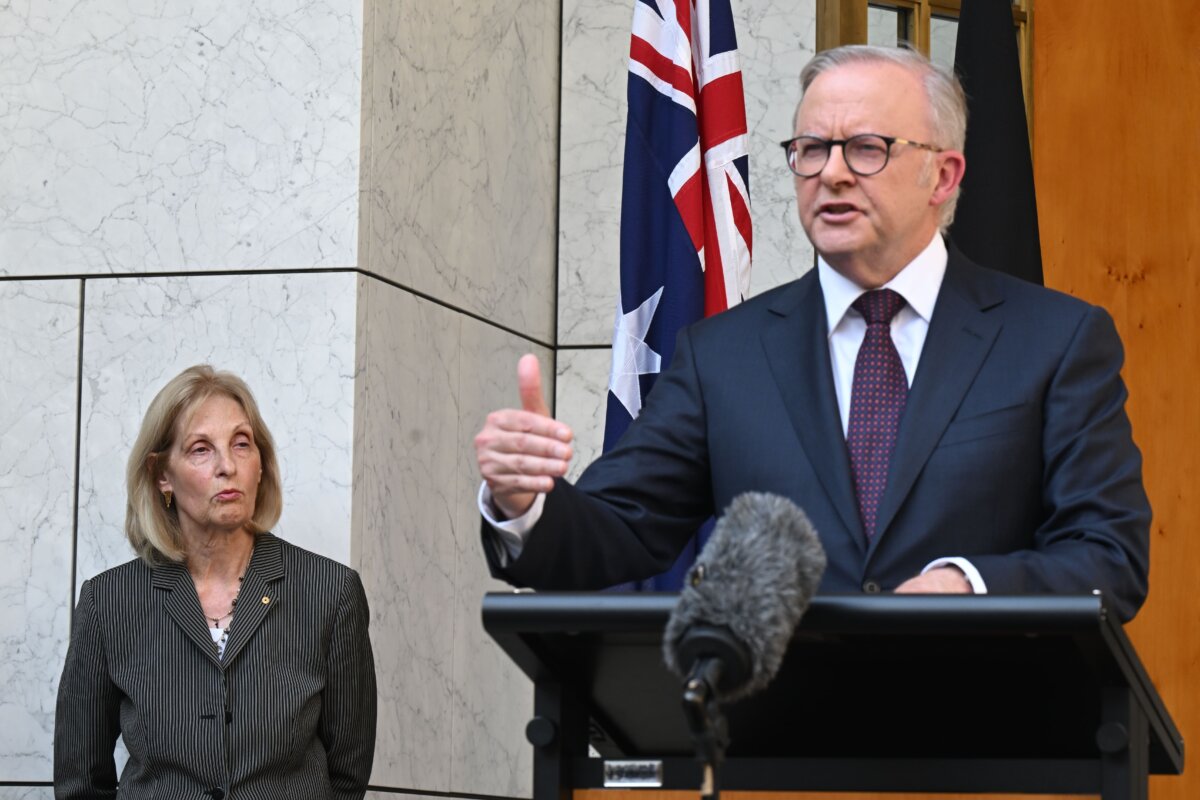

Prime Minister Anthony Albanese has announced a federal royal commission into anti-Semitism and social cohesion following weeks of intense pressure after the Bondi Beach terror attack that killed 15 people and injured 40.
The leader revealed his government’s decision at a press conference on Jan. 8, where Albanese said he would formally recommend Australia’s highest level of public inquiry be approved by the governor-general at an executive council meeting the following day.
Former High Court Justice Virginia Bell will serve as the single royal commissioner joined by former chief of Australia’s domestic intelligence agency, Dennis Richardson.
Richardson is currently leading an independent review into federal law enforcement and intelligence agencies.
The duo will also be joined by Special Envoy on Anti-Semitism Jillian Segal, who will act as an adviser.
The commission has been directed to deliver an interim report by April, with a final report due before the second anniversary of the Dec. 14 attack in 2026.
The federal government has also proposed merging the Commonwealth inquiry with the New South Wales state level one.
Albanese said he had spoken with New South Wales Premier Chris Minns and is awaiting confirmation.
A royal commission has the power to compel testimony and gather evidence to ascertain the reasons behind why an incident occurred, who is responsible, and make recommendations.
4 Areas of Focus
The royal commission will investigate four key areas:
- the nature, prevalence, and drivers of anti-Semitism—particularly religious and ideologically-motivated extremism and radicalisation;
- consider recommendations for law enforcement, border, immigration, and security agencies;
- examine the circumstances surrounding the Bondi terror attacks; and
- propose measures to strengthen social cohesion and counter ideological and religious extremism.
“This royal commission is the right format, the right duration and the right terms of reference to deliver the right outcome for our national unity and our national security,” Albanese said.
It comes as the prime minister endured weeks of pressure from different segments of Australian society calling for the public inquiry, including families of the Bondi victims, 120 business leaders, the Australian Catholic Bishops Conference, sportspeople, major Labor Party figures, and top security experts.
Albanese Explains Change of Position
Meanwhile, Albanese rejected claims the decision to establish a royal commission was due to political pressure saying his government had been working on the logistics for weeks and already has draft legislation prepared.
Albanese said a working version of the legislation is ready to be released for community consultation.
“We have worked very hard. This hasn’t been done up this morning,” he said.
Albanese said he was hopeful parliament would be able to begin debating the legislation before Jan. 26.
Albanese also moved to rule out any attempt to use the royal commission to litigate international conflicts, saying its focus must remain on domestic safety and cohesion.
“I don’t want a royal commission into whether we provide a solution on Gaza or on the Middle East. That’s not the role of a royal commission … Australians want two things when it comes to the Middle East. They want it to stop. They want peace, for Israelis and Palestinians. But the other thing that they want is for conflict to not be brought here.”
When asked whether the commission would also examine issues like Islamophobia, Albanese did not answer directly, instead saying that social cohesion is grounded in mutual respect.
“The Australian covenant is that when people arrive in Australia, they leave any hatreds or prejudices that they have in the customs hall.”
Criticism Over Appointment
The selection of Bell had earlier drawn criticism from former federal Treasurer Josh Frydenberg, who said the Jewish community was concerned with her appointment.
“It is unthinkable the prime minister would choose a commissioner that did not have the total confidence of the Jewish community,” Frydenberg wrote in a social media post late on Jan. 8.
He said Albanese had been “told directly by leaders of the Jewish community that they have serious concerns” about Bell.
In response, Albanese said, “I listened to a range of voices, and there were different views in the community,” adding that Frydenberg’s views should be set aside.
“If you look at what is required by this royal commission, there is no one of the stature of Virginia Bell,” he said.
He also spruiked the Justice Bell’s background and experience in criminal law.
Bell’s Background
Justice Bell was appointed to the High Court in February 2009 after serving as a judge on the New South Wales (NSW) Court of Appeal. A graduate of the University of Sydney, she completed her Bachelor of Laws in 1977.
Before entering private practice, Bell spent seven years as a solicitor at the Redfern Legal Centre. She was admitted to the NSW Bar in 1984 and appointed Senior Counsel in 1997.
Bell also served as a public defender between 1986 and 1989 and later assisted the Royal Commission into the New South Wales Police Service from 1994 to 1997.
Justice Bell is also recipient of Australia’s highest honour, the Companion of the Order of Australia (AC).
Jewish Group Responds
The Executive Council of Australian Jewry welcomed the announcement, saying a Commonwealth royal commission was the only appropriate mechanism to address the crisis.
ECAJ President Daniel Aghion said the government had made the right decision.
“We welcome the prime minister’s announcement and expect that the terms of reference of the royal commission will allow an honest examination of government policies and the conduct and policies of key institutions and figures in major sectors of our society in contributing or failing to adequately respond to the unprecedented levels of anti-Semitism in Australia over the past two years or more,” Aghion said on social media.
Opposition Leader Sussan Ley said Albanese was “forced to do so by the Australian people,” adding that a single commissioner was not sufficient.
“A single commissioner is inadequate for an inquiry of this scale, complexity and importance,” she said.
A day earlier, Ley said a royal commission needed to examine the full spectrum of extremism including radical Islamic extremism, far-left, and neo-Nazism.
 Friends Read Free
Copy
Facebook
Tweet
Friends Read Free
Copy
Facebook
Tweet