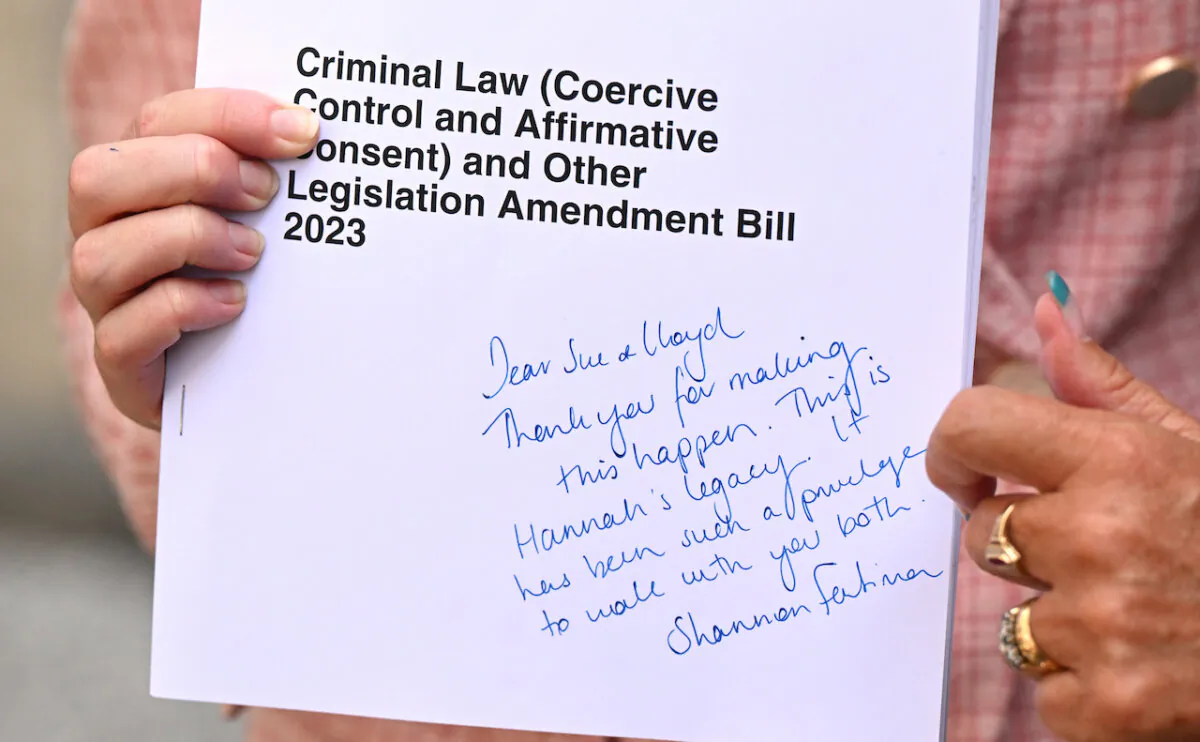

Coercive control will be a standalone offence after the Palaszczuk government introduced new laws that will see those guilty face up to 14 years’ jail.
This follows the passing of similar coercive control laws in New South Wales (NSW) in 2022 that will criminalise “violent, menacing or intimidating” behaviour in a domestic relationship. South Australia has also committed to legislating similar laws.
Queensland’s Minister for Women, Shannon Fentiman, declared it a “historic day.”
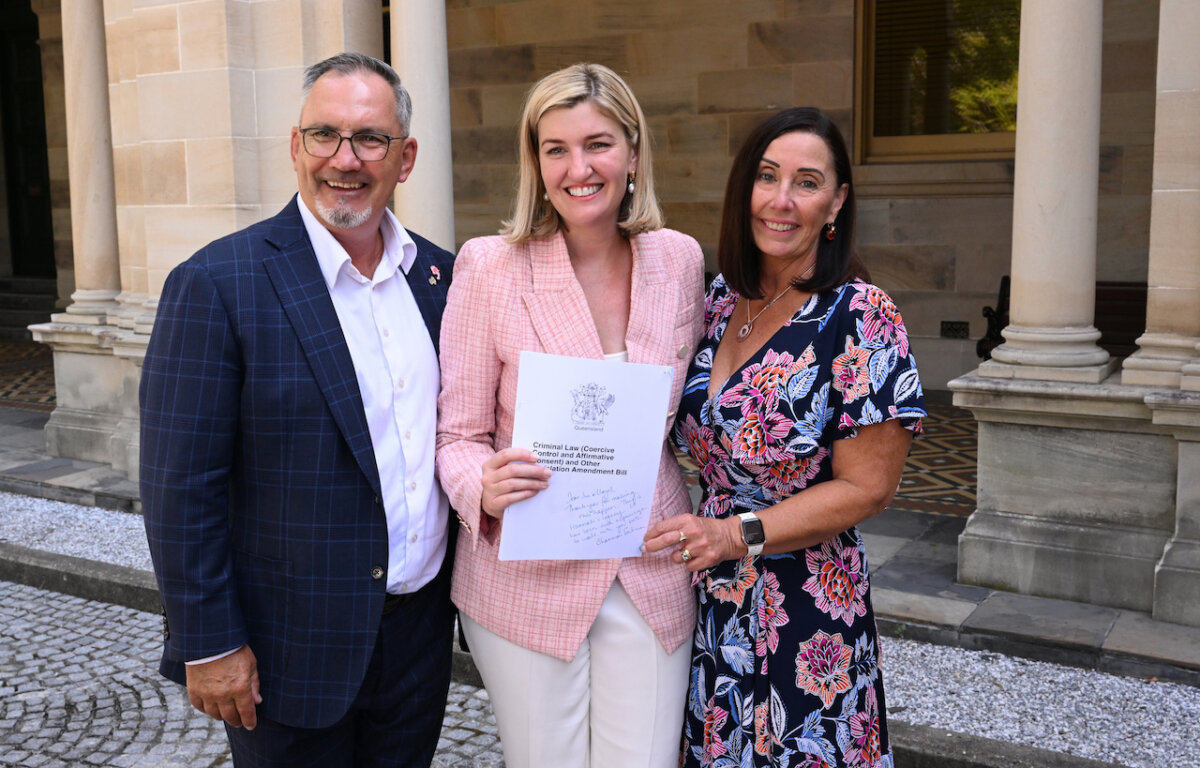
“We know that coercive control is a dangerous form of violence where perpetrators use fear and tactics to really control their victim,” Ms. Fentiman said outside the state’s parliament on Oct. 11.
“Because of the stories that we have heard from Sue and Lloyd Clarke, from Vanessa Fowler and so many other family members, we know just how dangerous coercive control really is.”
Coercive control is a form of abuse where perpetrators display a pattern of behaviour designed to intimidate and isolate the victim, including emotional, mental, and financial abuse, isolation, intimidation, sexual coercion, and cyberstalking.
The new legislation will cover conduct where an adult in a domestic relationship: engages in a course of conduct against the other person that consists of domestic violence occurring on more than one occasion; the person intends to coerce or control the other person; and where the conduct would reasonably likely cause the other person harm.
Harm, as defined under the Criminal Law (Coercive Control and Affirmative Consent) and Other Legislation Amendment Bill 2023, could be “physical, emotional, financial, psychological or mental, whether it’s temporary or permanent.”
It would also be an offence if a person is found to have committed coercive control on behalf of the perpetrator. This was a recommendation by the Women’s Safety and Justice Taskforce, which examined coercive control in Queensland.
Meanwhile, stealthing—removing a condom during sex without consent—will be considered rape and result in a maximum penalty of life imprisonment under the new laws.
Starts off Being ‘Very Subtle’: Parents of Deceased Daughter Tells of Coercive Control
Also speaking in front of the state parliament were Sue and Lloyd Clarke, whose daughter Hannah and her three young children tragically died after her estranged husband Rowan Baxter set fire to their car in February 2020.
“It’s very subtle. When (Hannah) first started going out with him, he got her to shut her Facebook page down … she couldn’t walk up the beach in bikinis, and slowly over time, more and more things come,” Ms. Clarke said.
Mr. Clarke said it has been “one hell of a rollercoaster ride.”
“We’ve seen it first hand, and I’m so glad that the present government has listened to our stories and our advocacy.”
The Clarkes have advocated for coercive control to be criminalised ever since their daughter died, earning them 2022 Queensland Australian of the Year honours.
They also operate the Small Steps 4 Hannah Foundation, which educates children and supports victims and their families.
“Now we need to step up education and awareness campaigns, so everyone from friends and loved ones to first responders and judges can recognise the signs of coercive control and take action,” Mr. Clarke said.
Queensland Premier Annastacia Palaszczuk said the Clarkes deserved credit for the new laws, which is expected to come into effect in 2025.
“Anyone who has met them has been touched by, not only the tragedy that they have gone through, but how they have now devoted their life to making a difference,” Ms. Palaszczuk said on Oct. 11.
The Proposed New Stealthing Laws
The proposed legislation also seeks to criminalise stealthing—removing a condom during sex without consent or knowledge.
The act will be considered rape and attract a maximum penalty of life.
This will bring Queensland in line with other jurisdictions, with the exception of the Northern Territory and Western Australia.
“Failing to use or interfering with a condom strikes at the heart of a person’s right to bodily autonomy and their right to choose whether and how they participate in a sexual activity,” Ms. Fentiman said.
Di Macleod, director of Gold Coast Centre Against Sexual Violence, said she supported the move to consider stealthing rape, reported the Courier Mail.
“I welcome the state government’s introduction of these laws to better reflect the reality of sexual violence and to increase victim-survivor’s access to justice,” she said.
Men’s Rights Activist Warns of False Allegations
Over the past decade, the federal government has spent $3 billion on initiatives to end violence against women and children.
However, men’s advocate Bettina Arndt said domestic violence rates have not reduced, and warned of false allegations against men.
Ms. Arndt pointed to a case in the NSW court in 2022 in which a Sydney woman falsely accused her ex-husband of rape, domestic violence, and assault after they divorced.
The man spent 32 days in jail and paid over $350,000 in legal costs before the judge ruled that the wife’s case against the man was “most unsatisfactory.”
Ms. Arndt wrote in an op-ed on The Epoch Times that it was quite a “high bar to prove someone has intentionally lied or falsified evidence,” noting that it was also difficult to find such a person guilty of malicious behaviour.
“Trust in our law depends on an assumption of fair treatment. We need to know that police and prosecutors aren’t there just to act for one side, but to ensure consequences for wrongdoing—that includes maliciously using false allegations to weaponise the legal system against the object of their grievance.”
Data from the Australian Bureau of Statistics (ABS) shows that in 2021-22, 2.3 million women experienced partner emotional abuse from their partners, while that figure is 1.3 million for men.
Meanwhile, 1.7 million women experienced physical or sexual abuse, compared to 526,600 for men.
1800 RESPECT (1800 737 732)
Lifeline 13 11 14
National Sexual Abuse and Redress Support Service 1800 211 028
 Friends Read Free
Copy
Facebook
Tweet
Friends Read Free
Copy
Facebook
Tweet