
With inflation still running hot and interest rates elevated, Labor’s economic narrative came under fire during estimates as senators pushed Treasury and Finance officials on rising deficits, housing, and tax.
During the Senate Economic Legislation Committee hearing on Feb. 11, Liberal Senator James Paterson went straight to the government’s budget position, pressing Finance Secretary Jenny Wilkinson on whether bigger deficits and higher public spending risk adding to inflation.
“We’ve got almost a 2 percent deterioration in the budget bottom line over two financial years, 1.9 percent and of that, 1.8 percent is due to government spending. Right?”
Wilkinson responded asking, “So senator, what you’re asking me is … sort of an abstract-type question.”
She then shifted to broader remarks about forecasting and the strength of private demand.
Paterson also tried to force Treasury to respond to media reports suggesting the budget deficit had expanded to $57 billion between the pre-election update (PEFO) and the mid-year update (MYEFO).
He repeatedly asked for the exact dollar figure and demanded an explanation for what drove the shift.
Wilkinson was again did not provide a direct figure, instead pointing Paterson to MYEFO charts that present the budget as a share of GDP—an approach she argued was the most meaningful way to compare medium-term outcomes.
Paterson rejected this framing, arguing dollar figures were easier for the public to grasp and asked Treasury whether the change was driven by policy decisions or weaker economic forecasts.
Productivity Blame Game
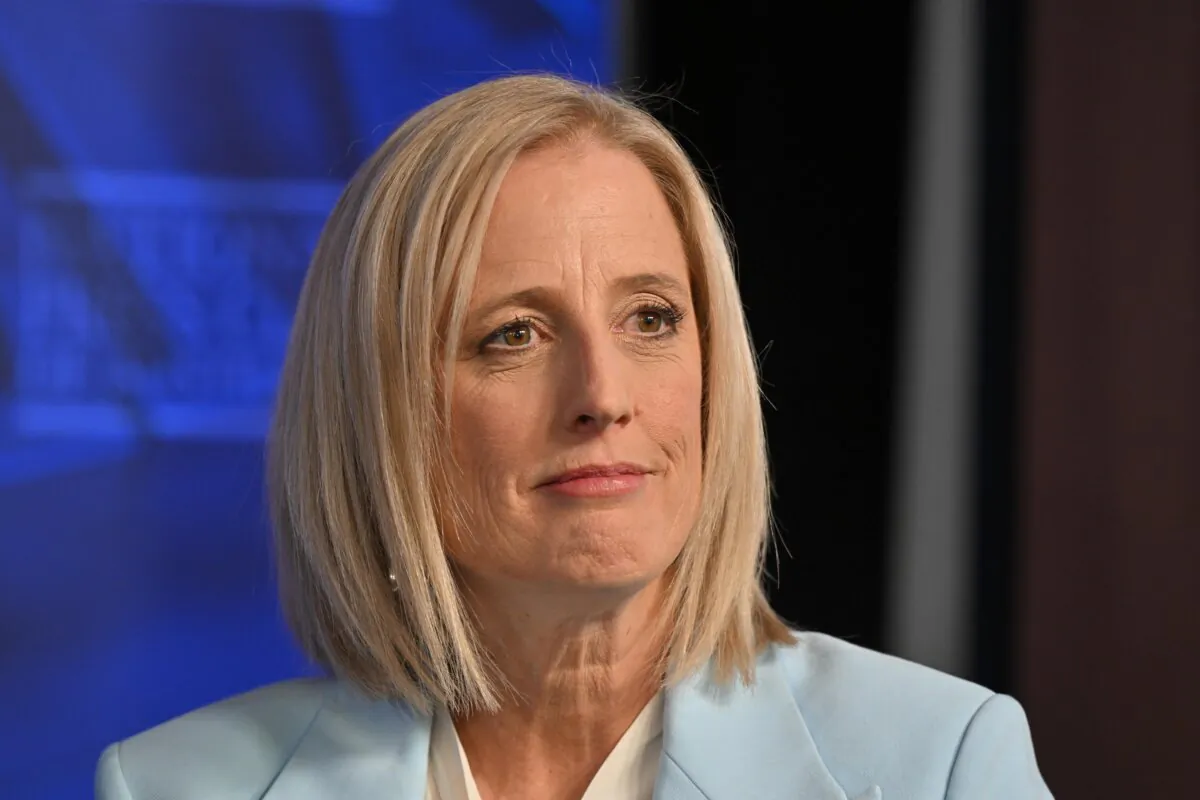
Finance Minister Katy Gallagher, who represented Treasurer Jim Chalmers at the hearing, pushed back against criticism of weak productivity.
“If I just remind you that over the decade to 2020, average annual labour productivity growth in Australia was the slowest in 60 years,” she said.
“And I think even [Liberal] Senator [Jane] Hume acknowledged that when you were in government, you didn’t do enough on the productivity agenda. In fact, you had the Productivity Commission reports and they sat on the shelf and you did nothing.”
Gallagher said Labor had revised down the budget’s productivity estimates on Treasury advice, and argued the treasurer was now driving the agenda.
She accused the Coalition of blocking key measures, saying it had opposed both the government’s reforms bills adding to the delay.
Housing Spend, Weak Supply
The shortage of housing supply was also debated with Liberal Senator Andrew Bragg challenging the government’s claim it is investing more than $45 billion across housing programs.
Bragg repeatedly asked why supply has not returned to levels above 200,000 homes a year, arguing the spending was not translating into completions.
Wilkinson did not dispute the headline number, calling it “a completely reasonable summation” across multiple programs, but did not respond to inquiries on build completions, saying detailed questions should go to Treasury’s housing group.
Bragg highlighted Reserve Bank forecasts suggesting housing construction will weaken over the next few years, despite the government’s housing targets.
Treasury officials declined to speculate on the Reserve Bank’s modelling, but said the RBA uses a technical assumption about the future path of interest rates.
Treasury defended its own projections in MYEFO, forecasting dwelling investment growth of 5.5 percent in 2025–26 and 6 percent in 2026–27, while conceding its 2026–27 forecast had been downgraded since the budget due partly to a higher interest rate profile.
Officials also confirmed the government has paused further changes to the National Construction Code, with consultation underway on streamlining and modernising it.
Submissions close on Feb. 27.
CGT Discount Under Pressure
Treasury also faced questions about the capital gains tax discount, after Greens Senator Nick Mckim cited figures saying it benefits high-income earners.
Wilkinson acknowledged the figures were published in Treasury’s Tax Expenditure Statement but said she could not explain why the distribution had shifted over time and did not want to mislead the committee.
She referred the questioning to Treasury’s revenue group, due to appear later.
She also said cutting the capital gains tax discount for property prices would probably only have a “marginal” impact on home prices.
The capital gains tax discount is often cited as a factor in Australia’s housing affordability debate, with critics arguing it encourages investor demand.
Under the rules, people who hold an asset for more than 12 months can discount 50 percent of the capital gain, a setting some say favours property speculation over first-home buyers.
Treasury Continues to Cite Global Risks
Treasury continued to attribute much of Australia’s inflation challenge to global pressures, pointing to elevated inflation in the United States, the United Kingdom, Canada and New Zealand, and uncertainty linked to U.S. trade policy, the war in Ukraine, and tensions in the Middle East.
Wilkinson said the volatility had flowed into markets, including record highs in gold as investors sought safe-haven assets.
She also defended the domestic outlook, saying there was “underlying positive momentum” and that private demand was contributing more to growth than public demand.
Wilkinson pointed to business investment in software, cloud computing and data centres, and said housing activity was lifting as approvals translated into commencements.
She also flagged risks from natural disasters, saying Treasury estimated the loss of activity could reach nearly $1 billion, or around 0.1 percent of quarterly GDP.
Nearly 120 Million Tonnes of Carbon Sequestration Needed
The government’s net zero modelling also came under pressure, after Coalition senators raised new concerns about the scale of land needed for carbon sequestration.
National Senator Matt Canavan cited Australian Bureau of Agricultural and Resource Economics and Sciences (ABARES) analysis showing that meeting net zero by 2050 could require 119 million tonnes of land-based sequestration.
He further said the agency estimated about 18 million hectares of farmland could be shifted to carbon credit production by 2050 — about “three times the size of Tasmania.”
Treasury officials confirmed they were aware of the ABARES work and said the department had consulted the agency during its own modelling.
However, the official said Treasury did not have the 18 million hectares figure before the government set its 2035 emissions target.
 Friends Read Free
Copy
Facebook
Tweet
Friends Read Free
Copy
Facebook
Tweet