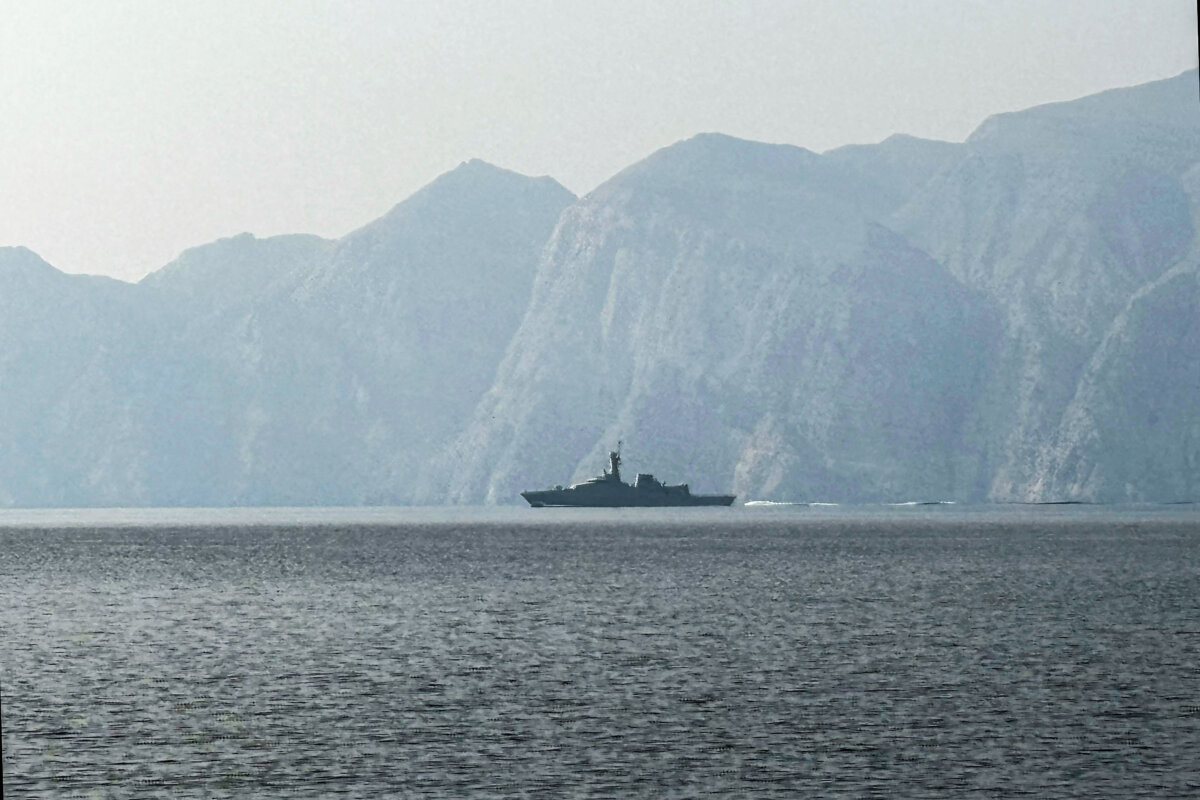

Iran and Iraq are discussing allowing some Iraqi oil tankers to pass through the Strait of Hormuz, Baghdad’s oil minister said on March 17.
Iraqi Oil Minister Hayyan Abdul Ghani said that “there is ongoing communication with Iran regarding allowing some Iraqi oil tankers to pass through,” in comments reported by state media outlet the Iraqi News Agency (INA). Iran has so far made no public comment on the talks.
Global Chokepoint
The issue of the effective closure of the Strait of Hormuz, through which a quarter of all oil barrels in the world pass, has sparked global concern.
Shipping through the vital artery has been disrupted since the United States and Israel began military operations against Iran at the end of February, and Tehran retaliated by firing missiles and drones at Israel and U.S. military assets across Gulf nations.
The discussions between Iran and Iraq come as other talks continue between multiple nations, which are all feeling the pinch as the war sends oil prices upwards.
European Union foreign policy chief Kaja Kallas said on March 17 that diplomatic means must be found to keep the Strait of Hormuz open.
“Nobody is ready to put their people in harm’s way in the Strait of Hormuz. We have to find diplomatic ways to keep this open so that we don’t have a food crisis, fertilizer crisis, energy crisis as well,” Kallas said in an interview with Reuters.
Kallas has floated the idea of replicating a United Nations-brokered deal that allows grain out of Ukraine during wartime. It lets Kyiv export grain, foodstuffs, and fertilizers through the Black Sea, without civilian vessels coming under attack by Russia.
She said she had spoken to U.N. Secretary-General António Guterres about the idea, and that the U.N. was “working on this.”
“Now the question is what the neighboring countries could agree to, especially Iran,” she said.
Greece, a major force in global shipping, has also said it wants a long-term solution to ensure free shipping through the vital waterway.
Greek Foreign Minister George Gerapetritis said on March 17 that the country does not “think that it is optimal to have separate agreements, so that ships enter or leave the Strait of Hormuz.”
“What we want is a well-established lasting solution, which will ensure peace, and this can only be done under a wider alliance and under the auspices of international organizations, and in particular the United Nations,” Gerapetritis said.
Meanwhile, India denied on March 17 holding talks with Iran about releasing three tankers seized in February in exchange for ensuring safe passage for Indian ships through the Strait of Hormuz.
Indian authorities seized the three Tehran-linked ships near Indian waters, alleging they had hidden or changed their identities and were involved in illegal ship-to-ship transfers at sea.
Indian foreign ministry spokesperson Randhir Jaiswal called the report, originally from Reuters, that New Delhi and Tehran had been in discussions over the vessels, baseless.
“There has been no discussion of this nature,” he told a news briefing. “I would also like to say the three vessels you referred to are not Iranian-owned.”
Trump Calls For Aid
President Donald Trump said on March 15 that he had asked around seven countries dependent on the waterway to contribute to its protection. A day before that, Trump said he hopes China, France, Japan, South Korea, and the UK will deploy ships to help patrol the Strait of Hormuz while U.S. forces continue targeting what remains of Iran’s naval capabilities.
This push for allies to help reopen the strait has drawn a patchwork response, with the UK and France signaling support for coordinated action to restore navigation.
Several European and Asian partners are rejecting military involvement, and the European Union is debating whether it can do more to protect shipping without widening the Iran war.
On March 16, Trump said that some countries have agreed to help patrol the Strait of Hormuz, a vital maritime chokepoint for global oil and gas shipments, and that an announcement will be made soon.
“There are a couple, we’ll be announcing some names. There are some that really were right up front,” he said. “I would say this, it’s a lot easier to get people today than it was two weeks ago.”
Iraq Working to Restore Pipeline to Turkey
In addition to the discussions with Tehran, Baghdad is working to bring a disused pipeline back online that would allow oil to be pumped directly to the Ceyhan port in Turkey, bypassing the Kurdistan region, Ghani said in a video statement on March 16, INA reports.
He said that the country will complete an inspection of a 62-mile section of the pipeline within a week to enable direct exports from the Kirkuk region of Iraq.
The reopening of the Kirkuk-Ceyhan pipeline, which has been shut for more than a decade, would offer an alternative export route at a time when shipping through the Strait of Hormuz has effectively been choked off by the ongoing conflict.
Exports via the 596-mile pipeline, which once handled about 0.5 percent of global supply, were halted in 2014 after repeated attacks by ISIS.
The oil ministry said exports via the pipeline could initially reach around 250,000 barrels per day, rising to about 450,000, if crude from fields in the Kurdistan region is included.
Baghdad has sought to use the Kurdistan pipeline as a temporary route for crude flows but said the Kurdistan Regional Government had set arbitrary conditions for its use, warning it may take legal action if exports are blocked.
The Kurdish authorities have rejected the accusations, denying allegations that they are obstructing exports and saying Baghdad has failed to address security and economic challenges facing the region’s oil sector.
Turkey has not yet commented on the proposal to reopen the Kirkuk-Ceyhan pipeline.
Iraq was among the first producers in the Organization of the Petroleum Exporting Countries (OPEC) to reduce its production following the outbreak of the war between Iran and the United States and Israel, with output falling from 4.3 million barrels per day to approximately 1.2 million barrels per day, according to INA.
Evgenia Filaminova, Aldgra Fredly, and Reuters contributed to this report.
 Friends Read Free
Copy
Facebook
Tweet
Friends Read Free
Copy
Facebook
Tweet