
OTTAWA—The Bank of Canada has held its key interest rate steady at 2.25 percent for a seventh consecutive meeting, while warning that higher oil prices and tariffs are putting increased upward pressure on inflation.
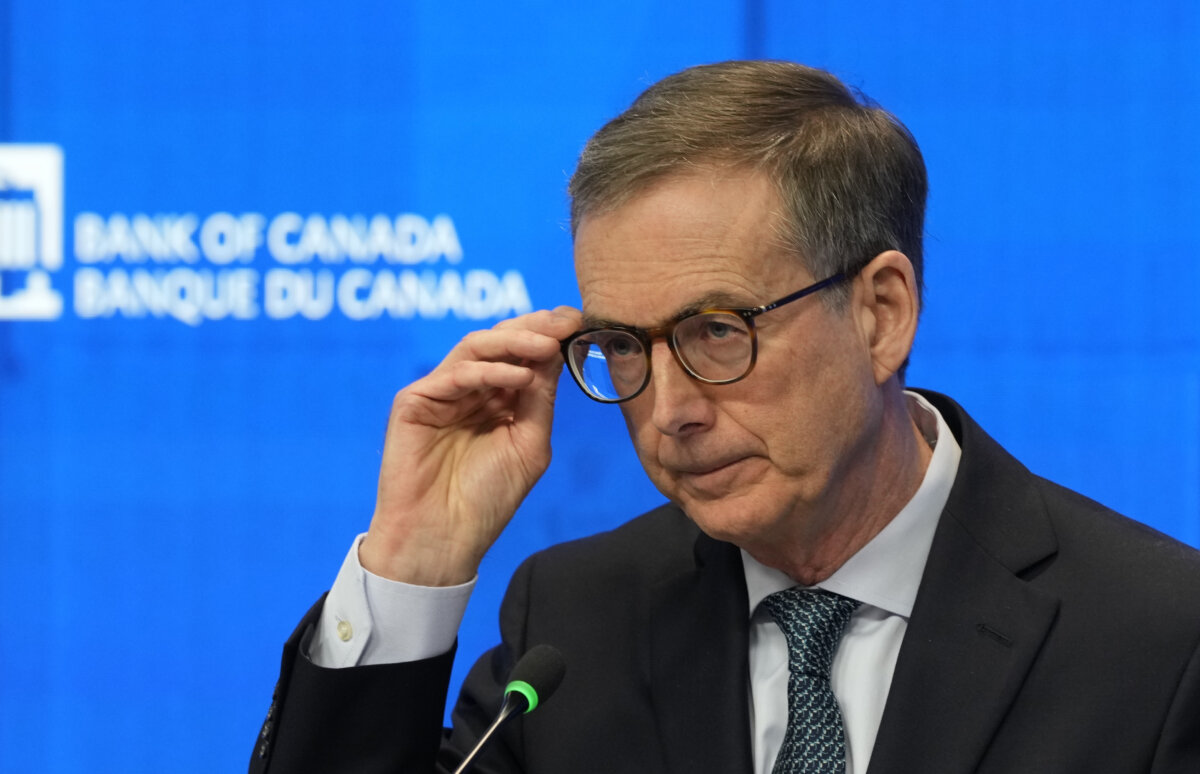
“The longer oil prices and refinery margins stay high, the greater the risk that higher energy prices spill over and turn into persistent inflation. In addition, the new U.S. tariffs and the Canadian counter-tariffs could add costs for some businesses and feed into consumer prices over time,” Bank of Canada Governor Tiff Macklem told reporters in Ottawa on Sept. 2.
Macklem said recent economic data had been largely in line with the Bank’s July forecast, leading it to maintain the interest rate at 2.25 percent. However, he said the “upside risks” to inflation had increased and that the Bank would adjust monetary policy as needed.
The governor said that since the Bank’s last decision in July, the conflict in the Middle East had “persisted without a clear path to resolution,” while shipments through the Strait of Hormuz remained curtailed.
In its July Monetary Policy Report, the Bank of Canada assumed Brent crude would average around US$75 in the third quarter of 2026 and decline to about US$70 by the end of 2027, with West Texas Intermediate following a similar path. Renewed fighting between the United States and Iran has since pushed WTI above US$90 a barrel, reaching US$92.29 intraday on Sept. 2.
Inflation had been elevated by higher energy prices, but the Bank’s July forecast called for it to ease toward 2 percent. Inflation hit 3.2 percent in May, fell to 2.8 percent in June, and rose again to 3.0 percent in July, according to Statistics Canada.
Macklem said the ongoing conflict in the Middle East is “keeping energy prices higher for longer,” increasing the upside risks to inflation. However, the Bank said there has been little evidence so far that higher energy prices have spread to other components of inflation.
Macklem also said the new U.S. tariffs and Canadian counter-tariffs pose uncertainty for the Canadian economy. Washington imposed 50 percent tariffs on CA$27.6 billion worth of Canadian goods effective Aug. 22, while Ottawa has announced matching counter-tariffs that will take effect Sept. 8.
Macklem said that while U.S. tariffs will hit targeted Canadian sectors “hard,” the Bank does not expect them to have a large impact on the overall Canadian economy because the affected products represent only a small share of Canadian exports to the United States.
“However, the situation remains fluid. The added uncertainty about the future of Canada-U.S. trade relations may lead businesses more broadly to delay investment and hiring decisions,” Macklem said.
The Bank noted that the Canadian economy has shown growth after stalling earlier in the year, with real GDP growing at an annualized rate of 3.3 percent in the second quarter of 2026. The Bank described the recovery as “broad based,” with exports and business investment rising and the labour market improving.
When asked by reporters whether the Bank was now more concerned about inflation than low economic growth—which could potentially lead to higher rather than lower interest rates—Macklem said the economy had shown “encouraging” growth despite uncertainty surrounding U.S. tariffs, but inflation remained “too high.”
“We are worried about both risks. The most important thing that is going to guide our decisions going forward is going to be our inflation forecasts and our assessment of the risks around that,” Macklem said.
The Bank said it will assess the sustainability of Canada’s economic rebound and the inflation outlook before making its next interest rate decision. The next decision is scheduled for Oct. 28, when the Bank will also release its next Monetary Policy Report.
 Friends Read Free
Copy
Facebook
Tweet
Friends Read Free
Copy
Facebook
Tweet