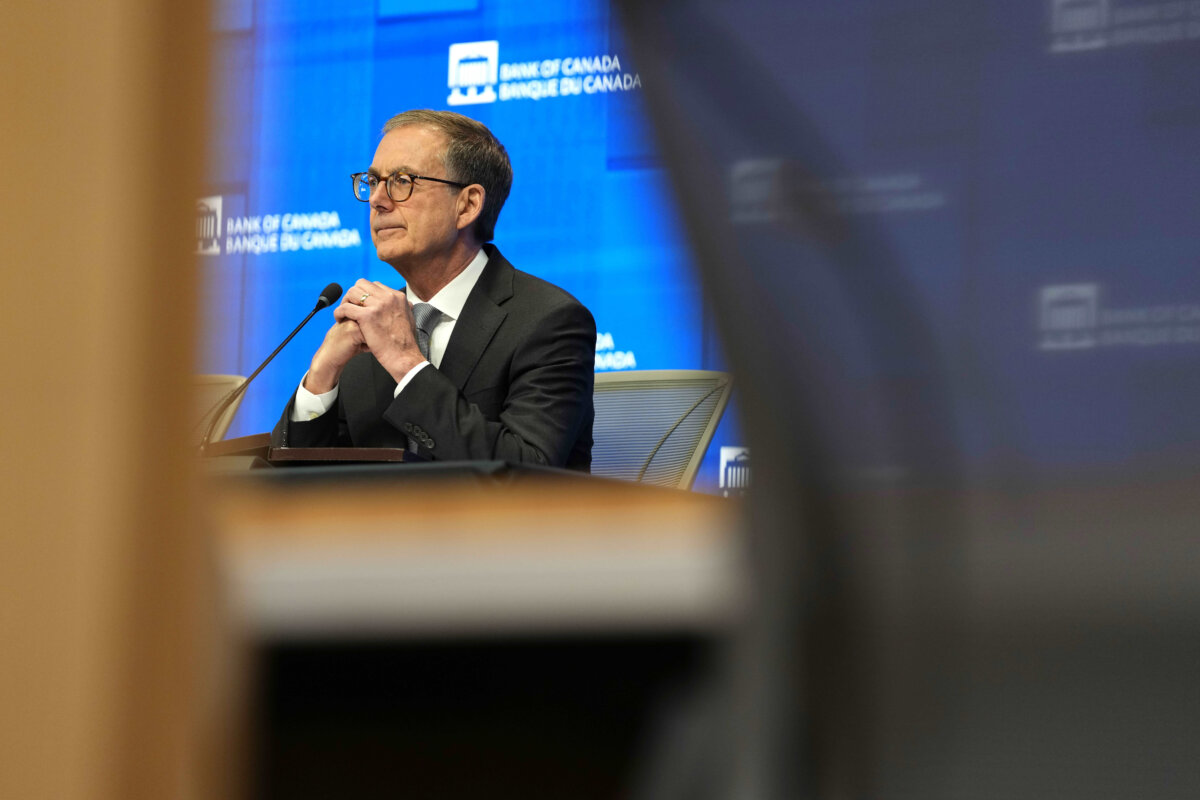

The Bank of Canada has decided to once again keep its policy rate at 2.25 percent, but said the path forward is unpredictable due to continued trade disruptions and the upcoming review of the United States-Mexico-Canada Agreement.
“Our forecast for economic growth and inflation in Canada has not changed significantly since our October projection,” Bank of Canada Governor Tiff Macklem said on Jan. 28.” However, uncertainty around our forecast is heightened, and the range of possible outcomes is wider than usual.”
The Bank’s governing council judged that the current policy rates remains “appropriate,” according to Macklem, but this is dependent on Canada’s economy growing in line with the Bank’s projections. “The consensus was that elevated uncertainty makes it difficult to predict the timing or direction of the next change in the policy rate,” Macklem said.
Macklem said tariffs and uncertainty are continuing to “disrupt” Canada’s economy, and while the third quarter of 2025 saw “strong growth,” it is likely that the fourth quarter saw stalled growth due to lower business inventory investment.
Macklem said inflation averaged around 2.1 percent in 2025, and has been in line with the Bank’s 1 percent to 3 percent range for two years. Consumer Price Index (CPI) inflation rose to 2.4 percent in December 2025 due to base-year effects related to the previous year’s temporary GST holiday.
“The Bank expects CPI inflation to stay close to the 2 percent target over the projection as tariff-related cost pressures are offset by excess supply,” Macklem said.
Macklem said with the upcoming review of the United State-Mexico-Canada Agreement (USMCA) later in 2026, geopolitical risks are “elevated.” Macklem said Canada’s transition into the new trade environment “could be smoother than we expect” due to stronger business and household spending.
“Alternatively, the labour market could weaken further as trade impacts deepen, leading to lower household spending. Financial conditions could also tighten if volatility returns to markets,” Macklem said.
The Bank said while employment in Canada has risen in recent months, the unemployment rate remains elevated at 6.8 percent, and few businesses have said they have plans to hire more workers.
The Bank expects GDP growth will be 1.1 percent in 2026 and 1.5 percent in 2027.
The Bank said the United States is continuing to see economic growth that outpaces expectations, which is driven by investment related to artificial intelligence and consumer spending, but tariffs are also pushing up inflation. The European Union has seen growth supported by activity in service sectors, while China’s GDP growth is expected to slow as weakened domestic demand offsets exports strength.
Monetary Policy Report
In the Bank’s January Monetary Policy Report (MPR), it said Canada’s economic outlook has changed little since its October report. “The Canadian economy continues to evolve much as expected, although quarterly growth patterns have been quite volatile,” the report said, adding that swings in trade and inventories as companies adjust to tariffs has resulted in this much of the volatility.
The report said U.S. tariffs pushed down quarterly GDP growth, and Canadian exports are about 4 percent lower than they were before trade restrictions were imposed.
The report said the average U.S. tariff rate has steadily risen in 2025 from 4.4 percent in July, to 5.9 percent in October, to 5.8 percent by the end of December. By contrast, Canadian tariffs rates on the U.S. fell from 2.6 percent in July, to 1 percent in October, before rising slightly to 1.2 percent by 2026.
U.S. tariffs have lowered Canada’s economic outlook, with an excess in supply of Canadian goods slightly offsetting inflationary pressures. The report said Canada’s GDP is projected to be 1.5 percent lower by the end of 2026 than the Bank projected in its January 2025 MPR.
The report said the upcoming review of USMCA is “unclear” and the negotiations could lead to many possible outcomes. This includes an 16-year extension of USMCA with limited changes, USMCA being re-negotiated with significant changes to rules of origin that makes trade more expensive, or the three countries failing to reach an agreement and reviewing USMCA every year until it expires in 2036.
Nearly all of Canada’s exports are compliant with USMCA, the report said, which has “helped preserve the competitiveness of Canadian exports overall.” An unfavourable outcome to the review would make Canadian exports less competitive, which would lead exporters to reduce production and investment and spill over into Canada’s broader economy.
Canadian businesses are continuing to diversify their trade and expand to new countries, although the report said these adjustments will take time and initially be costly.
The report said geopolitical uncertainty is elevated, and escalating tensions could disrupt supply chains and global commodity markets, leading to higher-than-expected inflation.
 Friends Read Free
Copy
Facebook
Tweet
Friends Read Free
Copy
Facebook
Tweet