A B.C. Supreme Court judge has found that one aspect of Canada’s drug-trafficking law is unconstitutional when it blocks non-medicalized “safer supply” programs without providing a practical way for them to operate legally.
Justice Catherine Murray issued the ruling on Sept. 29 in R. v. Kalicum, a constitutional challenge brought by Drug User Liberation Front (DULF) co-founders Jeremy Kalicum and Eris Nyx against the federal drug-trafficking law under which they were charged with possessing cocaine, heroin, and methamphetamine for the purpose of trafficking.
“After losing countless friends, colleagues, and neighbours to the crisis, they resolved to take action,” Murray wrote of Kalicum and Nyx’s organization and its activities of obtaining, testing, and distributing illicit drugs.
Non-medicalized “safer supply” programs are “urgently needed to save lives,” Murray added in her judgment, stating that the two “have borne the burden of bringing a successful constitutional challenge, doing a public interest service at considerable cost to themselves.”
B.C. has had a prescription-based “safer supply” program since the spring of 2020, but Kalicum and Nyx argued successfully in their challenge that there was also a need for a non-medicalized model outside the existing prescription system.
Specifically, Murray found that Section 5(2) of Canada’s Controlled Drugs and Substances Act (CDSA) breaches Section 7 and Section 15 Charter rights to life, liberty, and security of the person as well as equality rights due to preventing a non-medicalized safer supply program from operating legally even where it was saving individuals from serious harm or death and where it had no practical path to get a legal exemption.
“This challenge is about the lack of ability to obtain an exemption,” Murray wrote in her ruling. “It has been over 11 years since the toxic drug crisis was declared a public health emergency. It remains an emergency.”
“Safer supply” programs, supervised injection sites, and other “harm-reduction” approaches to addiction have come under increased scrutiny in recent years as B.C. and other provinces struggle with an addiction crisis and the issue of addicts using drugs near schools and playgrounds.
Critics such as Conservative MP Aaron Gunn have said that the state shouldn’t be sanctioning drug use.
“These policies aimed to ‘destigmatize’ and increase the accessibility of hard drugs in our communities, including fentanyl and crystal meth, and have contributed to the more than 15,000 British Columbians who have died from drug overdoses over the last 10 years,” Gunn said in past comments.
B.C.’s provincial health officer declared a public health emergency over fatal overdoses on April 14, 2016, about 10 years ago. The province recorded 17,102 deaths from toxic drugs from 2016 through 2024.
B.C. received a federal exemption to the CDSA to decriminalize up to 2.5 grams each of cocaine, methamphetamine, and opioids for personal use in January 2023, but political and public pushback and concerns about public drug use led to criminalization of public drug use being restored in most public spaces in May 2024.
The decriminalization pilot program expired Jan. 31, 2026, and a renewal of the exemption was not sought by the province.
Kalicum and Nxy’s Case
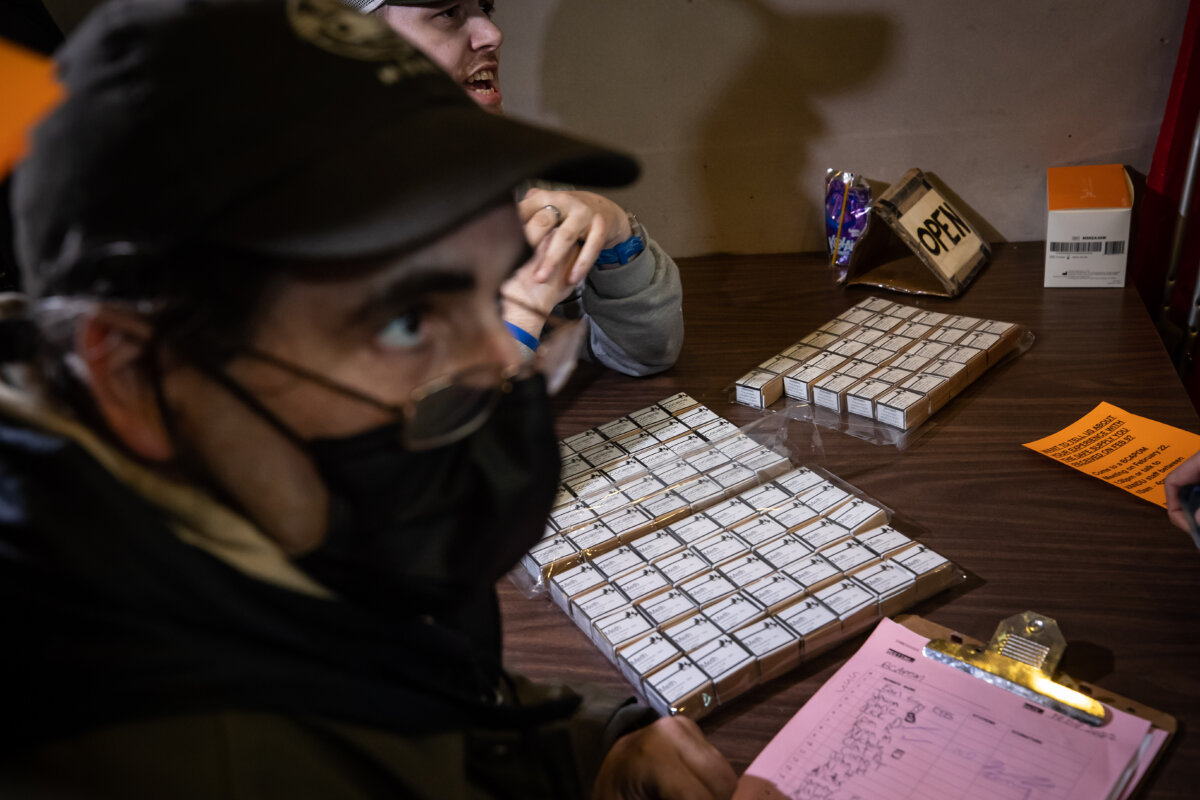
DULF started running a “compassion club” in Vancouver’s Downtown Eastside in the summer of 2022 and distributed cocaine, heroin, and methamphetamine they had obtained illegally to members, selling the drugs at cost after using laboratory testing methods to measure potency and check for contamination or other substances in the drugs.
Kalicum and Nyx stated that their goal was to offer drug users an alternative to untested, illicit drugs off the street and thereby lessen the risk of overdoses.
Prior to opening the club, DULF had requested an exemption from federal drug laws under Section 56(1) of the CDSA in order to operate legally but had been rejected by Health Canada. Section 56(1) gives the federal health minister the authority to grant exemptions to drug laws if doing so is considered in the public interest or deemed medically or scientifically necessary.
Vancouver police subsequently raided the club and the residences of Kalicum and Nyx on Oct. 25, 2023. Both were arrested and charged on May 31, 2024, with three counts each of possession for the purpose of trafficking cocaine, methamphetamine, and heroin.
Later that year on Oct. 15, 2024, Kalicum and Nyx filed a constitutional challenge against the provision under which they’d been charged.
Murray found Kalicum and Nyx guilty of all charges on Nov. 7, 2025; however, she put sentencing on hold until the court could consider their constitutional challenge. This subsequently led up to Murray’s Sept. 29 ruling that was made in favour of Kalicum and Nyx and stayed their convictions, meaning neither will be sentenced.
In addition to finding a constitutional breach due to the lack of a path for the pair to obtain an exemption for their program, Murray found that their operation lessened harm and did not negatively impact public safety or the broader community.
“I think you should be very proud of yourselves, and it’s people like you who make a difference and you just did. So, go do great things,” Murray told Kalicum and Nyx during a brief hearing on Sept. 29, adding, “I have no doubt that you will.”
Murray’s ruling does not void the federal law against possessing drugs for the purpose of trafficking; she suspended her declaration for six months to give the federal government time to respond to her decision via legislative, regulatory, or exemption system changes.
“The government should be given full opportunity to craft its own response,” Murray wrote in her ruling.
The Crown has 30 days to appeal Murray’s decision. Health Canada said it is aware of the case but has not yet decided whether to appeal it.
“We are aware of the decision and are reviewing it,” a spokesperson told The Epoch Times in a Sept. 30 statement. “Given that the appeal period remains open, we are not in a position to provide further comment at this time.”
Reaction
Speaking outside the B.C. Supreme Court courthouse in Vancouver on Sept. 29, Kalicum and Nyx’s lawyer Tim Dickson said the ruling is a “vindication” of the work being done by DULF and recognized that their efforts “did save lives” and constituted a “beneficial, positive, evidence-based program.”
“This case should never have been brought to trial. They never should have been prosecuted,” Dickson added.
Yuan Yi Zhu, an assistant professor of international relations and international law at Leiden University in the Netherlands, who is a Canadian, commented critically on Murray’s ruling.
“A judge in British Columbia just struck down the Criminal Code’s prohibition against possessing drugs for the purpose of drug trafficking as unconstitutional,” Zhu posted Sept. 29 on X, referring to the CDSA provision as a Criminal Code prohibition.
“I’d like to see any apologist for judicial activism spin this one,” added Zhu, who is also a research associate at the University of British Columbia’s Centre for Constitutional Law and Legal Studies.
Josh Dehaas, interim litigation director with the Canadian Constitution Foundation, also said that the court is interfering with the work of lawmakers.
“There were already safer supply programs: injectable heroin and opioids dispensed through pharmacies, but that was not good enough for the judge. There must also be a ‘non-medicalized safer supply’ for the convenience of addicts. How is that not clearly a policy decision?” he said in a social media post.
Conservative MP and health critic Raquel Dancho also stated her disagreement with Murray’s ruling and called on the federal Liberal government to appeal the decision.
“The ruling could have significant implications for drug enforcement, with impacts as severe as letting dealers who verify their drugs as ‘safe’ off the hook,” Dancho posted Sept. 29 on X.
“The Liberals must appeal this ruling. Dealing serious drugs must be met with serious criminal penalties. I’m shocked that I even have to say this.”
The Canadian Press contributed to this report.
 Friends Read Free
Copy
Facebook
Tweet
Friends Read Free
Copy
Facebook
Tweet