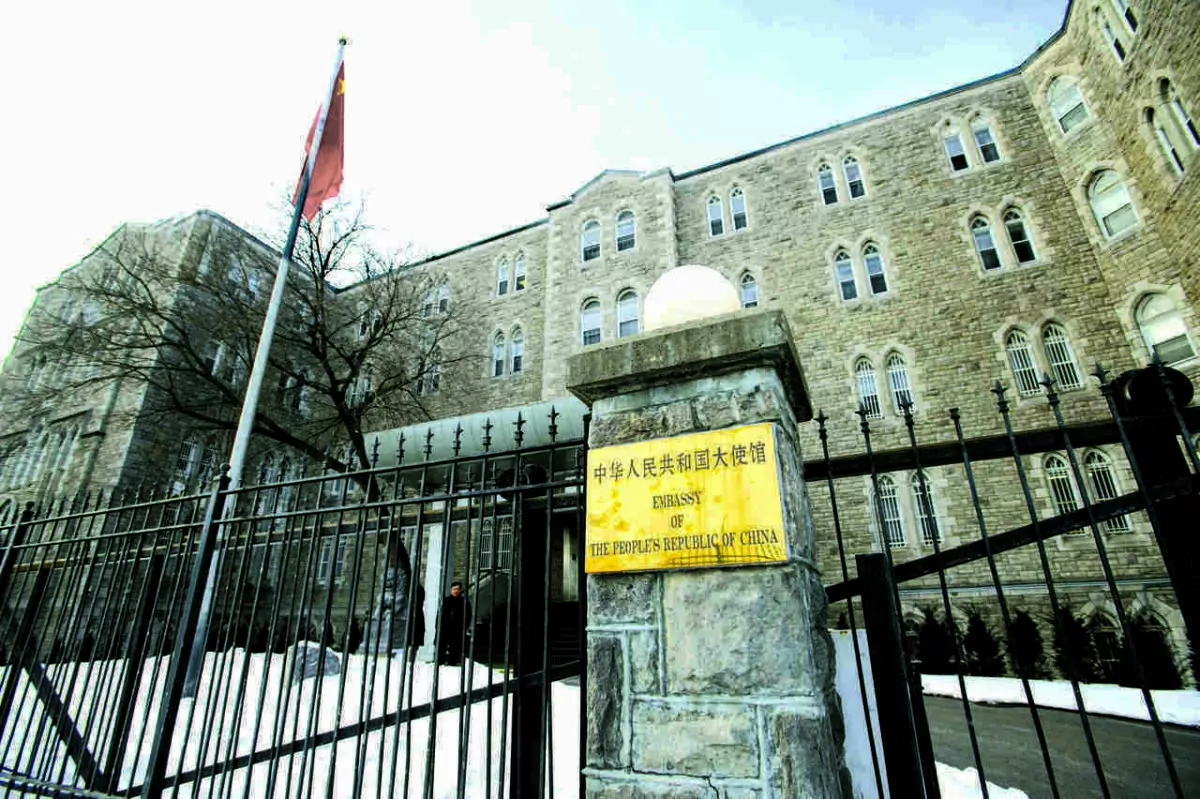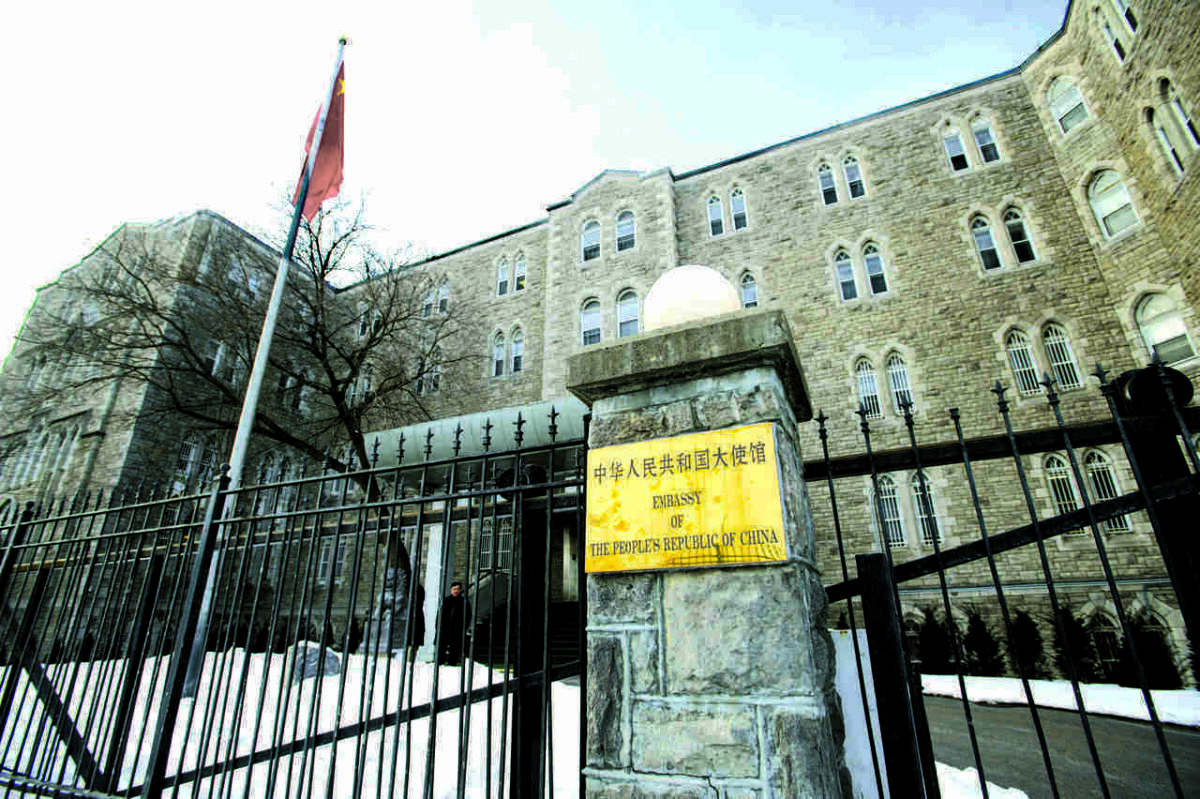

China has organized more than 100 consular “pop-up” events in Canada since 2015, which are framed as providing consular services to the Chinese diaspora community, but serve to advance influence operations, surveillance, and cognitive warfare, a new report says.
The Chinese embassy in Ottawa, in addition to the consulates in Toronto, Montreal, Vancouver, and Calgary, have organized at least 105 consular pop-ups across 11 provinces and 22 cities in Canada since 2015, says the report released Dec. 2 by the Jamestown Foundation.
Pop-up events are held at locations like hotel conference rooms, Chinese cultural centres, university classrooms, and clubhouses. The events can be viewed as “gray zone” activities, the report says, noting they “exploit an ambiguity in international law” and it remains unclear whether pop-up style consular service events that occur in non-designated diplomatic facilities are legal.
The events also serve as a mechanism for political activities and influence operations under the guise of consular services, which may violate the Vienna Convention on Consular Relations, according to the report, which also says it’s unlikely these events have obtained the Canadian government’s consent.
“Even if consent were obtained, evidence suggests that these events go beyond consular services by also providing a platform for political activities,” the report says. “This includes influence operations and cognitive warfare targeting Chinese diaspora communities, united front work strengthening the PRC’s capacity for overseas political mobilization, and the creation of new norms that exacerbate Beijing’s preexisting extraterritorial law enforcement efforts.”
A spokesperson from Global Affairs Canada told The Epoch Times that consular officials accredited to Canada are “free to provide consular services and meet with their citizens in their designated consular district in Canada.”
The spokesperson said in a Dec. 4 emailed statement that foreign missions are free to conduct such activities, but “allowable consular functions are clearly defined” in the Vienna Convention.
“Foreign consular officials in Canada must exercise their duties in accordance with Canadian law and international law. They cannot threaten, intimidate or coerce those in Canada, or otherwise violate Canadian law or Canadian sovereignty,” they said.
The events have been held nationwide in cities in B.C., Alberta, Saskatchewan, Manitoba, Ontario, Quebec, New Brunswick, Newfoundland and Labrador, Nova Scotia, Prince Edward Island, and the Yukon.
The most recent event was held in London, Ont., on Nov. 1 and was organized by the Chinese consulate in Toronto, the report says.
The report points to an example in November 2022 when then-Deputy Consul General Hong Hong led a team from the Toronto consulate to host two on-site document processing sessions in Manitoba at a Chinese cultural centre. Hong had said the events aimed to align Chinese Communist Party (CCP) directives “to explore approaches to enhance the well-being of and strengthen ties with overseas Chinese communities.”
The consular team also made a “special trip” to an elderly couple’s residence in Manitoba to process their passport renewal application, as the couple was unable to attend the event.
Home visits are “an unusual diplomatic practice” and are questionable on legal grounds, usually carrying “significant security implications,” the report says, noting these types of visits can serve as tools for surveillance or coercion under the guise of consular services and “could be used to impose direct or indirect pressure on individuals Beijing deems to be political threats.”
“This sets a potentially alarming precedent for [China’s] growing and pervasive efforts to extend its outreach and exert control over diaspora communities,” the report notes.
“These gray-zone activities, therefore, pose a significant threat concealed within Beijing’s broader coercive repatriation campaigns and transnational repression.”
Focus on Canada
China has organized and hosted consular pop-ups over the last decade around the world, including across the United States and in other countries such as the United Kingdom, Japan, Hungary, Tanzania, and Jamaica.
Meanwhile, the report notes that the scale of operations is “much larger” in Canada than in the United States, with all Chinese consulates and the Chinese embassy in Canada involved, targeting most provincial capitals in the country. The report said this reflects a “sub-national strategy aimed at maximizing influence at the provincial level.”
Comparatively, only some consulates in the United States have been involved in such activities. This suggests “a more coordinated and centralized country-wide strategy” behind the events in Canada, rather than “a localized or fragmented approach,” the report says.
It said events in Canada are also held in “more controlled settings,” such as semi-private locations that are used for such events repeatedly, compared to those in the United States. The report suggests this could indicate Chinese consulates in Canada have sought to keep these “gray zone” activities under the radar.
Pop-up events in Canada also tend to target provincial capitals and smaller regional centres, rather than major metropolitan areas, which aligns with a strategy developed by former CCP leader Mao Zedong in the late 1920s—“leveraging local power to encircle the central authority” or “encircling the cities from the countryside.”
“At the time, Mao argued that because the CCP was weaker than its adversary it should first focus on building power and influence in rural areas before expanding outward through guerrilla tactics,” the report says.
The sub-national strategy “aims to co-opt, influence, and manipulate individuals and groups at the local level to gradually isolate and pressure central authorities to align with the Party’s political agenda,” the report adds.
China’s influence operations have “faced significant pushback” at the national level in Canada after China detained Canadian citizens Michael Kovrig and Michael Spavor in 2018, as well as the discovery of overseas Chinese police stations and electoral interference, and a public inquiry into foreign interference.
“From [China’s] perspective, sub-national efforts can influence decision-making at the local and provincial level while minimizing attention at the national level,” the report says.
Foreign Interference
Concerns about foreign interference and transnational repression by the Chinese regime have been heightened in Ottawa in recent years, with a public inquiry looking into the issue extensively. The final report of the Foreign Interference Commission said that China is the “most active perpetrator of foreign interference targeting Canada’s democratic institutions.”
An investigative report by Spanish NGO Safeguard Defenders in 2022 also indicated that unofficial overseas Chinese police stations were operating in major cities in Canada as part of an operation consisting of similar offices in dozens of countries. Subsequent investigation by authorities confirmed the existence of illegal Chinese police stations in Canada.
Earlier this year, leaders of the G7 countries signed a joint statement condemning transnational repression, pledging to support those who may be targets of this “aggressive form of foreign interference.”
China scholar Charles Burton told reporters on Nov. 29 that the statement “acknowledges the existence of transnational repression, but it hasn’t resulted in Canada taking any effective measures against it as yet.”
“We haven’t expelled any of the diplomats and their proxies who are involved in transnational repression, nor have we declared persona non grata the senior levels within the embassy who are responsible for this kind of program,” Burton said.
Noé Chartier contributed to this report.
 Friends Read Free
Copy
Facebook
Tweet
Friends Read Free
Copy
Facebook
Tweet