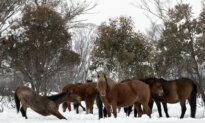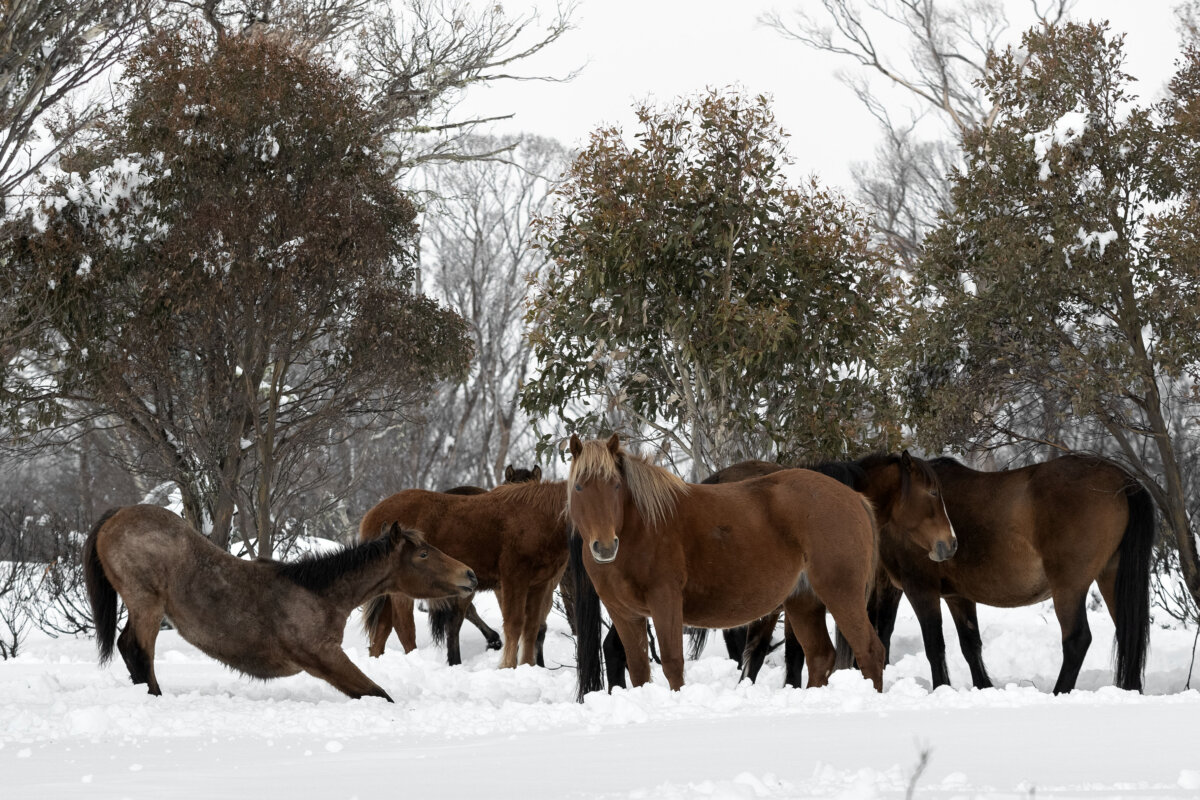

A wildlife biologist and Australian Army veteran says locals around Mount Kosciuszko in the New South Wales (NSW) alpine region are finding the bodies of wild horses that allegedly died in agony during a government cull.
The NSW government lists wild horses, or brumbies, as pests and a threat to the region’s eco-system, with a cull currently paused while numbers undergo a population survey.
Sybelle Foxcroft, who has worked as an environmental expert and investigator, has been observing the situation and says it is unlike anything she has ever witnessed.
“I’ve never seen a campaign so very ugly against an animal,” she told The Epoch Times.
“This is just abnormal.”
In one distressing example, Foxcroft says residents who have grown fond of the local horses discovered the body of a mare which had been shot in the shoulder, appearing to have bled out as she delivered a premature foal.
“There was a mare with two broken legs, a mare giving birth to a foal, this is like sanctioned cruelty and brutality,” Foxcroft said of the aerial culls.
“It’s like they’re trying to make us used to it.
“It’s a case of propaganda being sold to the public to annihilate the brumbies.”
Questioning the Count
The state government plans to cut brumby numbers down to 3,000, but in order to do so, estimates must be made to determine how many horses are in the park.
Foxcroft argued that the counting hazard-rate method used to estimate the number of brumbies in the national park is flawed and is a system never designed to be used in terrain with low visibility areas.
The method relies upon sectional surveys which are then used to calculate a mathematical estimate for the entire park.
And brumby advocates argue the NSW government’s estimate of 10,309 wild horses in Kosciuszko National Park has been questioned through its own scientific peer-review process.
They said the confidence interval for estimated numbers of brumbies had a wide margin of 95 percent, meaning the estimated number may be as high as 16,411 horses in the national park, or as few as 6,476.
Are Brumbies to Blame?
Foxcroft claimed that brumbies are being blamed for environmental damage caused by other factors.
She gave a specific example of she-oak skinks, a species whose decline has been largely attributed to the brumbies’ impact on the environment.
Foxcroft alleged that the culprit is the Snowy Hydro Project, which she says has disturbed the ground and allowed a particular fungus to flourish, impacting the skinks.
She also claimed instances of horses stepping on corroboree frogs are rare.
“They don’t care about the culture, they helped build our country,” Foxcroft said.
“[Brumbies] helped build out country… what else can you think except they’re trying to destroy our heritage and blame them for things they’re scientifically not to blame for.”
Brumbies were a key part of early European settlement in Australia, helping with travel, transport, farming, cattle mustering and war.
The brumby became immortalised in Banjo Paterson’s 1890 poem The Man From Snowy River, which went on to feature in the Opening Ceremony of the 2000 Sydney Olympics.
‘Complex and Challenging’ Management
A spokesperson from the NSW National Parks and Wildlife Service (NPWS) told The Epoch Times that wild horse management in Kosciuszko National Park is “complex and challenging” and that it acknowledges the different views of the public on the matter.
“NPWS has statutory responsibilities to protect the natural and cultural heritage values of Kosciuszko National Park, including through the control of feral animals,” they said.
“There is strong scientific evidence that wild horses damage the park’s fragile alpine and subalpine environment.
“Impacts include trampling and grazing vegetation, eroding waterways and destroying key habitat for threatened species such as the broad-toothed rat, northern corroboree frog and stocky galaxias fish.”
The NPWS said horse culling would resume only after the results of the 2026 wild horse population survey were released.
“Animal welfare is a high priority,” they said.
“All control activities follow strict standard operating procedures and animal welfare standards. These procedures were developed with independent expert veterinary advice and are informed by legal requirements and are reviewed regularly.
“An independent animal welfare assessment was conducted of the aerial shooting program targeting wild horses in Kosciuszko National Park in July 2026.
Performed by an independent veterinarian, no non-fatally wounded and no adverse animal welfare outcomes were recorded during the assessment.”
The NPWS maintains its operations have been compliant with standard operating procedures and comparable to previous animal welfare assessments.
Additionally, a practice of repeat shooting is encouraged in order to kill horses as quickly as possible.
The Epoch Times understands that from June 9 and July 11, 2026, the NPWS eliminated 3,407 introduced animals in Kosciuszko National Park, including 2,009 deer, 1,039 brumbies, 310 pigs, 35 goats and 11 foxes.
 Friends Read Free
Copy
Facebook
Tweet
Friends Read Free
Copy
Facebook
Tweet