
U.S. President Donald Trump’s Board of Peace on Wednesday unveiled a $2.45 billion Gaza reconstruction plan.
The proposal, laid out by board officials during a meeting on the sidelines of the U.N. General Assembly, includes 66 projects to rebuild Gaza’s infrastructure and economy, with an estimated delivery time of six months.
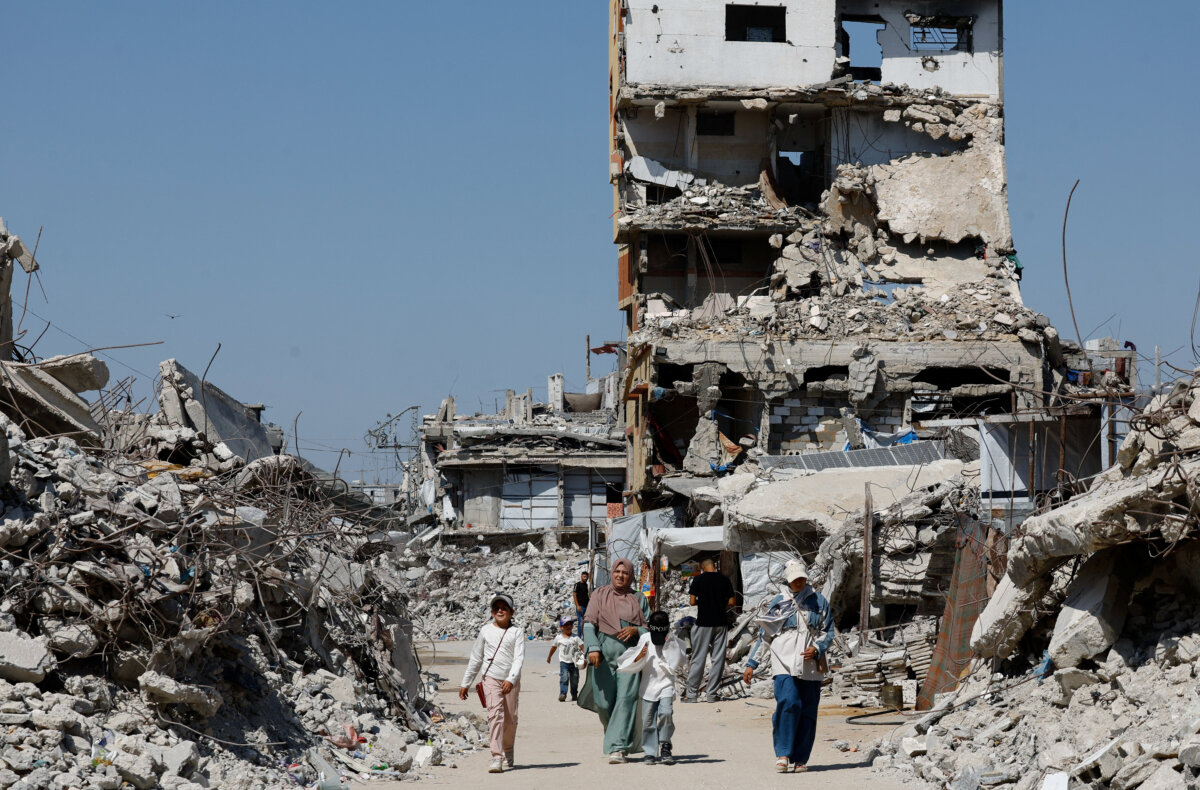
Among the largest proposed projects is a $400 million plan for insulated caravans to house displaced residents currently living in tents and about $275 million for debris recovery, unexploded ordnance management, and recycling operations.
Other major initiatives include approximately $100 million to restore public transport, $78 million to repair partially damaged homes, $67 million to rehabilitate five hospitals, and $50 million to restore hospital services.
Documents the board released Wednesday say the projects are ready to begin as soon as funding and access allow. According to the board, it has already received $18 billion in early commitments.
U.S. Secretary of State Marco Rubio told reporters on Wednesday that the mission was looking for more countries to join those that had already pledged financial assistance.
Trump officially launched the Board of Peace in January to oversee the peace process between Israel and the Hamas terrorist group while addressing other global conflicts. That followed the October 2025 ceasefire that halted large-scale fighting between Israel and Hamas.
The board members, including U.S. envoy Steve Witkoff and President Donald Trump’s son-in-law Jared Kushner, are tasked with overseeing Gaza’s postwar reconstruction and implementation of the U.S.-led peace plan.
Under the framework, Hamas would surrender its weapons to a Palestinian administration overseeing civilian governance, while an International Stabilization Force and a new Palestinian force would assume security as Israeli forces withdraw in phases.
The recovery package, outlined during a Board of Peace presentation on Wednesday, estimates physical damage in Gaza to be about $35.2 billion, while total recovery and reconstruction needs over the next decade are projected to reach about $71.4 billion.
The chief commissioner of the National Committee for the Administration of Gaza, Ali Shaath, said Gaza will rebuild and recover.
“Fewer than half of Gaza’s hospitals remain even partially operational and most schools are silent,” he said in a statement. “But within this lies an opportunity to build something fundamentally different: a Gaza not defined by cycles of fragility, but by dignity, prosperity and visible, real progress.”
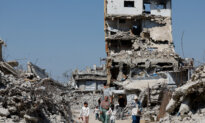
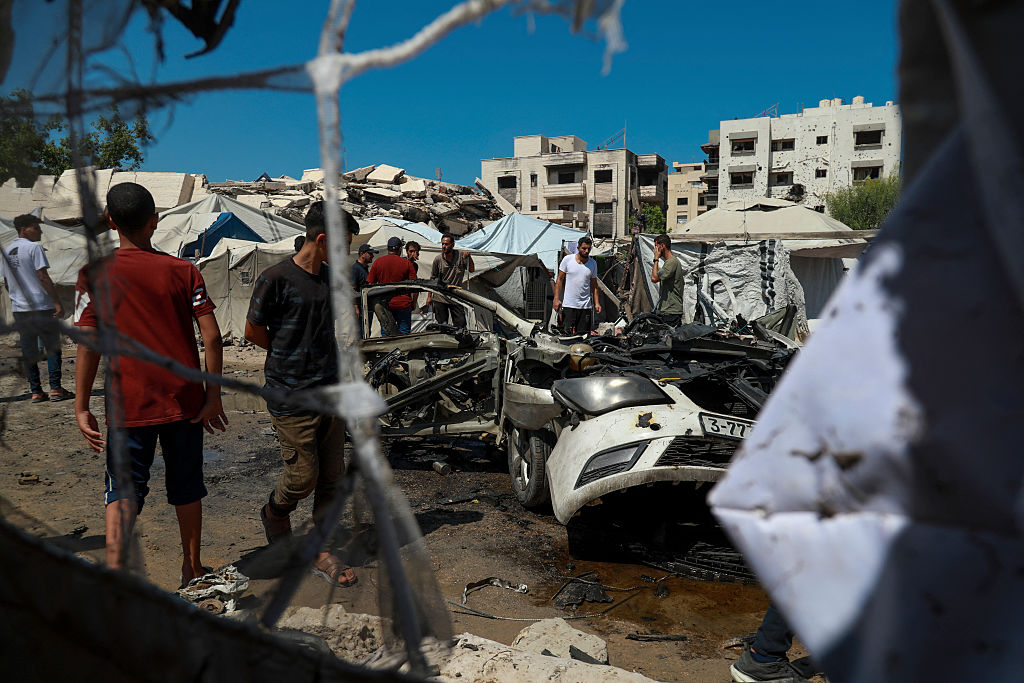 Residents walk through a damaged area beside a destroyed car following Israeli strikes in Gaza City on Sept. 1, 2026. (Eyad Azam/Middle East Images/AFP via Getty Images)
“And even as there’s different delays on different things for whatever reason, we’re still working every day, and we’re just refining and sharpening the axe, getting ready for when we get the time to cut the tree, and hopefully that will be very, very soon,” he said.
He said in a Sept. 23 post on X that the board’s goal is to achieve a fully demilitarized Gaza.
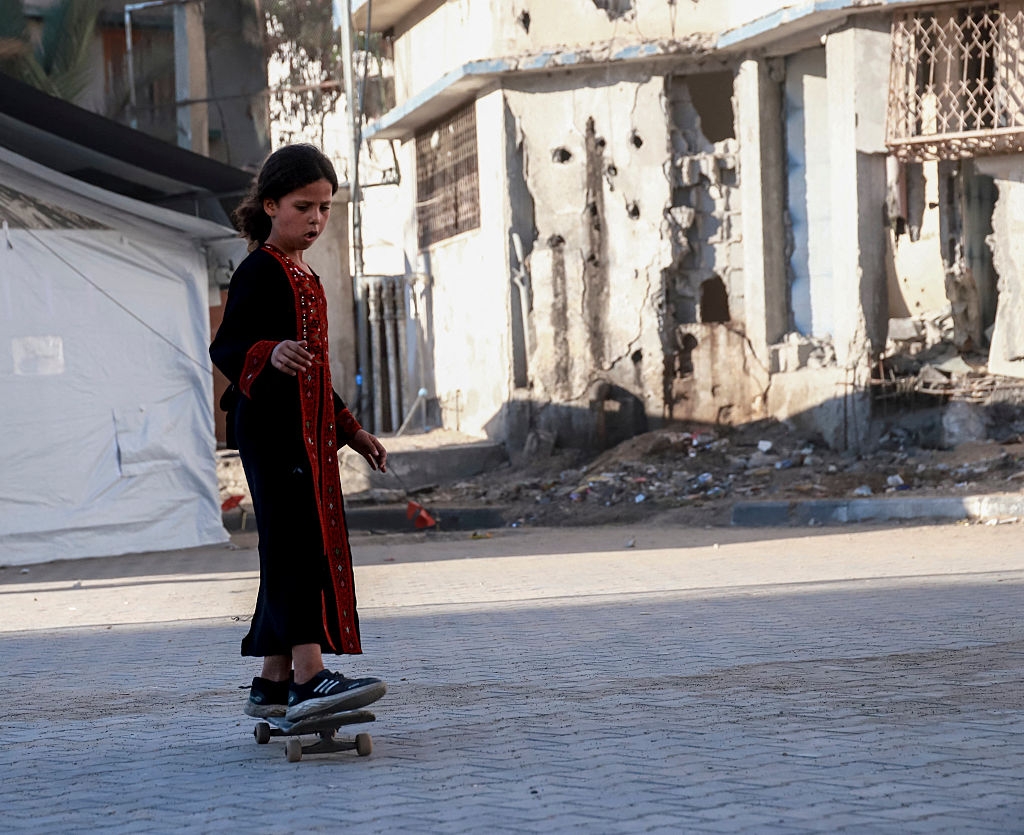 A girl rides a skateboard along a paved street beside damaged buildings and a displacement tent in the Gaza Strip on Sept. 23, 2026. (Mohammed Abusalama/Middle East Images/AFP via Getty Images)
“All of the hostages are home. There is a ceasefire, imperfect as it may be, but it still exists,” he said. “Humanitarian efforts have achieved historic results, with billions of dollars donated and pledged to meet urgent needs and support the long work of recovery.”
Challenges Remain
Although the October 2025 ceasefire ended large-scale fighting, Israeli forces continue carrying out strikes that they say target Hamas and other groups, while Gaza remains divided between Israeli- and Hamas-controlled areas.
Trump in late July said an agreement had been reached for the complete disarmament of Hamas and other armed groups in the region.
The president said at the time that the agreement would be implemented in phases, with Israeli forces withdrawing as disarmament progresses and security gradually transferring to an International Stabilization Force and a new Palestinian security force.
Israeli Prime Minister Benjamin Netanyahu publicly rejected elements of the board’s proposal in August. He said that Israel would not pull back from its current positions until Hamas had been fully disarmed.
Stabilization Force
The commander of the International Stabilization Force for Gaza, U.S. Army Maj. Gen. Jasper Jeffers, said in February that Indonesia, Morocco, Kazakhstan, Kosovo, and Albania had committed troops to serve the mission.
He added that Egypt and Jordan committed to train police. Jeffers said the stabilization force would begin operations in Rafah in southern Gaza, where it would train police before expanding its presence sector by sector.
The board’s high representative, Nickolay Mladenov, acknowledged the challenges ahead, saying the initiative was unprecedented.
“Nobody has ever attempted what we are doing in Gaza,” he wrote in a Sept. 23 post on X. “There will be setbacks and weeks when progress is slow. But a year ago this was an idea on paper. Today it is a plan, with people ready to carry it out.”
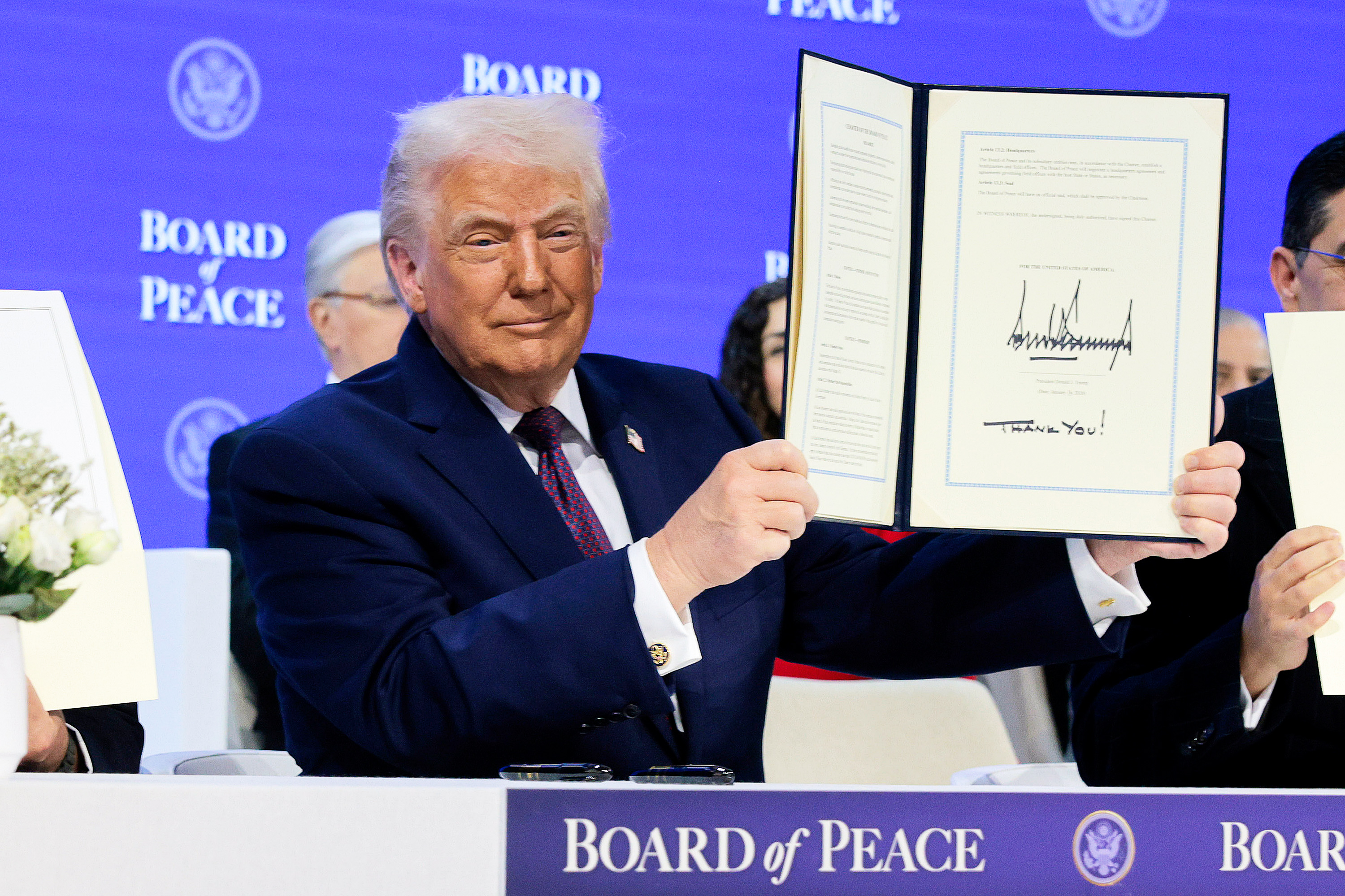 U.S. President Donald Trump holds up his signature on the founding charter during a signing ceremony for the Board of Peace at the World Economic Forum (WEF) in Davos, Switzerland, on Jan. 22, 2026. (Chip Somodevilla/Getty Images)
 Friends Read Free
Copy
Facebook
Tweet
Friends Read Free
Copy
Facebook
Tweet