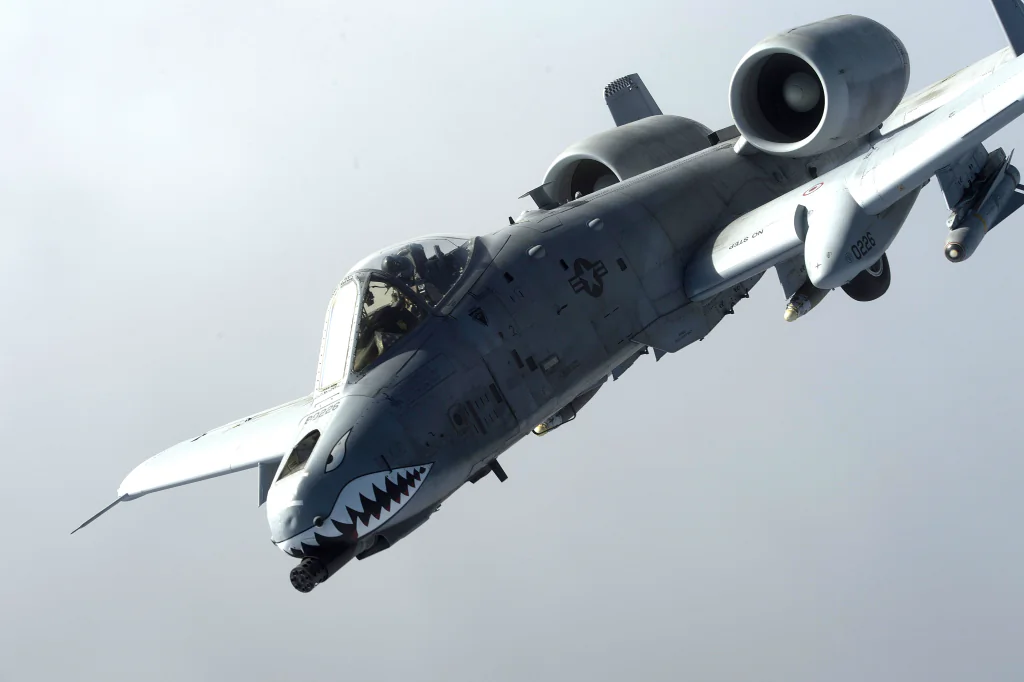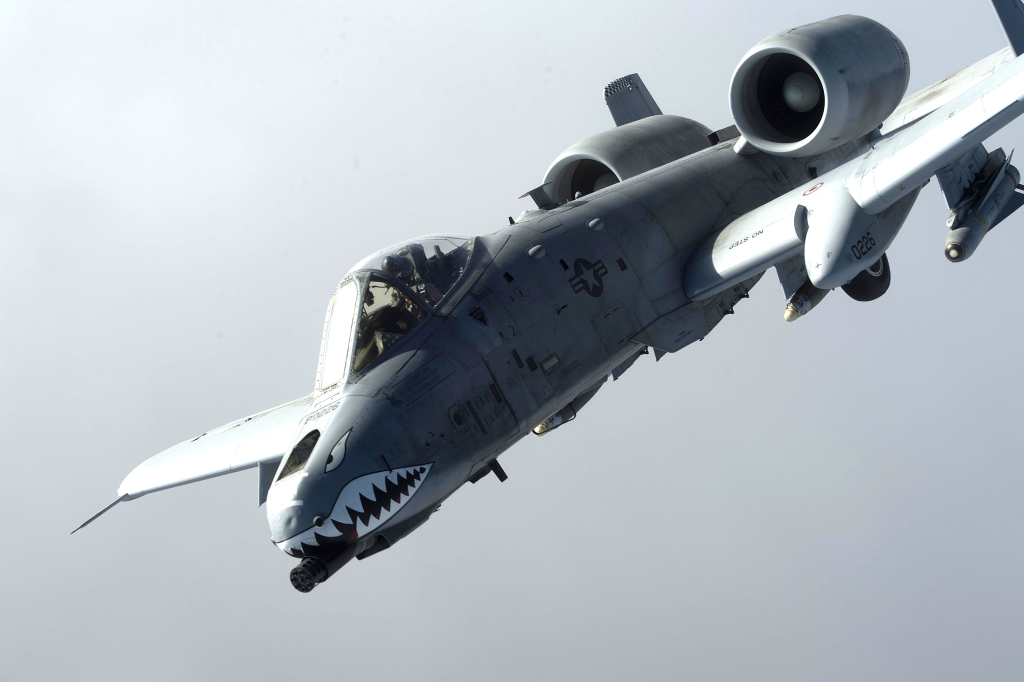

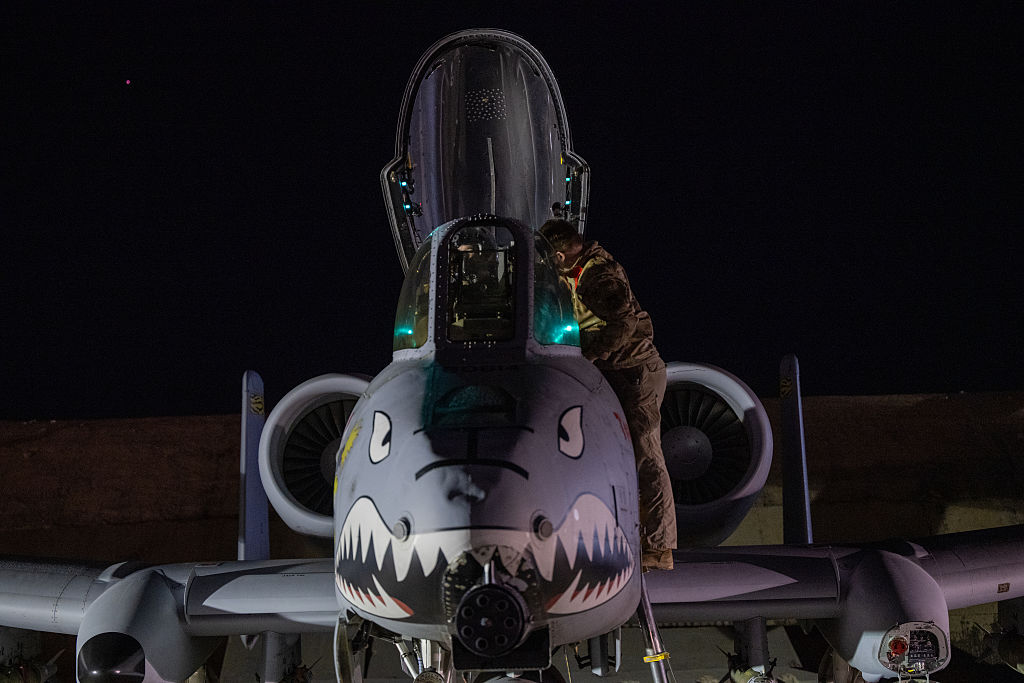
The A-10 Thunderbolt II is not the sleekest, swiftest jet in the U.S. Air Force’s arsenal. Its “slow and low” lumbering is so aerodynamically “ugly” that it is better known by its nickname, “Warthog.”
But to an infantryman under enemy fire or bracing to assault a well-defended position, seeing A-10s barrel onto the battlefield before him is a beautiful thing.
“I definitely had my bacon pulled out of the fire by A-10 pilots and the platform itself,” said retired Marine Special Operations Lt. Col. Ivan Ingraham, who led Marines in combat in Afghanistan and has seen the terrifying tenacity of the “flying gun” in decimating entrenched enemies while absorbing frantic fire no longer aimed at his advancing troops.
The fact that he is alive is “living proof” of the A-10’s devastating, low-altitude, close-air-support lethality, he told The Epoch Times.
Ingraham, a novelist who writes about leadership development on his substack The Logbook and on military matters for, among other outlets, Task & Purpose, The War Horse, and The Epoch Times, is among analysts who see significant portent in an otherwise little-noted development in Operation Epic Fury: the boosted presence of A-10s over targets in Iran.
As first reported on March 31 by Air & Space Forces Magazine, the Pentagon on March 30 began doubling its A-10 Thunderbolt II fleet in the Middle East, dispatching at least 18 additional Warthogs from the Royal Air Force station Lakenheath in the UK and Air National Guard bases in Michigan and New Hampshire into combat against Iran.
There are now as many as 40 in theater.
To infantry veterans and veteran military analysts, the dramatic increase in A-10s means two things: The United States does, indeed, have dominant air superiority and specific objectives are being targeted for the eventual introduction of ground troops.
“I don’t want to get too speculative,” Ingraham said. “But if they’re doubling the number of A-10s, it can only be for the fact that they are going to actually do boots on the ground, and they need something that’s going to be able to protect some sort of forces, or find some sort of overwatch for troops that are going to be engaged.”
Pieces in Place
Before March 30, about a dozen A-10s were already operating in-theater, including in long-standing support of Army units and the Iowa National Guard in Iraq and Syria.
An A-10 was damaged by presumed Iranian ground fire on April 3—its pilot parachuting to safety in Kuwait before it crashed—an indication of Iran’s growing presence. Several A-10s assisted in the rescues of F-15 crewmen in Iran on April 3 and April 5.
“Warthog is now in the fight across the southern flank and is hunting and killing fast-attack watercraft in the Strait of Hormuz,” Chairman of the Joint Chiefs of Staff Gen. Dan Caine revealed in a March 19 Pentagon news conference.
The subsequent late-March boost in A-10 deployments is one piece in a moving mosaic of pieces that could portend the positioning and posturing of Marines and soldiers in the region.
At least 1,000 paratroopers from the 82nd Airborne are in theater. More than 2,200 Marines aboard USS Tripoli are in the Arabian Sea and will be joined by mid-April—under a new moon—by a same-sized combat contingent aboard USS Boxer.
The 10th Mountain Division, already scheduled to relieve the Iowa National Guard in Iraq and Syria this spring, is gearing up for a more robust presence, maybe sooner rather than later.
A third aircraft carrier, USS Bush, will be in range by mid-month, a key “third deck” as the Southwest monsoon becomes more prominent, requiring more “stand down” cleaning and maintenance of jet engines in the Arabian Sea.
All the signs stack up, even with Trump agreeing on April 7 to a two-week delay in his threat to bomb power plants, bridges, and rail lines to continue negotiating with Iran.
Unlike Feb. 28 when the U.S. and Israel launched Operation Epic Fury, if the tentative cease-fire doesn’t hold, those forces will be in place by mid-April should the president think they’re needed.

F-35 No Warthog
Ingraham and other analysts, such as Mike Fredenburg—who writes about military technologies on his substack Mike’s Defense Talk and for The San Diego Union-Tribune, National Review, and The Epoch Times—said that if ground troops are used, their primary air cover will be provided by F-35s, which are replacing the 1970s-era A-10s in the Air Force’s arsenal.
They said that the F-35 has many assets but that when it comes to getting down and dirty in close-in air support, it is no match for the Warthog.
“I have my experience in combat with it as a ground force commander who benefited from its capabilities directly,” Ingraham said. “It’s a purpose-built close air support platform designed for helping ground troops under 10,000 feet in the air. And it’s the only platform that is truly designed to do that.”
Fredenburg wrote in a March 24 opinion piece in The Epoch Times: “Despite Air Force claims that the A-10 has no place on the modern battlefield, a claim it has been making for decades, the A-10 is once again using its unmatched versatility and loitering capability to destroy fast-attack watercraft, drones, and enemy positions.
“And for the role it is performing in Operation Epic Fury, the Warthog is vastly superior to any F-35, F-15, F-16, or B-2, or even the most advanced drone in the U.S. arsenal.”
In June 2025, the Air Force accelerated plans to retire its remaining 162 A-10s by the end of fiscal year 2026. Congress has halted the decline, requiring the Air Force to maintain at least 103. At least 716 were built since 1972, with the last one rolling off the assembly line in 1984.
“Those proclaiming its irrelevance on the ‘modern battlefield’ is nothing new,” Fredenburg wrote. “The A-10 has been delivering stellar performance since it got its first real test in the 1991 Gulf War, where it flew more than 8,000 sorties and destroyed hundreds of Iraqi tanks and thousands of other vehicles.”
“It did so while absorbing ground fire that would have downed any other aircraft, helicopter, or drone,” he wrote.
Ingraham said, “The bottom line is, even now, what they call fifth-, sixth-generation aircraft can’t do the job that the A-10 does.”
 Friends Read Free
Copy
Facebook
Tweet
Friends Read Free
Copy
Facebook
Tweet