
The UK will purchase a dozen U.S.-made F-35A stealth fighter jets capable of firing tactical nuclear weapons, marking the first time since the Cold War that the UK’s air force will be able to carry nuclear arms.
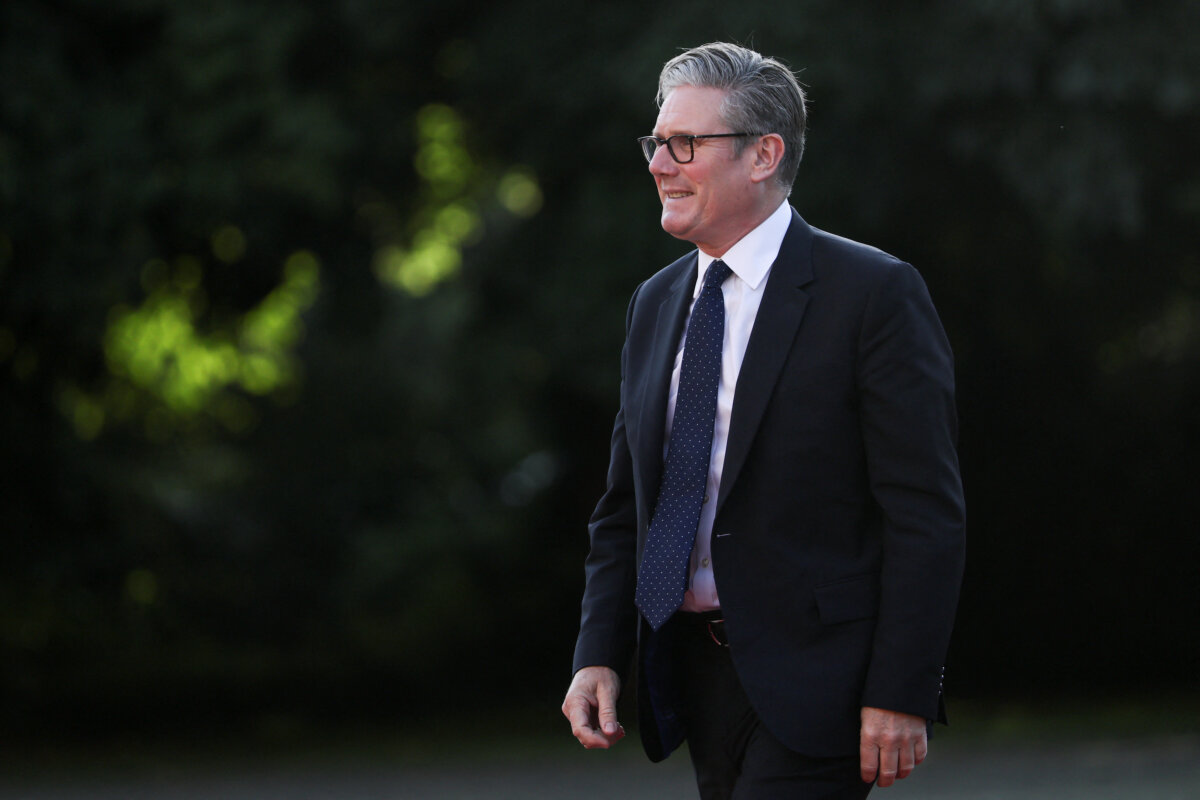
“In an era of radical uncertainty we can no longer take peace for granted, which is why my government is investing in our national security,” UK Prime Minister Keir Starmer said in a statement on June 25.
F-35A fighter jets can carry both nuclear and conventional weapons and are produced by U.S. company Lockheed Martin.
“The purchase represents the biggest strengthening of the UK’s nuclear posture in a generation,” the UK government said.
“It also reintroduces a nuclear role for the Royal Air Force for the first time since the UK retired its sovereign air-launched nuclear weapons following the end of the Cold War.”
Starmer is currently attending NATO’s two-day summit at The Hague—which finishes on June 25—with world leaders such as U.S. President Donald Trump, European Commission President Ursula von der Leyen, and Ukrainian President Volodymyr Zelenskyy.
A defense spending target of 5 percent of gross domestic product (GDP) for each member country is expected to be agreed upon on the last day, more than doubling the 2 percent benchmark set during a summit in Wales in 2014.
The target includes 3.5 percent of GDP for core military spending and 1.5 percent for security-related infrastructure.
NATO Secretary-General Mark Rutte said, “This is yet another robust British contribution to NATO.”
Following the collapse of the Soviet Union in 1990 and the end of the Cold War, the UK reduced its nuclear stockpile and dismantled the ability of the Royal Navy’s surface ships to carry or deploy nuclear weapons.
The WE-177, the last free-fall nuclear weapon with the Royal Air Force, entered service in 1966. In 1995, the then-Conservative government announced that it would withdraw the WE-177 from service by the end of 1998.
Since 1998, Britain’s nuclear deterrent has rested solely on the Trident submarine-based system.
The UK has maintained a continuous at-sea deterrent since the 1960s, currently deployed via four Vanguard-class submarines armed with U.S.-made Trident II D5 missiles.
The submarines are based at Faslane, near Glasgow, Scotland, and are being replaced by Dreadnought submarines being built at Barrow-in-Furness in Cumbria, England, which will enter service in the 2030s.
At the NATO summit, Von der Leyen and Rutte both spelled out the importance of beefing up Europe’s defense industries in order to compete with Russia and other hostile countries such as China and Iran.
Von der Leyen said that in the past few months, there had been a “once-in-a-generation tectonic shift” on defense spending in Europe.
She said the defense industry needed to not just replenish stocks of arms and equipment but to “learn from Ukraine’s battlefield experience.”
Rutte said, “It’s simply unthinkable that Russia, which has an economy 25 times smaller than NATO’s, should be able to outproduce and outgun us.”
He said NATO must produce more arms to prevent war, but he said it required a “quantum leap.”
Currently, no NATO member state dedicates 5 percent of its GDP to defense spending. According to the latest available data, the closest is Poland at 4.12 percent. Several countries, including Italy and Canada, still fall short of the current 2 percent target.
Spain has reached a deal with NATO to be excluded from the 5 percent defense spending target.
Spanish Prime Minister Pedro Sánchez, who is the leader of the Spanish Socialist Workers’ Party, said in a televised address on June 22, “We fully respect the legitimate desire of other countries to increase their defense investment, but we are not going to do it.”
On June 20, Trump said Spain “has to pay what everybody else has to pay” and that Madrid was “notorious” for low defense spending.
At the pre-summit news conference on June 23, Rutte was asked why he had given Spain an exception and what message it sent to other countries that also believe that it’s not necessary to reach the 5 percent spending target.
Rutte said that he has “always had [the] highest respect for Spain’s contribution to NATO.”
“Fact is that Spain thinks they can achieve those targets on a percentage of 2.1 percent,” he said. “NATO is absolutely convinced Spain will have to spend 3.5 percent together.”
Evgenia Filimianova and Chris Summers contributed to this report.
 Friends Read Free
Copy
Facebook
Tweet
Friends Read Free
Copy
Facebook
Tweet