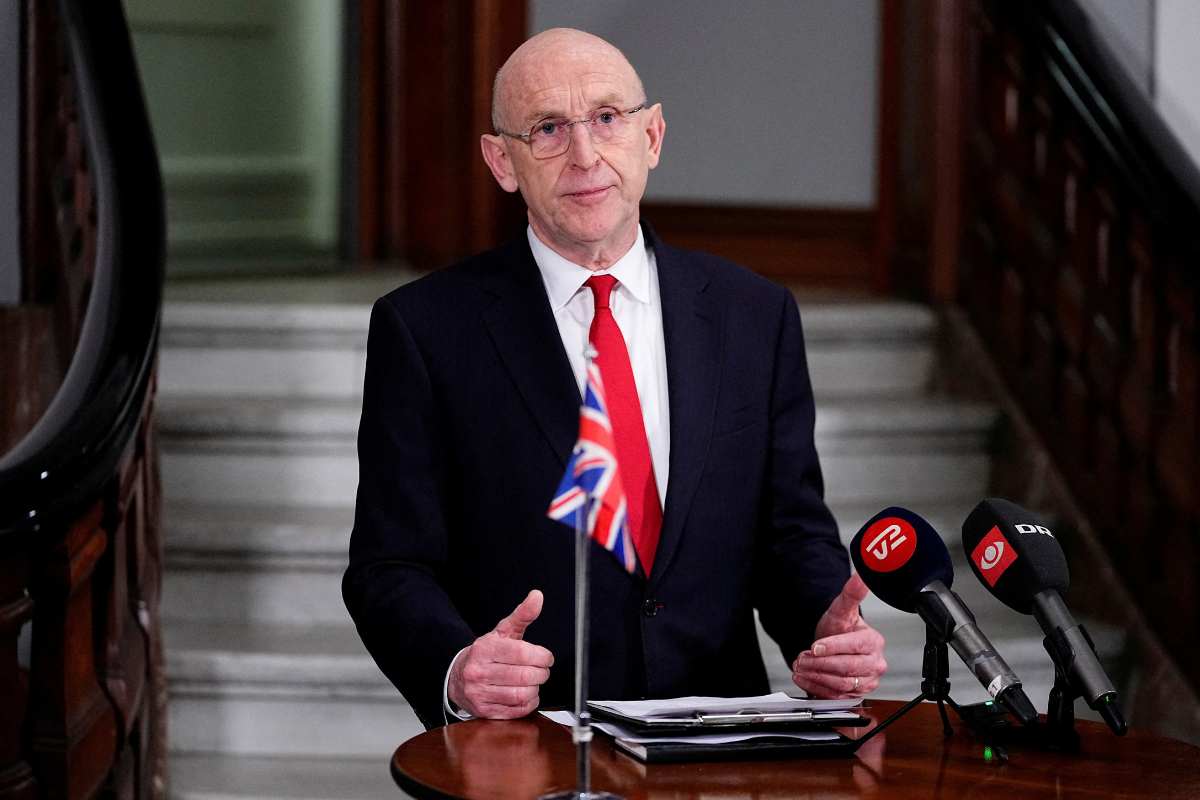

British Secretary of State for Defence John Healey resigned on June 11, accusing British Prime Minister Keir Starmer of failing to commit adequate resources to defend the country amid heightened threats.
Healey announced his shock resignation in a highly critical public letter posted on X, in which he accused Starmer and the British Treasury of being “unable” and “unwilling” to “commit the resources that the nation needs to defend the country at this time of rising threats.”
The Labour MP, who has sat in the House of Commons for almost three decades, said that the prime minister had initially recognised that “Britain faced a new era of threat which demanded a new era for defence,” but, since January, “the demands on defence have increased still further, as have the UK commitments you have rightly made to allies.”
“Conflict in the Middle East, with the UK now leading the multinational Strait of Hormuz military mission; High North security, with the UK now leading NATO’s Arctic Sentry mission; increased Russian activity towards the UK and NATO nations and increased attacks in Ukraine, with the Paris Agreement confirming a British deployment to Ukraine after a ceasefire,” Healey wrote, outlining those commitments which had since been undertaken.
He said that, despite working on a Defence Investment Plan together with Starmer and the Treasury, the resulting final settlement, which Healey said he first saw on June 8, “falls well short of what is required for defence and the country at this dangerous time.”
Healey said that without a plan that “meets the moment,” he is “being forced to make decisions that would reduce the readiness of our Forces and increase the risk to personnel on operations, and could make the country less safe.”
He said the situation left him with “no other option” than to submit his resignation.
Healey had held the post for almost two years, assuming office immediately after the Labour Party ousted the Conservative government of Rishi Sunak in 2024.
The UK’s defense and finance ministries have been locked in talks for months over how to meet rising demands to expand military spending, delaying the Defence Investment Plan, which was expected to be published last year.
Military leaders have stressed that the plan is needed to address the rising threat level amid frequent Russian incursions into British waters, but the government is already struggling to reduce debt while the overall tax burden is at its highest level in decades.
UK Chief of the Defence Staff Richard Knighton told the BBC on June 5 that “this is the most dangerous period that I have known,” adding that “we need to spend more on defence and do it faster.”
“The challenge for ministers is to make those difficult trade-off decisions,” he added.
Many within the UK’s defense industry have also been frustrated over the delay to the plan, saying it cannot invest in long-term programs.
In February, the boss of the UK’s biggest defense company, BAE Systems, urged ministers to publish the plan as soon as possible.
BAE CEO Charles Woodburn said that BAE and other companies wanted clarity on how the money would be spent, saying that the lack of information was delaying investment.
“We were expecting it before the end of last year, and from an industry perspective, we’re all keen to crack on,” he said on Feb.18, according to The Guardian.
“The sooner the better as far as we’re concerned.
“Earlier clarity means that industry can make plans and invest, deploy our strong balance sheets … so looking for clarity is important for business. We’re keen that we see the publication of [the Defence Investment Plan] as soon as possible.”
Last month, the Aerospace, Defence, Security, and Space trade body (ADS), which represents more than 18,000 British companies, also urged ministers to publish the plan.
ADS CEO Kevin Craven described the 12-month gap between the Strategic Defence Review and the Defence Investment Plan as “pretty abysmal,” in comments to the BBC on June 1.
“We’re in a world where all of the threat assessments say that 2027 could be the point at which we come under credible military threats,” he said.
“Whether we do or we don’t, I’m not being alarmist about it, we need to be ready for that, and we’re not, simplistically.”
Craven also said that ADS members, particularly smaller firms, are warning about threats to their long-term future if things do not start progressing.
Starmer said on June 5 that the plan will be published before a NATO summit beginning on July 7.
The UK is currently attempting to cope with Washington’s move away from protecting Europe, while at the same time dealing with the repercussions of the U.S.–Israeli war with Iran, which exposed the Royal Navy’s inability to immediately deploy an advanced warship to the Middle East after the conflict broke out in February.
 Friends Read Free
Copy
Facebook
Tweet
Friends Read Free
Copy
Facebook
Tweet