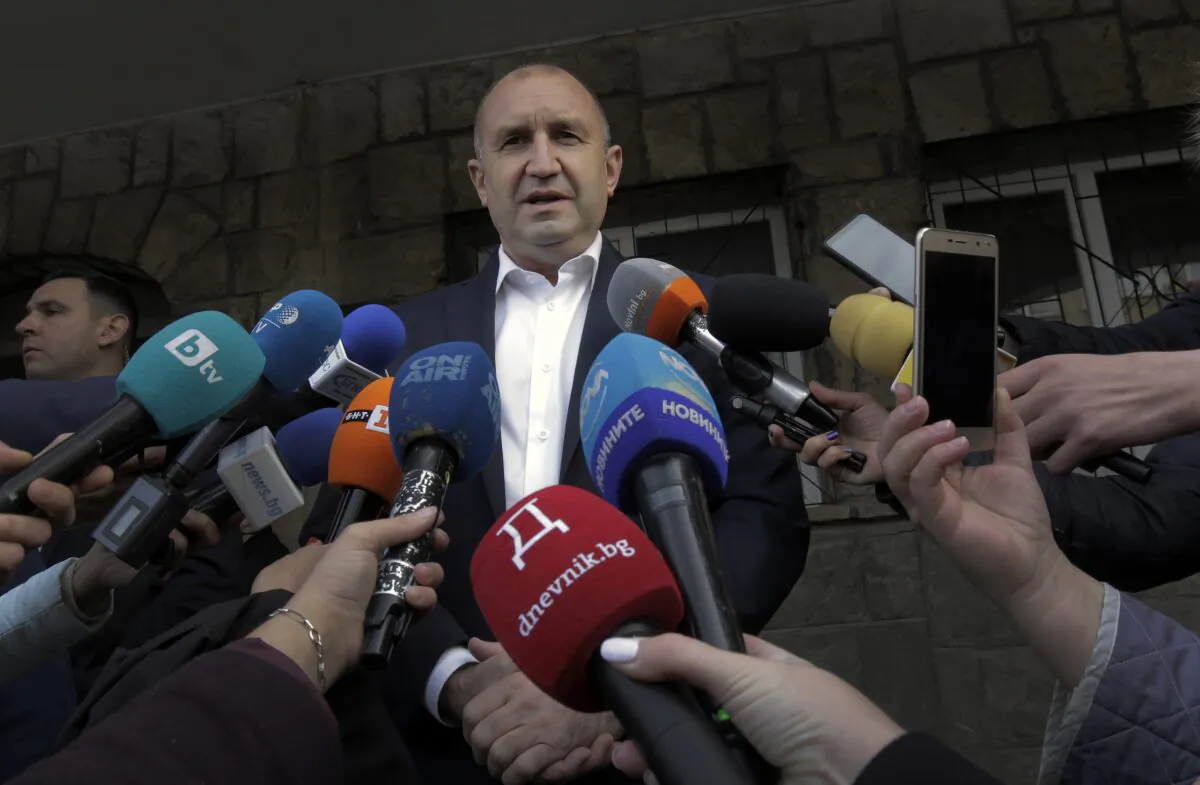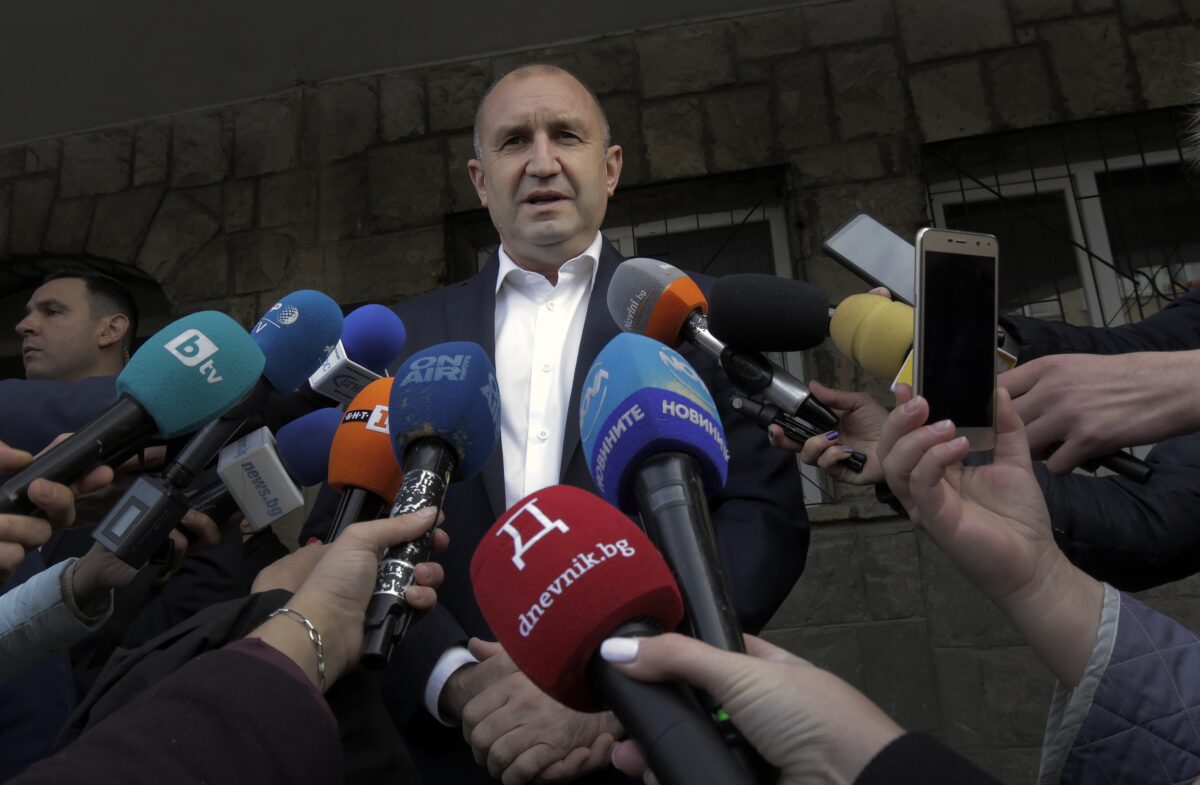

Bulgaria will not allow U.S. tanker aircraft to remain at Sofia Airport for a prolonged period, Bulgarian Prime Minister Rumen Radev said, expressing dissatisfaction that the United States has not granted visa waivers for Bulgarian citizens traveling to the United States.
In March, Bulgaria’s Council of Ministers had authorized the United States to deploy up to 15 aircraft and up to 500 support personnel for nonmilitary purposes at the Vasil Levski Sofia Airport, according to a May 29 report from the state-owned Bulgarian News Agency (BTA).
The country’s Government Information Service announced on May 29 that this arrangement has been extended until June 30, after which U.S. aircraft and personnel will no longer be permitted to remain at the airport.
“At the previous Cabinet meeting, I announced that during my conversation with the President of the U.S., I requested the lifting of visa requirements for Bulgarian citizens. So far, I have not received a positive response,” Radev said during a Cabinet meeting on May 29, according to BTA.
“I fully understand the complexity of the regulatory procedures and the need for time, but we also have our own priorities and procedures and cannot respond positively to the request for the prolonged stay of tanker aircraft at Sofia Airport.”
The United States has a Visa Waiver Program that allows citizens of certain countries to travel to the United States for business or tourism for 90 days without a visa. Beneficiaries of the program include Australia, Belgium, France, Germany, Luxembourg, Greece, Singapore, the Netherlands, Taiwan, South Korea, and the UK.
Bulgaria is not a beneficiary of the program.
In March, Iran had warned Bulgaria against allowing the United States to use its airports for carrying out military operations in the Middle East nation, according to Reuters. Tehran specifically protested against the U.S. military’s refueling of planes parked at the Vasil Levski Sofia Airport.
Bulgaria’s decision to limit U.S. aircraft’s presence at Sofia Airport comes despite the country’s security partnership with the United States.
According to a January 2025 statement from the State Department, the United States and Bulgaria have maintained a security partnership for more than 15 years.
In the previous five years, Washington provided Bulgaria with more than $238 million in security assistance aimed at increasing “military professionalization, human resourcing capabilities, cyber security, divestiture of Soviet and Russian legacy equipment, maritime domain awareness, and NATO interoperability,” the statement said.
The two nations had signed the U.S.–Bulgarian Defense Cooperation Agreement in 2006, which provides the U.S. military access to several Bulgarian military facilities.
The Epoch Times reached out to the State Department for comment but received no response.
Bulgaria and NATO
The Trump administration has asked member nations of NATO, including Bulgaria, to increase their defense spending.
In June 2025, NATO allies agreed to increase their defense spending targets from 2 percent of gross domestic product (GDP) to 5 percent by 2035. Recently, Radev said that his country was committed to spending 5 percent of its GDP on defense.
According to a NATO report, Bulgaria spent an estimated 2.06 percent of its GDP on defense last year.
In a May 28 statement, NATO said that Secretary-General Mark Rutte met with Rudev to discuss the preparations for the upcoming NATO summit scheduled for July 7–8 in Ankara.
During the meeting, Rutte highlighted that Bulgaria was spending more on defense and welcomed investments made in the sector, which is “helping the whole of the Alliance to become stronger.”
The United States and Bulgaria met for a third high-level strategic dialogue in December 2025.
The defense partnership between the two nations boosts security and stability in the Western Balkans, in the Black Sea region, and along NATO’s Eastern Flank.
“Bulgaria’s acquisition of F-16 fighter aircraft and Stryker armored vehicles, joint participation in the multinational NATO battlegroup hosted by Bulgaria, and a developed Bulgarian defense industry all enhance NATO interoperability and common security and support U.S. defense exports and industry,” the U.S. Embassy in Bulgaria said in a Dec. 9, 2025, statement.
Reuters contributed to this report.
 Friends Read Free
Copy
Facebook
Tweet
Friends Read Free
Copy
Facebook
Tweet