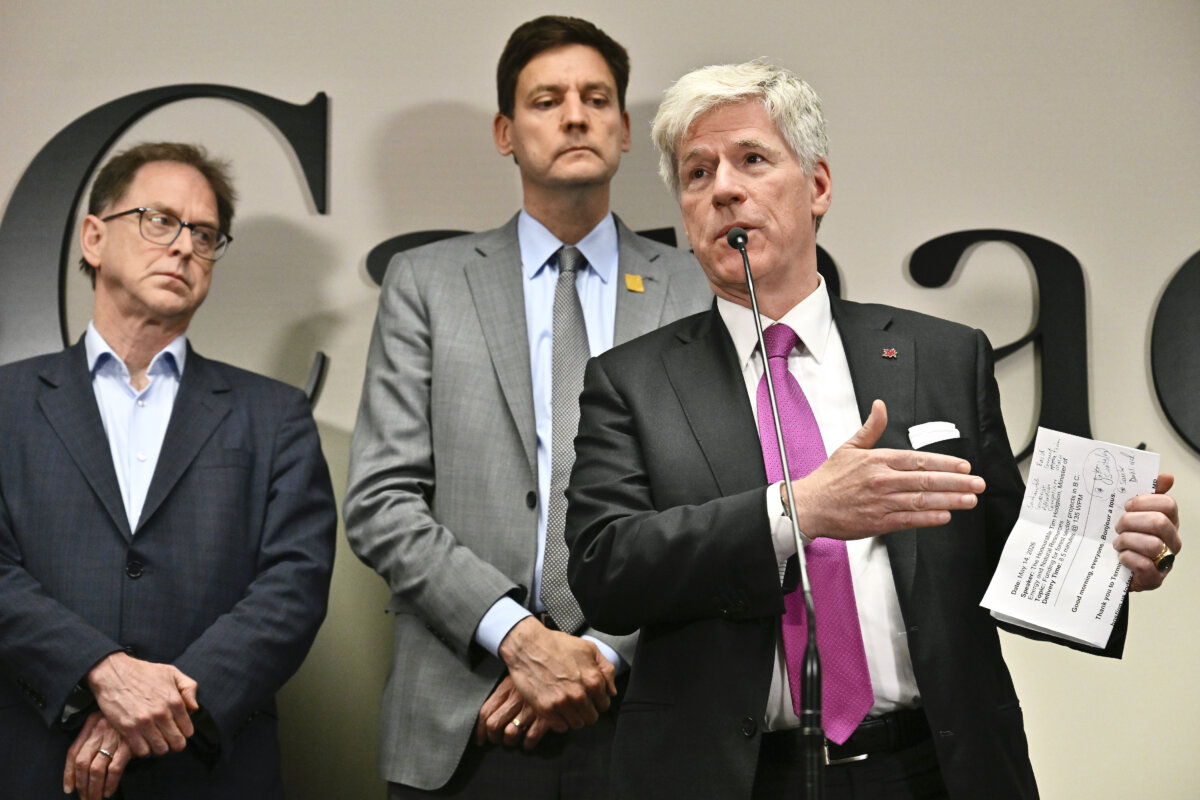

Canada has signed a major long-term contract to send LNG from northwest B.C. to Germany, says Energy Minister Tim Hodgson.
The agreement commits German utility company Securing Energy for Europe (SEFE) to buy 1 million tonnes of liquefied natural gas (LNG) per year for up to 20 years starting in the “early 2030s,” Hodgson said. The gas will be shipped from the proposed Ksi Lisims export facility north of Prince Rupert.
“This contract represents the first agreement that we see long-term, low-carbon LNG from Canada being shipped to our allies in Europe,” he said. “We’re in a world where our allies are begging us to produce our resources.”
The Ksi Lisims LNG project is an indigenous-led development in partnership with the Nisga’a Nation, Houston-based Western LNG and Calgary-based Rockies LNG Partners.
It will operate on hydroelectric power from B.C.’s grid, resulting in emissions levels “approximately 94 percent below the current global average once fully electrified,” according to Hodgson. He said it will move Canada closer to its goal of net-zero greenhouse gas emissions by 2050.
LNG is natural gas that has been chilled into a liquid state, enabling it to be shipped by sea around the world on specialized tankers.
Hodgson said the Ksi Lisims facility could attract roughly $30 billion in private investment and will boost Canada’s GDP by $15 billion over 30 years.
Canada is increasingly viewed as a trustworthy and dependable energy supplier by allies in Asia and Europe, particularly in light of global energy shocks caused by disruptions to tanker traffic in the Strait of Hormuz, the minister said.
“We are in an energy crisis of epic proportions across three dimensions: energy availability, energy security, and energy transition,” Hodgson said, paraphrasing remarks previously made by Prime Minister Mark Carney.
Canada is also particularly attractive as an energy supplier in light of European allies who want to reduce their dependence on Russian energy due to Russia’s ongoing invasion of Ukraine, according to Hodgson.
“They look at Canada and say, ‘wow, you produce the most responsible product in the world, you produce it in partnership with First Nations, you produce it at an effective cost. It’s interesting. We really want to do business with you,'” Hodgson said.
Also speaking at the press event, B.C. Energy Minister Adrian Dix said the agreement illustrates how the province is committing to large-scale industrial growth in conjunction with indigenous peoples and environmental rigour.
“This is how you address issues,” Dix said, adding that approvals and electricity agreements have already been finalized on the project, and that B.C. already has over $100 billion in major projects underway or in the planning stage.
Although the project has regulatory approval, the partners have yet to make a final investment decision, which would clear the way for construction to begin.
Asked about the recent resignation announcement of former Environment Minister and Liberal MP Steven Guilbeault, who has been critical of the Carney government’s shift towards supporting more conventional energy projects such as LNG, Hodgson said the government’s view is to “build” rather than restrict.
“The collective view is the way we’re going to get there is not by telling people what they can’t do, but by building in a more responsible way,” he said. “We’re a big tent party. We have people who share their views. At the end of the day, we come together, we form a collective view, and then we execute on that.”
Environmental groups and some neighbouring First Nations oppose the Ksi Lisims project, saying they are concerned about the impact of the proposed Prince Rupert Gas Transmission pipeline which will be needed to get natural gas from gas fields to the facility.
Asked whether the project may lead to conflicts similar to protests against the since-completed Coastal GasLink pipeline in B.C., Hodgson declined to address the topic directly.
“We’re not going to talk about if, we’re going to talk about how,” he said. “The how is we’re going to do it in an environmentally responsible way, in partnership with indigenous peoples.”
Nisga’a Nation President Eva Clayton also defended the partnership structure when asked about profits that would go partly to a U.S.-based company.
“Many of us indigenous groups were managing poverty,” Clayton said. “We now want to manage prosperity.”
The Ksi Lisims project and a proposed expansion to the existing LNG Canada export terminal at Kitimat, B.C. are both before the federal government’s Major Projects Office, which commits to speeding up approvals for major infrastructure projects deemed to be in Canada’s national interest.
The Canadian Press contributed to this report.
 Friends Read Free
Copy
Facebook
Tweet
Friends Read Free
Copy
Facebook
Tweet