
News Analysis
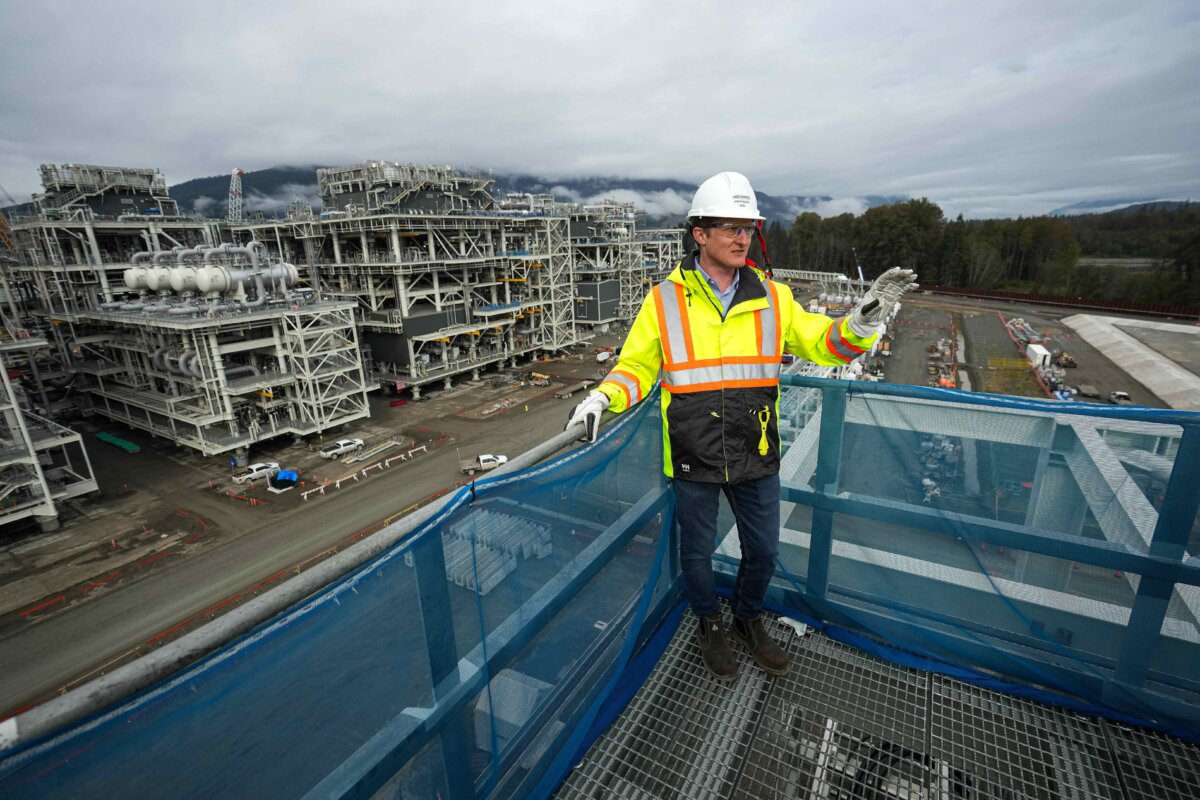
After seven years of construction on an export terminal, the first large-scale shipment of Canadian liquefied natural gas (LNG) was shipped to Asia on July 1 from Kitimat, B.C., marking a start to a largely untapped sector of the Canadian export market.
The U.S. Energy Information Administration projects that North America’s capacity to export LNG will more than double between 2024 and 2028, leaving room for major growth and prosperity in Canada’s LNG industry going forward.
“The future is really bright if we seize this opportunity with a renewed focus nationally on trade diversification, and an understanding that maybe we don’t want to always be reliant on the U.S.,” Cody Battershill, CEO and founder of Canada Action, a grassroots non-profit that supports Canadian energy, told The Epoch Times.
But while industry players welcome the new development, they say there’s still much untapped potential and that Canada is lagging well behind the United States.
“There are still many regulatory barriers and roadblocks from the last 10 years that have not been lowered yet, that have not been removed yet,” Battershill said.
Canada exports far less LNG compared to the United States, which began exporting LNG in 2016 and has eight large-scale export terminals in operation as of March 2025. Five additional export terminals are approved and are either in the commissioning phase or are under construction in fiscal years 2025-26 or 2027 and beyond, as of April 2025, while more terminals have been approved but have yet to be built.
The United States remained the world’s largest LNG exporter in 2024, the U.S. Energy Information Administration says. U.S. LNG exports make up a quarter of the global market, according to an analysis by S&P Global released in February 2025. The U.S. LNG industry has contributed more than US$400 billion to the U.S. GDP since 2016, the study indicated, adding that it’s expected to contribute approximately US$1.3 trillion to the GDP by 2040 and create 500,000 jobs a year on average. The U.S. GDP in 2024 was about US$30 trillion.
Canada, by contrast, has only the one major LNG terminal in Kitimat currently exporting LNG. The country has six other LNG export projects and one infrastructure project in various stages of development, including the Woodfibre LNG terminal in Squamish, B.C., and the Cedar LNG terminal in Kitimat that are under construction and expected to start operating in 2027 and 2028.
A smaller-scale export terminal run by Tilbury LNG in Delta, B.C., started operating in 2017. Preliminary development and environmental assessment is also being done on the Ksi Lisims LNG terminal in Gingolx, B.C.
Still, with 19 accepted LNG proposals in B.C., Battershill sees a shift in energy-friendly policies.
‘A Game-Changing Moment’
LNG Canada’s facility in Kitimat is the largest single private-sector investment in Canadian history. The project was estimated to cost $40 billion to reach operation status, according to a federal government news release in 2019, which also indicated it was expected to create over 10,000 jobs when accounting for pipeline construction as well as other upstream employment. The terminal has a 40-year export licence, allowing export of 14 million tonnes of LNG per year. The company hopes to expand that capacity to 28 million tonnes per year if a second phase of construction goes ahead.
“Now having this first LNG facility finally up and running, as it ramps up to full capacity, it’s really at a game-changing moment, and the potential is quite massive for our country if we seize the opportunity,” said Battershill.
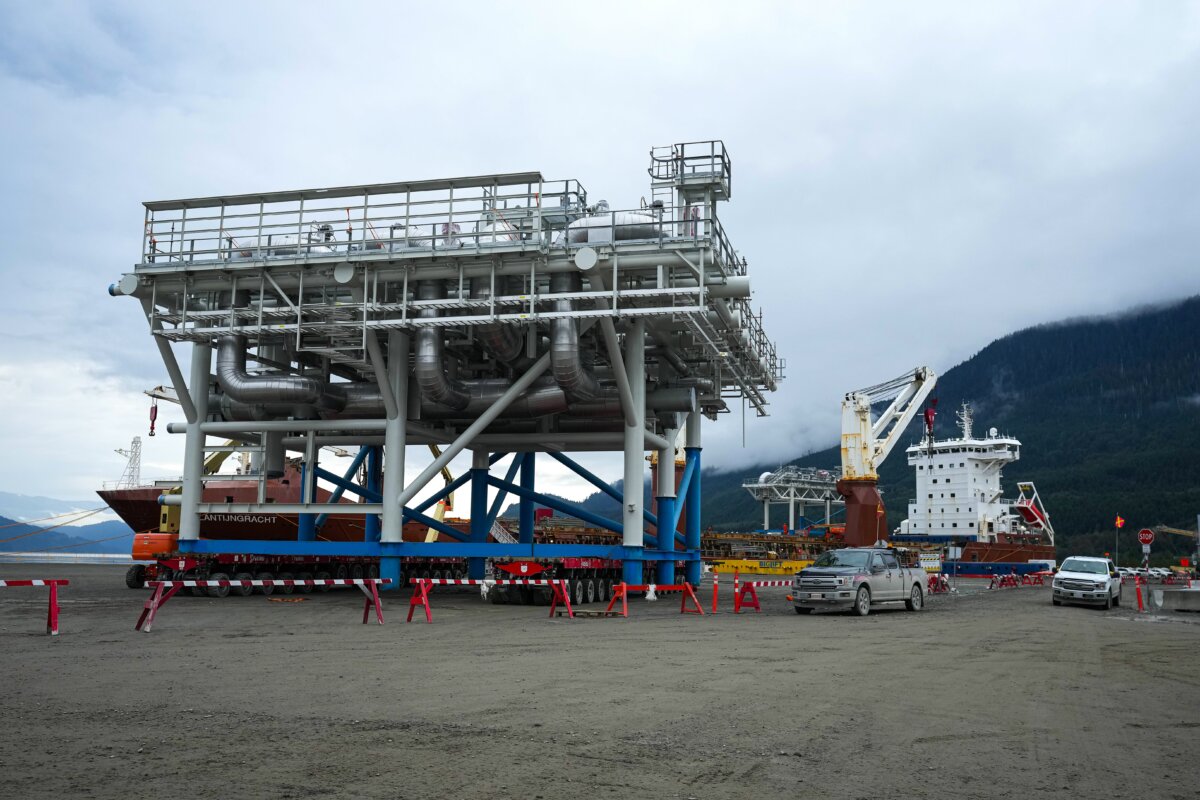 A module that arrived by ship sits at the dock at the LNG Canada export terminal under construction in Kitimat, B.C., on Sept. 28, 2022. (The Canadian Press/Darryl Dyck)
LNG Canada is a joint venture company comprising five global energy companies: Shell, Petronas, PetroChina, Mitsubishi Corporation, and KOGAS. The project had faced several significant delays, primarily due to the extensive groundwork, including passing numerous environmental and safety evaluations and an extended period of testing to ensure everything was working safely and correctly.
Now that the Kitimat terminal is fully operating, giving Alberta an export facility for its gas to go to markets beyond the United States, consulting firm Deloitte is forecasting a big increase in the province’s natural gas prices.
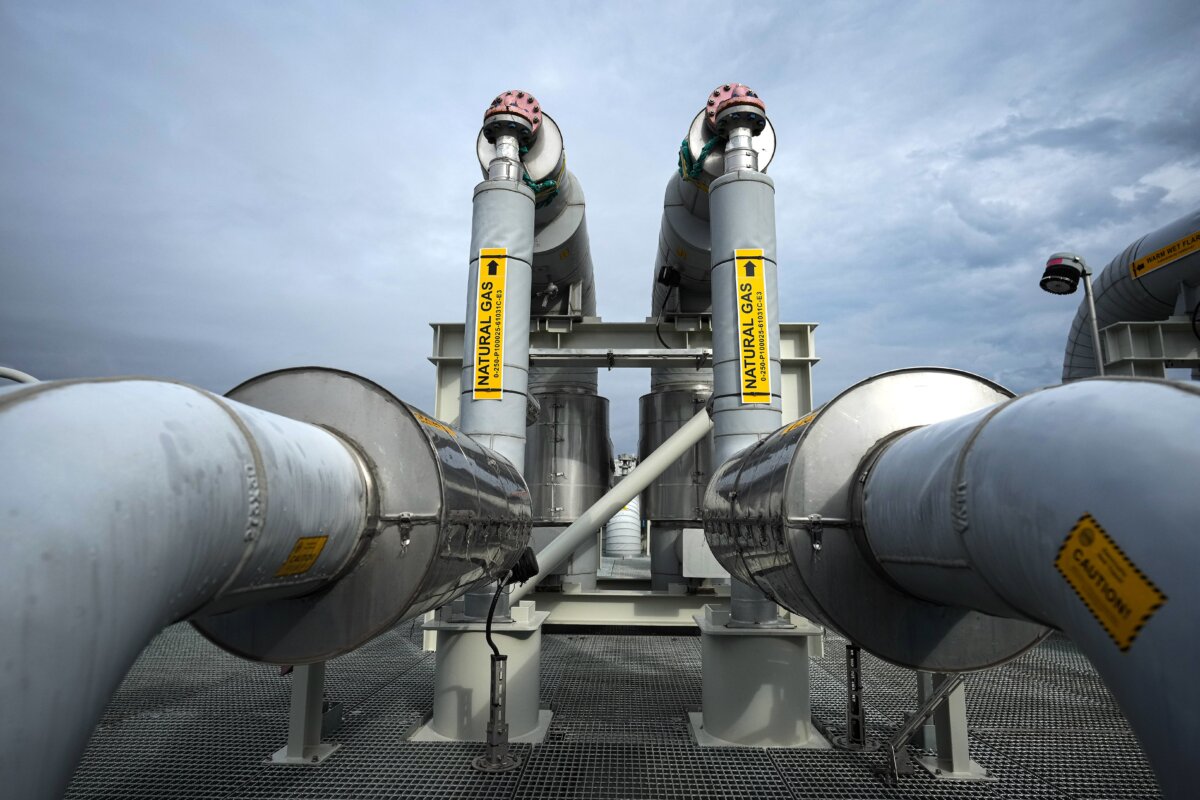 Piping is seen on the top of a receiving platform which will be connected to the Coastal GasLink natural gas pipeline terminus at the LNG Canada export terminal under construction, in Kitimat, B.C., on Sept. 28, 2022. (The Canadian Press/Darryl Dyck)
The Alberta benchmark price for natural gas—called the AECO price, referring to the Alberta Energy Company—is expected to average $2.20 per mmBTU in the second half of this year and then rise to an average of $3.50 per mmBTU in 2026. By 2032, the average AECO price is projected to hit $4 per mmBTU. (MMBtu stands for one million British thermal units, a standard measurement used in the energy sector to quantify thermal energy and compare the energy content of different fuels.)
Besides the economic developments and market diversification priorities, there are also national security concerns when it comes to expansions to Asia that may involve China, including Chinese state-owned enterprises such as PetroChina.
“We do see corporate actors out of PRC [People’s Republic of China] using all means and various techniques at their disposal to try to further the objectives of the Communist Party of China,” Nicole Giles, senior assistant deputy minister at the Canadian Security Intelligence Service, told parliamentarians during a meeting in May 2024.
Prime Minister Mark Carney has said that as Canada looks to diversify its trading partners, any potential partners in Asia would need to share Canadian values, noting that this doesn’t include China. Carney said that China poses the “biggest security threat” to Canada, and the recent foreign interference commission concluded that Beijing is the most active foreign power interfering in Canada’s affairs.
‘We Can Produce it for Decades’
Richard Masson, an executive fellow at the University of Calgary’s School of Public Policy, says Canada’s cheap natural gas has major potential on the world market but has been undervalued for far too long.
“The whole premise for LNG Canada and for West Coast exports is we have very, very abundant and cheap natural gas. We know we can produce it for decades,” Masson, former CEO of the Alberta Petroleum Marketing Commission, said in an interview.
“This now gives that gas that’s in Alberta and B.C. a chance to go offshore, and so hopefully that’ll help get better prices for our gas, because we’ve suffered from low prices compared to every other place in the world for a very long time.”
Because of the high quantity of natural gas produced and limited export market, Canadian LNG sells at a much lower price than it would get in foreign markets.
“If we could get more gas to other places and sell it at higher prices, we would, but we keep over-producing relative to the demand in the local market, which keeps the price relatively low,” Masson said.
Canada has the ninth-largest reserves of natural gas on the planet, but thus far, only B.C. LNG is being exported to overseas markets. Alberta, for its part, is Canada’s largest natural gas producer, producing 61 percent of Canada’s natural gas in 2023, followed by B.C. at 37 percent.
The majority of Alberta’s natural gas exports go to the United States, Ontario, and Quebec via pipelines, while Saskatchewan’s natural gas exports go via pipelines to the Midwestern United States.
“Maximizing the value of our resources is the smart thing to do,” said Battershill. “Number two, we want to have control over our own economic security and trade diversification is critical. Number three, global demand is growing.”
‘Positive Tone’
Battershill is hopeful that the start of exports from LNG Canada’s Kitimat terminal could indicate a shift in gas policy by the Liberal government and provincial governments such as British Columbia.
“It’s the most positive tone that we’ve seen from the federal government and also from the B.C. government in a very long time,” he said, noting the fact that “all these projects are owned in part or being led or supported by indigenous communities that want economic reconciliation, economic control, economic sovereignty and economic opportunities.”
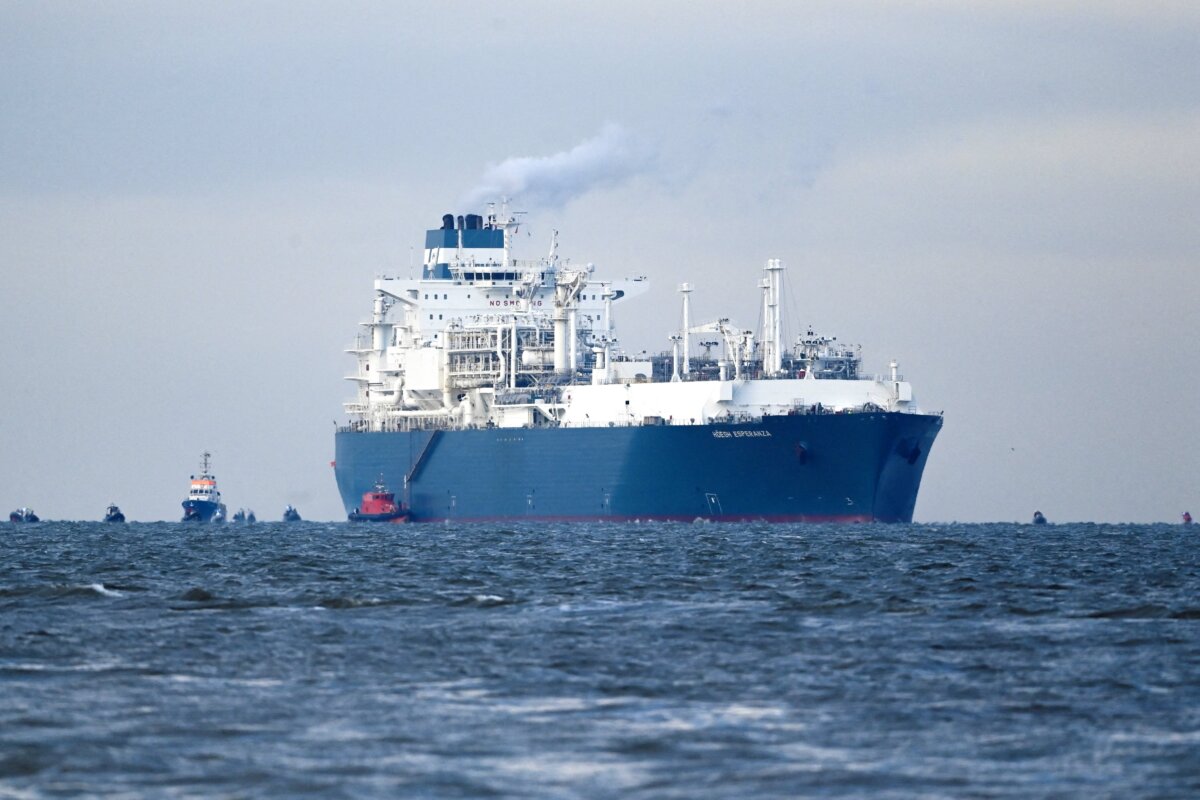 Floating Storage Regasification Unit ship Hoegh Esperanza, loaded with an initial shipment of liquefied natural gas, is guided by tugboats as it arrives at the port of Wilhelmshaven, Germany, on Dec. 15, 2022. (Fabian Bimmer/Pool/AFP via Getty Images)
By contrast, Michael Binnion, president and CEO of Questerre, a Canadian natural gas and technology company with assets around the world, feels the federal and some provincial governments are still far from embracing a truly LNG-friendly outlook in a concrete enough way to stimulate more approvals, especially in Eastern Canada.
“If there was a government that said we would absolutely approve the production of gas and the shipment by LNG, I’m quite confident we would see a lot more activities in Canada,” he told The Epoch Times.
Binnion said the federal government left the country playing second fiddle for the past decade, acting as a source of cheap natural gas for the United States.
“Canada is selling our gas at a huge discount, and Americans are taking a profit,” he said. “It’s one of the most incredibly daft things, non-strategic things, that the country could do.”
Binnion pointed out that U.S. tankers must go on a much longer route to Asia or Europe via the Panama Canal from their export terminals on the Gulf Coast, whereas Canada has much shorter routes from the east and west coasts.
“In terms of the trade route to the world’s largest economies—Europe and North Asia—Canada has the shortest and best passage, and it’s just an incredible natural geographic advantage that Canada has just not exploited,” he said.
Binnion said that at least six undrilled and unproven shale gas plays exist in Eastern Canada, and that major natural gas discoveries remain untapped in northeast B.C.’s Horn River Basin and in Liard Basin (which includes parts of B.C., Yukon, and the Northwest Territories). In addition, Quebec’s Utica natural gas discovery contains an estimated 20 trillion cubic feet but also hasn’t yet been approved for production or export.
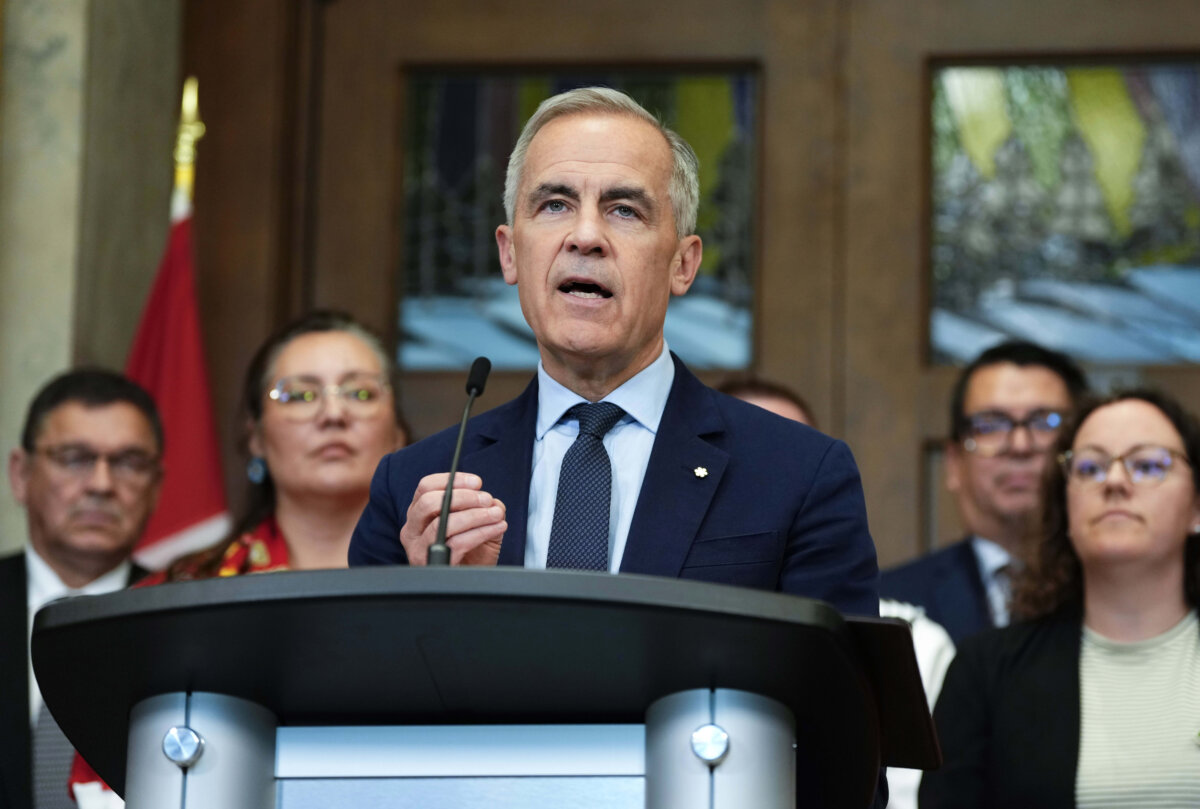 Prime Minister Mark Carney is joined by members of his cabinet and caucus as he speaks at a news conference in the foyer of the House of Commons after Bill C-5 passed in the House, on June 20, 2025. (The Canadian Press/Justin Tang)
Binnion also pointed to the numerous discontinued B.C. LNG projects in the past decade and the amount of time to get projects built and ready to operate.
“The answer is, infrastructure,” he said. “Really the only thing that’s been holding it back is the ability to get the infrastructure approved.”
Battershill notes that Canada has missed several significant opportunities to sell its LNG to allies around the world. This includes former Japanese Prime Minister Fumio Kishida’s request in 2023 for more Canadian energy and LNG. Without Canada putting forward any corresponding commitment, Japan turned to other nations to seek natural gas to meet its needs. Another example was Germany’s request in 2022.
“We had the German chancellor asking for Canadian LNG three years ago, being told there’s no business case, and now they’re buying more than ever before from Qatar and the United States, and that’s just a missed opportunity for Canada,” he said.
Bill C-5
The beginning of operations in Kitimat came after B.C. Premier David Eby recently said he wants the oil tanker ban off B.C.’s north coast to remain in place, despite calls from Alberta Premier Danielle Smith to lift the ban. Smith wants to prioritize a new pipeline running from Alberta to the West Coast in accordance with Carney’s focus on “nation-building” projects and the recent passage of Bill C-5, the Building Canada Act.
Battershill said that while positive shifts for the LNG industry are occurring at the federal and provincial level, regulations like the Impact Assessment Act and federal and provincial greenhouse gas emissions caps remain a challenge.
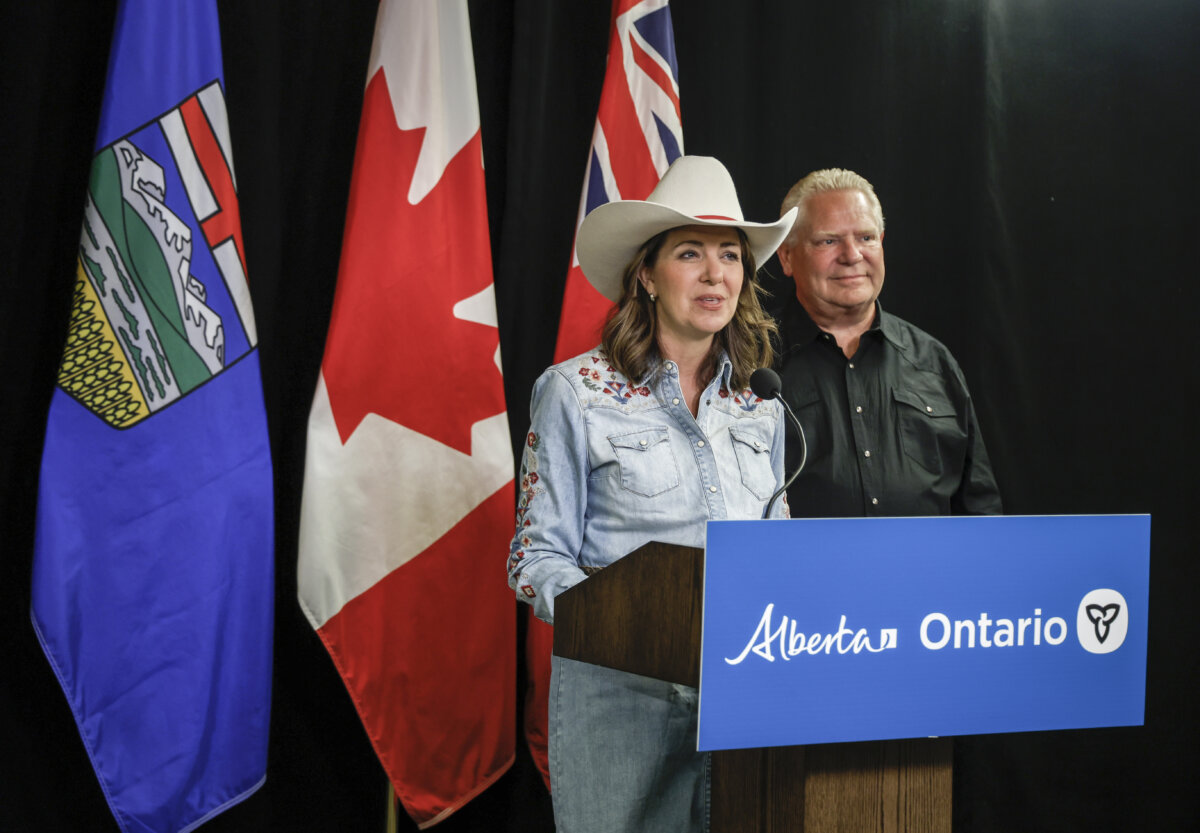 Alberta Premier Danielle Smith and Ontario Premier Doug Ford speak before signing agreements to build new energy and trade infrastructure, in Calgary on July 7, 2025. (The Canadian Press/Jeff McIntosh)
Masson echoed these concerns, saying that while Bill C-5 does add some potential for moving LNG forward, it’s far from a guarantee, especially when more restrictive emissions requirements within B.C. are taken into account.
“C-5 might help us a bit, but it’s a long way from being a settled matter,” he said.
Carney has promised that Bill C-5 will fast-track the regulatory process and interprovincial collaboration for major projects deemed in Canada’s national interest. Recently, he said it is “highly likely” a new oil pipeline from Alberta to the B.C. coast will be brought forward by the private sector and approved.
Ontario Premier Doug Ford met with Premier Smith on July 7 at the Calgary Stampede and signed two memoranda of understanding about a potential pipeline from Ontario’s James Bay deep sea port to Alberta as well as a railway project from Ontario’s mineral-rich Ring of Fire region to ports and processing points in the West.
According to Battershill, unity among provincial premiers is a promising sign, and it’s now up to Canadians to work together to seize the opportunity presented by LNG.
“I think there’s many factors right now that really, if we can work together and seize this opportunity, can create massive economic opportunities, both for indigenous and non-indigenous communities in this country for decades to come.”
 Friends Read Free
Copy
Facebook
Tweet
Friends Read Free
Copy
Facebook
Tweet