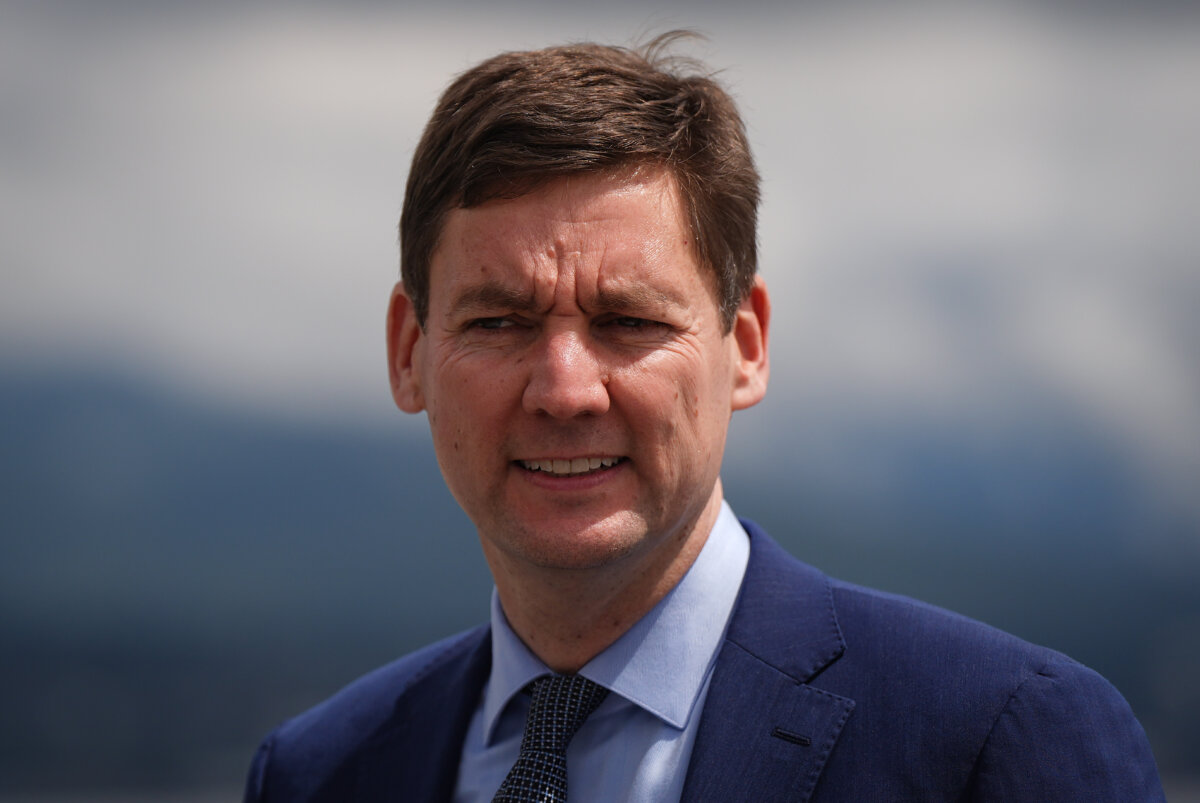

B.C. Premier David Eby says he wants the oil tanker ban off the province’s North Coast to remain in place in order to protect the environment and allow other cargo in the area to continue unimpeded.
His comments come as Alberta Premier Danielle Smith has been pushing the federal government to remove the ban so Alberta can ship its oil and gas to more markets.
In a June 24 interview with CBC, Eby said he supports the tanker ban because B.C.’s North Coast is “an ecologically sensitive area” and is also “an increasingly important route for general cargo movement.”
Ottawa first banned oil tanker traffic in 2019 under Bill C-48, citing environmental protection as the primary reason. The law bars any oil tankers carrying over 12,500 metric tons of crude oil from doing business between the northernmost point of Vancouver Island, B.C., and the Alaska border.
This legislation was a major factor in the cancellation of the Gateway Northern pipeline project, which was proposed to move 525,000 barrels of oil per day from Alberta to a port in the northern B.C. town of Kitimat, where it could be exported via oil tanker to Asian markets.
Smith has been renewing her call to remove the oil tanker ban in recent months amid newly elected Prime Minister Mark Carney’s stated focus on “nation-building” projects in the face of the U.S. tariffs.
Specifically, Smith has called for a reversal of the ban, as well as removal of the Impact Assessment Act, which grants additional powers to the federal government to review and potentially prohibit major projects. She also wants assurance that Alberta be given “full access” to oil and gas corridors to the north, east, and west, and renegotiation of federal equalization payments so that Alberta is no longer “subsidizing other large provinces who are fully capable of funding themselves.”
The Carney government has declined to reverse the oil tanker ban or the Impact Assessment Act but recently passed its Bill C-5 legislation to fast-track major projects deemed to be in the national interest. Carney has promised to “broaden programs that work for Albertans,” and says he is open to a new pipeline from Alberta to B.C. if there is national “consensus.”
While Eby has said he is “open” to discussing pipelines with Alberta Premier Danielle Smith, he’s also said that in his opinion “the economics aren’t there” to justify building a pipeline from Alberta to B.C., and that no proponent has come forward with a proposal.
“The problem is that so much of the conversation centres on a hypothetical pipeline project with no backers and no financing,” Eby said in a June 22 interview with CTV News. “I’d much rather concentrate on real projects—ones that are moving through, or ready to move through, environmental review.”
Eby pointed to other potential projects—such as a liquified natural gas export plant plant in Kitimat and a gold and silver mine near Vanderhoof, B.C.— as “real projects that have investors, permits, and clear timelines.”
“We need to stay focused on these high-impact initiatives—projects that will drive GDP and long-term prosperity—rather than waste energy debating a pipeline that hasn’t even made it past the idea stage,” he said.
For her part, Smith has said she is confident she will be able to convince Eby of a pipeline funded by private sector partners because it’s “good for the country,” and that she believes Eby is “on Team Canada.”
 Friends Read Free
Copy
Facebook
Tweet
Friends Read Free
Copy
Facebook
Tweet