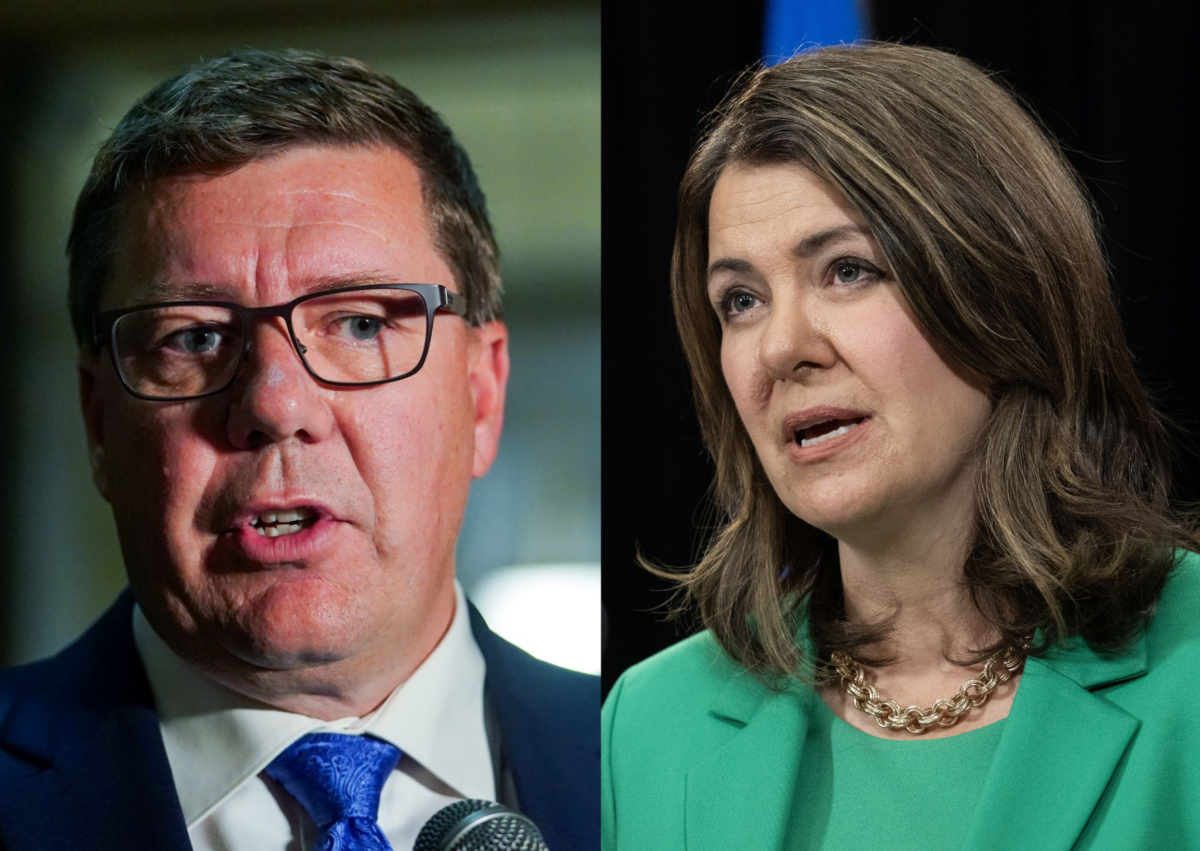

Alberta Premier Danielle Smith and Saskatchewan Premier Scott Moe are calling on Ottawa to make six changes to federal policies they say are necessary to “unleash” their provinces’ economies, arguing these changes will ultimately benefit Canadians and help make Canada the “strongest economy in the G7.”
The two premiers held a joint press conference on June 18, following a meeting between their government caucuses. They said they wanted to make a “unified call” for an end to “all federal interference” in the development of provincial resources.
“We are here today as a united caucus, because we have decided that enough is enough,” Smith said.
“Because together, we believe Alberta and Saskatchewan have an opportunity to speak with one voice to Ottawa, outlining a vision for our country, and we can call for a country that works for all of us.”
The changes they call for include the removal of federal policies such as the Impact Assessment Act, the oil and gas emissions cap, clean electricity regulations, the oil tanker ban off B.C.’s northern west coast, and the net-zero vehicle mandate. The Impact Assessment Act, previously known as Bill C-69, introduces federal environmental requirements for major projects such as pipelines.
The premiers are also asking Ottawa to abandon any regulations involving industrial carbon emissions, plastics, or the “the commercial free speech of energy companies.”
Reaching International Markets
Smith and Moe also urged Ottawa to expand economic corridors for the international export of products such as oil, gas, critical minerals, and agricultural and forestry products.
Specifically, they called for enhanced oil and gas access to tidewater on the west coast, along with corridors and port-to-port access to tidewater on the Pacific, Arctic, and Atlantic coasts.
Moe said that although a pipeline to the northwest coast might not carry Saskatchewan’s oil, it would benefit the province by narrowing the oil price differential and raising the price received per barrel. It would also free up rail and port capacity for key exports like potash, he said, and allow increased, better-priced oil exports to the United States.
“Accessing world prices for our resources will benefit all Canadians, including our First Nations partners,” the premiers said in a joint statement.
They also highlighted ongoing trade tensions, urging Ottawa to push for the removal of American and Chinese tariffs on Canadian goods.
They noted that Beijing’s tariffs on Canadian agri-food products, including canola products, have had “significant impacts on the West,” while Washington’s recent increases in tariffs on Canadian steel and aluminum are “deeply concerning.”
They added that Prime Minister Mark Carney can reach his stated goal of strengthening Canada’s economy by working with the provinces.
“Alberta and Saskatchewan agree that the federal government must change its policies if it is to reach its stated goal of becoming a global energy superpower and having the strongest economy in the G7,” they said.
“We need to have a federal government that works with, rather than against, the economic interests of Alberta and Saskatchewan.”
Continued Calls for Change
Both premiers had already called for some of these changes separately.
Before this year’s federal election, Smith provided a list of demands she wanted the next prime minister to address within the first six months of their term, saying it was needed to avoid a “national unity crisis.” The Alberta government has long opposed a number of federal policies it says hinder resource development in the province and infringe on provincial jurisdiction.
Following Carney’s victory in the election, Smith said the province would create a “special negotiating team” to work with the federal government on the province’s demands, as well as an “Alberta Next” expert panel to determine ways to “protect” the province from “future hostile” federal policies.
Moe, for his part, gave Carney a list of 10 policy changes shortly after he became prime minister, including the repeal of clean electricity regulations and the federal emissions cap, the modification of the Impact Assessment Act, and the expansion of pipeline capacity, along with other measures such as bail reform. Moe described these proposals as being part of a “Strong Saskatchewan, Strong Canada Plan.”
Carney, who has pledged to turn Canada into an “energy superpower” and the “strongest economy in the G7,” has said he will keep the Impact Assessment Act but has committed to simplifying the review process for major projects, promising a “one project, one review” approach, which Ottawa says will reduce decision timelines from five years to two.
He also reduced the consumer carbon tax to zero upon taking office in March, while pledging to instead make “big polluters pay” in industry. The carbon tax has faced strong opposition from the federal Conservatives and some premiers, including Smith and Moe.
He has also said he would support projects of national interest as long as they meet certain criteria, including their potential to advance Canada’s economy, the interests of indigenous peoples, and the government’s climate goals.
He has not committed to specific projects, but on the issue of pipeline construction, which both Alberta and Saskatchewan have advocated for, he has said he would support pipelines if there is “consensus” for their development.
The federal government recently introduced the One Canadian Economy Act, aimed at speeding up major project approvals and reducing interprovincial trade barriers. Meanwhile, the bill has raised concerns from some MPs related to the sweeping powers it would give the government to exempt projects from existing laws without reasonable limits.
 Friends Read Free
Copy
Facebook
Tweet
Friends Read Free
Copy
Facebook
Tweet