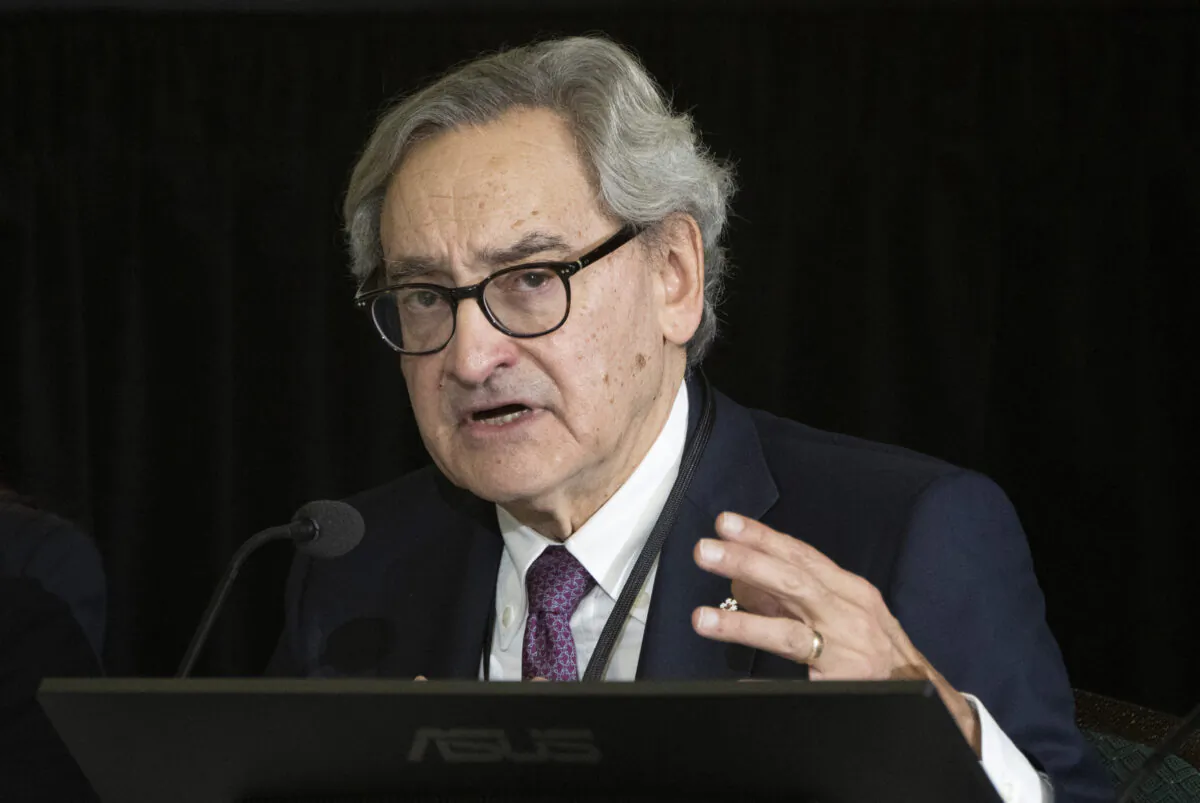

Prime Minister Mark Carney said the head of Quebec’s public utility company Hydro-Québec, Michael Sabia, will become the new Clerk of the Privy Council, the highest ranking civil servant in the government.
Carney said Sabia’s vast experience in the public and private sectors will help his government fulfill its objective to build the “strongest economy in the G7” and lower the cost of living.
“Mr. Sabia will help us deliver on this mandate and our government’s disciplined focus on core priorities,” the prime minister said in a June 11 statement.
Carney also thanked John Hannaford for his time in the clerk role and congratulated him on his upcoming retirement. Sabia will start his new functions on July 7.
The Clerk of the Privy Council serves as the head of the federal public service and is also secretary to the cabinet, an advisory role to the prime minister and elected officials.
“Prime Minister Carney asked me to take on this role at a time when the country is facing some unprecedented challenges,” said Sabia in a statement. “In that context, I am joining the federal government to tackle these challenge[s] head on.”
Prior Roles
Sabia had served as CEO of Hydro-Québec since 2023. The public utility corporation raked in $2.6 billion in net revenues in 2024, while contributing to $4 billion in taxes.
Before his role at Hydro, Sabia served as deputy minister of finance in the federal government. He had been appointed in the role in December 2020, a few months after Chrystia Freeland replaced Bill Morneau as finance minister.
He received more media coverage during his tenure there due to his appearance at the Public Order Emergency Commission in 2022 created to evaluate the government’s invocation of the Emergencies Act in response to the convoy protests earlier that year. His testimony was centred around his department’s order to financial institutions to freeze the bank accounts of those involved in the encampments of downtown Ottawa.
Months prior to joining the finance department, Sabia had been appointed as chair of the Canada Infrastructure Bank.
Opposition MPs have scrutinized the establishment of the bank in recent years, as they were trying to understand the role played by consulting firm McKinsey.
The idea to create the bank, a crown corporation investment arm, had sprung from Morneau’s Advisory Council on Economic Growth, which was chaired by then-McKinsey boss Dominic Barton. Sabia was also part of the council while he was president of Quebec’s institutional investment arm CDPQ.
Sabia told MPs in committee in 2023 that the firm McKinsey had effectively played the role of secretariat for the council and had been “very involved in our reports and our deliberations.”
Morneau asked Sabia to become chair of the Canada Infrastructure Bank in April 2020 to speed up its work. Sabia decided to hire McKinsey consultants to speed up the bank’s operations.
“In order to do that in the quickest and most economical way, the decision taken at the time was to use some of the people from McKinsey who had been involved in the initial thinking around the Infrastructure Bank, to draw on their accumulated knowledge of this so that we wouldn’t have to start from ground zero and would be able to move ahead quickly, which we were able to do,” he told the House of Commons industry committee in 2023.
One of the largest projects of the Canada Infrastructure Bank is Montreal’s light-rail network, for which CDPQ has been the largest stakeholder, with a $2.95 billion investment announced in 2018.
Sabia left the CDPQ in February 2020 and became bank chair in April 2020.
Shared Path With Carney
While with CDPQ, Sabia had taken part in the United Nations’ Net-Zero Asset Owner Alliance, a grouping of institutional investors focusing on “decarbonization” of the global economy. Carney has a similar profile, having spearheaded efforts to sign on financial institutions to a similar initiative while he was the UN envoy on climate finance. Major U.S. and Canadian banks left that initiative after the election of U.S. President Donald Trump.
Sabia and Carney also share leadership experience with the World Economic Forum, the Prime Minister’s Office has noted. Sabia served as co-chair of the forum’s working group on infrastructure and development, whereas Carney was a former board member.
Before joining the CDPQ, Sabia served as CEO of Bell Canada and CFO of Canadian National Railway. He will be making a return to the Privy Council, having previously served as Deputy Secretary to the Cabinet.
Sabia’s appointment comes after Carney announced another major change in his entourage and leadership team. He said in early June that Marc-André Blanchard would be assuming the role of his chief of staff.
Blanchard is Canada’s former ambassador to the United Nations and his most recent position was also with CDPQ, as its executive vice-president.
 Friends Read Free
Copy
Facebook
Tweet
Friends Read Free
Copy
Facebook
Tweet