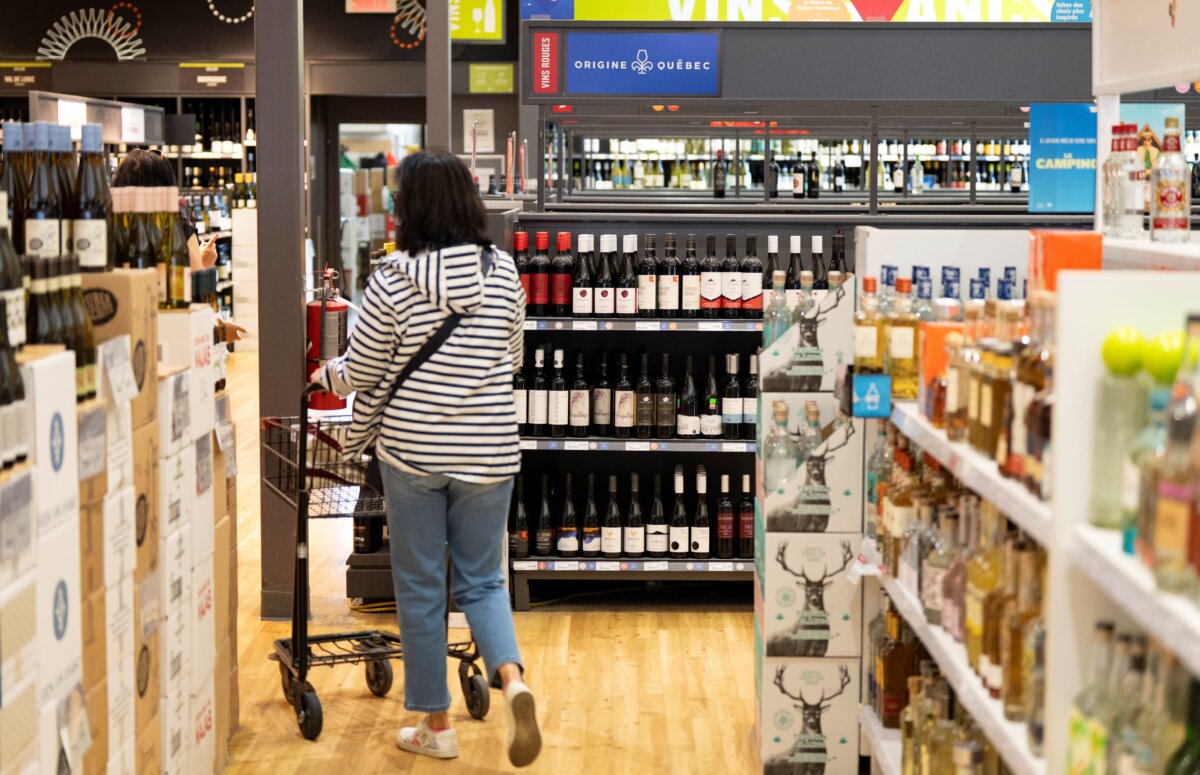

Prime Minister Mark Carney has asked provinces to restock American alcohol on shelves and ensure there are no provincial government barriers to buying goods and services from U.S. suppliers, according to Nova Scotia Premier Tim Houston.
Houston said Carney raised the matter with premiers in a virtual meeting held Aug. 19 and said Carney told premiers the request had come out of ongoing negotiations with Washington.
“We’ll work through that process,” Houston told press Aug. 19, noting that Nova Scotia was willing to comply with the request, pending a final deal.
“Whether Nova Scotians, or whether Canadians, will actually buy it when it gets back on the shelves, that’s a whole other discussion,” Houston added.
Polling done by Nanos Research in late July found that 74 percent of Canadians were unlikely or somewhat unlikely to buy American alcohol if it’s back on the shelf.
Provinces and territories took steps to limit the purchase or sale of U.S. alcohol products starting in March 2025 in response to U.S. tariffs, although the measures taken varied by province or territory. Alberta and Saskatchewan resumed accepting new U.S. alcohol shipments in June 2025, while various import restrictions and sales bans remained in other provinces and territories.
The White House has stated that the restrictions are one of its trade complaints against Canada, with a July proclamation by U.S. President Donald Trump citing provincial restrictions on U.S. alcohol as a discriminatory trade practice.
Canadian imports of U.S. alcoholic products declined by roughly 81 percent between March 2025 and February 2026 year-over-year, according to the White House.
In addition to alcohol restrictions, Trump also brought up Canada’s supply management dairy tariff quota system and trade practices around U.S. automobiles in announcing 50 percent tariffs in July. The tariffs are set to apply even to goods that otherwise are in compliance with the Canada–U.S.–Mexico Agreement.
Trump has given an Aug. 21 deadline for the two countries to reach a deal before 50 percent U.S. tariffs take effect on roughly 5 percent of Canada’s total trade with the United States.
Trump had originally said the 50 percent tariffs would go into effect Aug. 19, but posted on social media Aug. 18 that he would delay them for three days, saying the two countries had reached an agreement “subject to the finalization of documents,” while also indicating that the long cancelled Keystone XL pipeline “may be awoken from the grave” as part of broader Canada–U.S. discussions.
The White House proclamation announcing the delay in the 50 percent tariffs also said Canada had committed to resolving the issues regarding alcohol, dairy, and automobiles, although Carney has previously said Canada’s dairy policies are non-negotiable.
Canada–U.S. Trade Minister Dominic LeBlanc said Aug. 19 that Ottawa was seeking to make sure that the dairy supply management system stayed “entirely intact” in any deal with the United States and said he was “confident” it would not be changed.
Houston said premiers were also told that the “core elements” of the system would remain unchanged, but didn’t provide specifics.
Canada’s supply-management system regulates domestic production and imports of dairy, poultry, and eggs, while tariff-rate quotas allow specified volumes of imports at lower tariff rates and impose much higher rates for products that exceed those quotas.
Deal
For his part, Trump said that a deal has been reached with Canada.
“We had a very good conversation with the prime minister last night, and we’ve come to a deal with Canada,” Trump told reporters Aug. 19.
“They called yesterday, and they gave us the points that we had to have. Very fair deal for both.”
Specifically, Trump said some tariffs on Canada will be brought “down to zero” while others may be reduced “a little bit,” while sectoral tariffs on Canadian steel and aluminum could be lowered to levels comparable to those against the aluminum and steel of other countries.
Carney stated that “significant progress” has been made in negotiations and a deal is in sight.
“Canada entered these discussions with the best overall trade terms,” he posted Aug. 19 on X.
“We are now moving towards an agreement that reinforces that Canadian advantage, including by securing the best terms in each of Canada’s most important strategic sectors and providing greater certainty about our future trading relationship.”
In the wake of Trump announcing the impending tariffs on July 20, Carney responded by saying Canada would do “whatever it takes” to safeguard Canada’s workers and economy and said “everything’s on the table” if no deal was reached.
U.S. Trade Representative Jamieson Greer said Washington was “very happy” with the deal that has been reached and confident it can be finalized.
More Policies
In addition to ensuring U.S. alcohol is back on shelves, Houston said Carney also asked premiers to assess their provincial procurement policies to make sure there aren’t any that exclude the purchase of American goods and services.
“That’s something we’re going to have to look at as well,” Houston said Aug. 19.
The Nova Scotia premier said he is “optimistic” about the forthcoming agreement and that “the broad strokes of it seem really good for Canada.”
Houston said Canada would keep some ability to favour domestic companies in awarding defence contracts under the new potential deal as well, which he hailed as good news for Nova Scotia, a province that has a significant naval shipbuilding industry.
“All in all, we’re moving in a good direction for our relationship with the United States, and that’s positive for everyone,” he said.
Saskatchewan Premier Scott Moe said that restocking U.S. alcohol won’t be an issue for Alberta or Saskatchewan as “we’ve allowed consumers to make their own choice all along.”
Both provinces temporarily halted new purchases of U.S. alcohol in 2025 but continued to allow retailers to sell existing stock and did not remove American alcohol from shelves.
Speaking to reporters in Prince Albert, Sask., Aug. 19 following the premiers’ call with Carney, Moe said he is hopeful that the finalized deal with the United States will offer some alleviation of U.S. tariffs that are hitting Canadian steel, aluminum, automobiles, and lumber.
“We need to have, in many ways, preferred market access to our largest trading partner,” Moe said. “I feel that is what we are in the process of achieving.”
 Friends Read Free
Copy
Facebook
Tweet